
Mindmap
Effective Reading
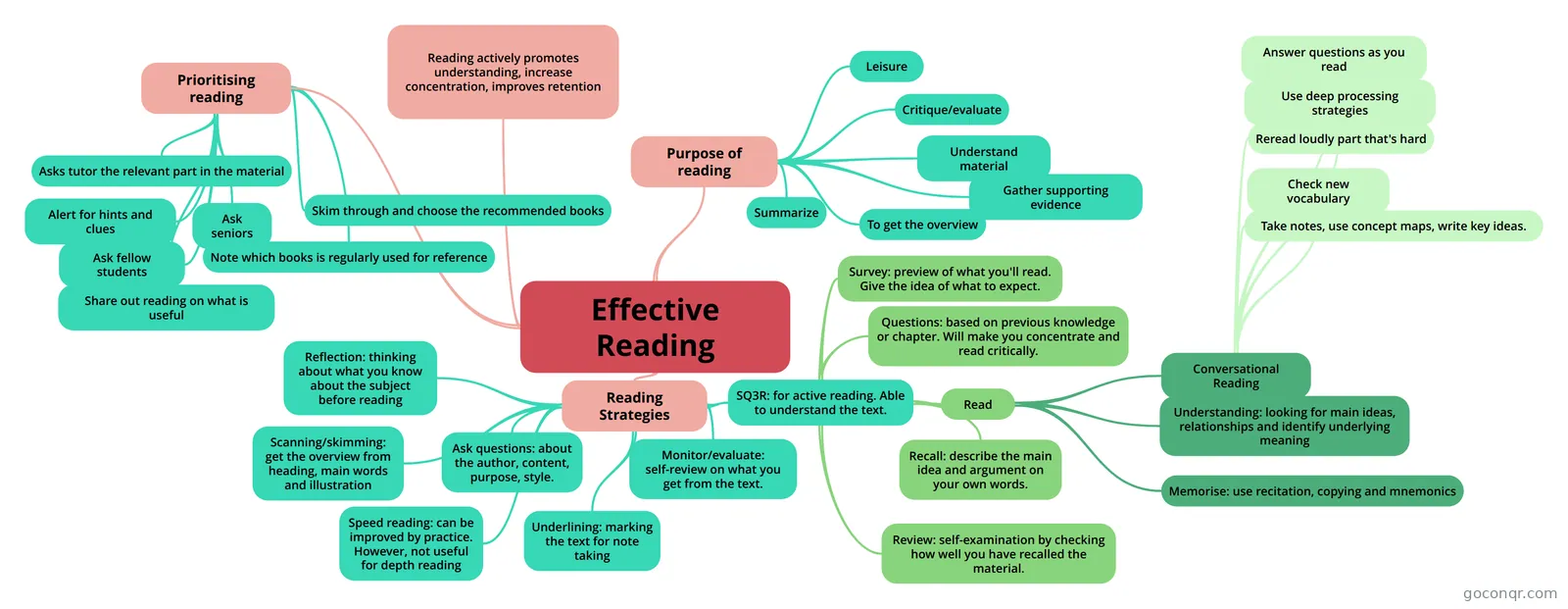
Mind map: effective reading strategies
Inhalt der Mindmap
Effective Reading
Reading actively promotes understanding, increase concentration, improves retention
Purpose of reading
- To get the overview
- Gather supporting evidence
- Summarize
- Understand material
- Critique/evaluate
- Leisure
Reading Strategies
- Reflection: thinking about what you know about the subject before reading
- Scanning/skimming: get the overview from heading, main words and illustration
- Speed reading: can be improved by practice. However, not useful for depth reading
- Ask questions: about the author, content, purpose, style.
- Underlining: marking the text for note taking
- Monitor/evaluate: self-review on what you get from the text.
- SQ3R: for active reading. Able to understand the text.
- Survey: preview of what you'll read. Give the idea of what to expect.
- Questions: based on previous knowledge or chapter. Will make you concentrate and read critically.
- Read
- Conversational Reading
- Take notes, use concept maps, write key ideas.
- Answer questions as you read
- Reread loudly part that's hard
- Check new vocabulary
- Use deep processing strategies
- Understanding: looking for main ideas, relationships and identify underlying meaning
- Memorise: use recitation, copying and mnemonics
- Conversational Reading
- Recall: describe the main idea and argument on your own words.
- Review: self-examination by checking how well you have recalled the material.
Prioritising reading
- Asks tutor the relevant part in the material
- Alert for hints and clues
- Ask fellow students
- Ask seniors
- Share out reading on what is useful
- Note which books is regularly used for reference
- Skim through and choose the recommended books