
2590849


| Question | Answer |
| Extrinsic incubation Period (EIP) | Time to infectioness in vector |
| Biological vectors | Carry paths that multiply within vector and are transmitted usually by biting |
| Mechanical vectors | Pick up paths externally and transmit by physical contact; Often require interrupted feeding or short time between moving from source of infection to place of transmission |
| Type I peritrophic matrix | Stomach is a chitinous sack around blood meal in the mid-gut |
| Type II peritrophic matrix | A continuous secreted tube through the midgut |
| Coxal fluid | Secreted by ticks during biting; carries paths |
| Vector manipulation during infectiousness | Probing behaviour of infected mosquitoes altered; Lower [apyrase] in saliva = increased clotting in host; means more probing required to feed = greater chance of transmission, esp. if seeking another host to complete blood meal |
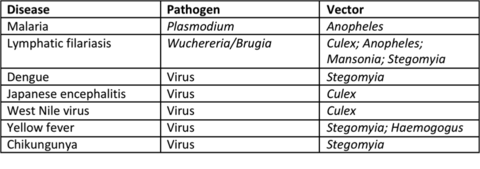
| Mosquito borne disease | |
| Mosquito mating | Adult female mates soon after emergence - swarming; sperm stored in spermathecae to fertilise multiple batches of eggs; Anopheles males may insert plug into female to prevent further mating |
| Anopheline larval morphology | No siphon - lie flat at water surface |
| Stegomyia larval morphology | Shorter, darker siphon, with one pair of sub-ventral tufts |
| Culex larval morphology | Longer, narrow siphon, with more than one pair of sub-ventral tufts |
| Mosquito pupal morphology | Very similar between sub-genera; swim but don't feed; identification mainly by rearing to adults |
| Anopheles adults | Head down, body up when feeding; Long palps with white banding; Male palps are club shaped |
| Culicine adults | Head down, body level when feeding; Short palps; Male palps not club shaped |
| Temperature dependency for mosquito egg development | Days in the topics; Weeks in temperate/arctic environments |
| Anopheles breeding and egg laying | Typically found in open, sunlit water; Single eggs with floats; Dislike concrete &/or organic pollution in breeding sites, overgrown with vegetation; LIKE temporary, small pools of water - e.g. hoof prints after rains, flooded cultivation ridges; However, An. funestus prefer dense vegetation |
| Anopheles culcifaces | Main vector in rural India and Sri Lanka; Occupies pools of stagnant water by streams/rivers - peak in dry season as water levels fall; Density dependent transmission - at low density, mainly zoophagic, so low transmission; Endophilic to easy to target with IRS |
| Anopheles stephensi | Main urban vector in India; Breeds in large man-made containers, e.g. water tanks; |
| Anopheles dirus | Major malaria vector in forests of SE Asia; Breeds in shaded pools; Highly efficient vector of MDR Plasmodium; Loggers and hunters at risk |
| Anopheles albimanus | Malaria vector in S America; Breeds in water bodies broken with leaves of flotage; Active at night but may feed during the day; Weight of numbers vector; In dry season, can breed in brackish coastal lagoons |
| Anopheles darlingi | Major malaria vector in Amazon; Habitats created by deforestation; streams, puddles, ponds |
| i love | pal |
| Larval dipping | With ladle; larval numbers per dip is a reliable measure of larval density and how well control is performing |
| Human landing catch | Used to monitor number of bites per person, per day |
| CDC Light Traps | Battery operated light lure; beside a bednet 1m above the ground; catches are proportional to human landing catch; Preferable method |
| Pyrethrum spray collections | Cover all surfaces inside with sheets; Spray indoors to knock down mosquitoes for collection - good condition for dissection |
| Exit trap collection | To catch mosquitoes exiting from windows during the night; Mosquitoes that bite indoors but then rest outside are caught - invulnerable to IRS |
| Pit trap collection | Pit with side tunnels dug to trap outdoor resting Anopheles |
| Animal baited traps | Animal under a net; to catch zoophagic Anopheles |
| Bednet collections | Searching for mosquitoes resting indoors in the morning with a torch and pooter; only effective where the nets are untreated |
| Measuring adult survival | Polovodova method - measuring dilations of ovaries; indicative of the number of times a femal has blood fed and become gravid; the older the female, the more likely to be infective |
| Horses for courses | The choice of vector control methods depends on the setting - ecology, epidemiology, programmatic conditions |
| Adult vector control | Most important, as has disproportionally large effect on vector potential (R0 and C - survival); IRS, ITN/LLIN - standardised, no need for adaption; Robust and broadly efective |
| Larval vector control | Affects density only; Have to target most significant vector; Only if breeding sites are FIXED, FEW & FINDABLE; Must be closely adapted to local conditions |
| Vectorial capacity, C | Daily rate of infectious bites per person; Most influenced by survival probability |
| Sporozoite rate | The percentage of females that bear sporozoites in their salivary glands; Expressed as a percentage |
| Pare-Taveta Scheme Intervention | 1954-1959; effect of IRS on malaria transmission; Massive fall in infant infection, but did not quite reach 0, so deemed a failure |
| Increasing insecticide resistance and reduced development | Resistance is increasing, but new active compounds are not being developed; Mostly for agriculture, which is not safe for IRS; Pyrethroids (1970s) are still the best option |
| Attacking adult vectors with ITNs | Insecticide can restore effectiveness of a net with holes; Gives 2x protection vs untreated; Easier - much less insecticide (than IRS), less training, less often; Also contribute to mass effect protection |
| Long lasting insecticides for nets | Compounds can now last longer than the lifetime of the net; Can be applied as a coating or incorporated into material; Selling as second hand - can people tell if they are (still) treated? |
| ITNs and child mortality | Even where children do not develop immunity due to exposure, there is no rebound in mortality, as long as net usage remains; However, younger children are more likely to be covered than older children |
| ITN/LLIN vs IRS | Similar impacts on malaria; LLIN longer lasting, less logistically challenging; IRS campaigns can fail unless well planned and implemented - nets can be simply given out; IRS needs to occur once or twice per year - LLINs may last 3 years |
| Choosing ITN/LLIN or IRS | Based on feasibility and sustainability on large scale; IRS advantages against highly seasonal, unstable or epidemic malaria - extremely effective for a few months, rapid response |
| Sandfly oviposition | Eggs laid in damp sites with organic material - makes control at breeding sites difficult; 4 instars; Immature stages very rarely seen in field |
| Adult feeding | Both sexes feed on sugar sources; Females take blood meal for ovarian development; Pool feeders; Host choice varies by species; Endo- or exo-pahgic; Have stomodeal valve to prevent bloodmeal back-flow; Bloodmeal straight to mid-gut |
| Sandfly dispersal | Are weak flyers; 'hopping' flight; low dispersion - few hundred metres; Means Leishmania tends to be focal |
| Sandflys as human vectors | 2 genera are human vectors - Phlebotomus (Old world) and Lutzomyia (New world); +70 species transmit parasite |
| Leishmania development in Sandflies | Sandfly egg to adult - 4 weeks; Amastigotes ingested and multiply; Procyclics develop into nectomonads escape PM and attach to mid-gut; Develop into nectomonads that reproduce; Develop haptomonads and metacyclics; Migrate to stomodeal valve |
| Factors effecting sandfly control | Zoonosis vs anthroponosis; One or many reservoirs; Resting/breeding sites scattered or concentrated; Endo or exo phagic; Endo or exo philic; Insecticide resistance |
| Vector control of zoonotic leishmaniasis in humans | IRS/ITN can be effective if sandflys are endophilic, transmission is domestic, if main reservoir is common around household; Can target the main reservoir - dogs, rodents, cows etc. |
| Deltamethrin-impregnated nets reduce human landing rates of L. longipalpis in Amazon households | >50% bites indoors; Most biting occurs when children are under nets; ITNs reduced landing rate by 80%; ITNs killed 98% flies inside houses |
| Effect of insecticide-impregnated dog collars on incidence of zoonotic VL in Iranian children | Reduce the odds of infection by 61% in dogs and 535 in children; Collars could have a role in control and replace dog culling in some places; Effectiveness depends on importance of wild versus domesticated canids |
| Rodent control for Sandfly control | Destroy rodent burrows - potential laying sites for sandflies |
Want to create your own Flashcards for free with GoConqr? Learn more.