
27992452
Description

Mind Map by David Wang, updated more than 1 year ago

|
Created by David Wang
about 5 years ago
|
|
Light and Optics
- Light
- History
- Pythagoras
- Thought we could see
because light beams
came out of our eyes.
- Thought we could see
because light beams
came out of our eyes.
- Euclid
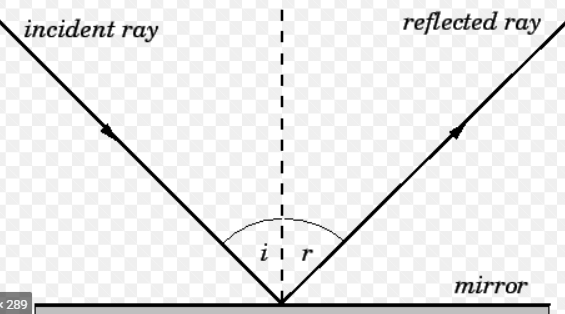
- Discovered the angles of
reflection, and that they are the
same for the incident ray and the
reflected ray when you shine a
beam of light at a mirror.
- Discovered the angles of
reflection, and that they are the
same for the incident ray and the
reflected ray when you shine a
beam of light at a mirror.
- al-Haytham
- Discovered how vision
worked, and he was
correct, unlike Pythagoras.
- Discovered how vision
worked, and he was
correct, unlike Pythagoras.
- Newton
- Using a prism, he discovered
white light is a mixture of
light of different colors.
- Using a prism, he discovered
white light is a mixture of
light of different colors.
- Michelson
- Discovered the speed of light.
- Discovered the speed of light.
- Pythagoras
- Properties
- Light travels in straight lines.
- Called rays.
- Represented by an
arrow in diagrams.
- Called rays.
- Movement
- Light can change directions
- Reflection
- When light bounces off and object
- The law of reflections
says that the angle of
light hitting a mirror
will be the same as the
angle as it leaves.
- The incident angle is always equal to the reflecting angle.
- The incident angle is always equal to the reflecting angle.
- When light bounces off and object
- Refraction
- When light bends through and object
- Different objects and mediums refract light differently
- Different objects and mediums refract light differently
- When light bends through and object
- Reflection
- Light can change directions
- Light is a form of energy
- Light travels in straight lines.
- Sources
- Natural
- Sources in nature
- bioluminescence, fire, sun, etc.
- bioluminescence, fire, sun, etc.
- Sources in nature
- Artificial
- Human made light sources
- Light bulb, chemical reactions, etc.
- Light bulb, chemical reactions, etc.
- Human made light sources
- Natural
- Transmission
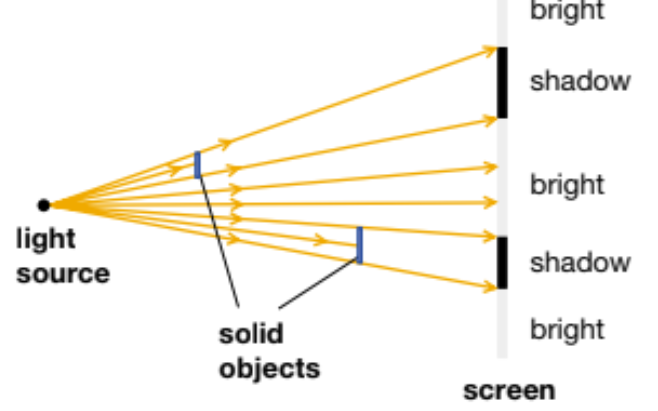
- Passing through objects
- opaque
- Light is unable to pass through this object.
- Creates shadows
- Shadows are the absence of light
- Shadows are the absence of light
- Creates shadows
- Light is unable to pass through this object.
- translucent
- Light can partially pass
through this object
- Light can partially pass
through this object
- transparent
- Light can clearly pass
through this object
- ex. glass
- ex. glass
- Light can clearly pass
through this object
- opaque
- Ray diagrams are
pictures that show
how light interacts
with a given object
- A mirror, lens, etc.
- A mirror, lens, etc.
- Passing through objects
- EM Spectrum
- Spectrum of
light
- Catagorized by wave length
- From longest to shortest: Radio, Microwaves,
Infrared, Visible, Ultraviolet, X-ray, Gamma ray.
- We can only see visible light
- We can only see visible light
- From longest to shortest: Radio, Microwaves,
Infrared, Visible, Ultraviolet, X-ray, Gamma ray.
- Catagorized by wave length
- Spectrum of
light
- History
- Optics
- Devices
- Man-made
- Telescope
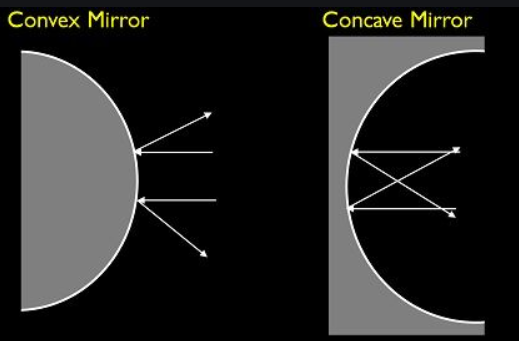
- Reflecting
- Uses concave mirror to focus light
- Uses concave mirror to focus light
- Refracting
- Uses convex mirror to focus light
- Uses convex mirror to focus light
- Reflecting
- Glasses
- Uses either lense
(depending on condition) to
focus light on the retina of
a slightly misshapen eye.
- Uses either lense
(depending on condition) to
focus light on the retina of
a slightly misshapen eye.
- Contact lenses
- Just like glasses, but directly on eye
- Just like glasses, but directly on eye
- Infrared camera
- Complicated, uses mirror to reflect infrared light to detector.
- Complicated, uses mirror to reflect infrared light to detector.
- Telescope
- Natural
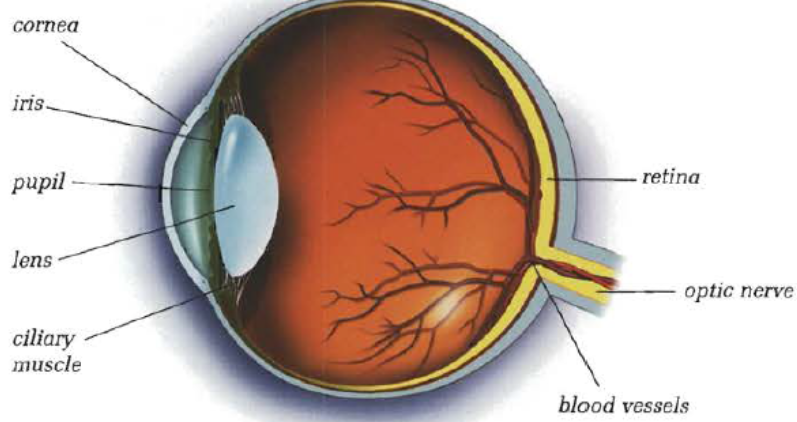
- Human eye
- Pupil
- Opening that lets light in
- Iris
- Control Pupil size
- Eyelid
- Covers, protects eye
- Lens
- Focuses light
- Retina
- Detects light
- Cones
- Detect Color
- Rods
- Detects brightness, black, white
- Detects brightness, black, white
- Detect Color
- Detects light
- Focuses light
- Covers, protects eye
- Control Pupil size
- Opening that lets light in
- Pupil
- Human eye
- Camera
- Aperture
- Diaphram
- Shutter
- Lens
- film, light sensor array
- Color film
- Black and white film
- Black and white film
- Color film
- film, light sensor array
- Lens
- Shutter
- Diaphram
- Aperture
- Man-made
- Mirrors and lenses
- Mirrors
- Plane mirror
- Just a flat
mirror
- Just a flat
mirror
- Concave
mirrors
- shaped like a "cave", focus and collect light
- shaped like a "cave", focus and collect light
- Convex
mirror
- Opposite of concave
- Spread light apart
- Spread light apart
- Opposite of concave
- Plane mirror
- Lenses
- Double Concave
- This lens focuses light rays as they pass through
- This lens focuses light rays as they pass through
- Double Convex
- This lens spreads light rays as they pass through
- This lens spreads light rays as they pass through
- Double Concave
- Mirrors
- Devices
- Other Facts about light
- Lightyears are the
distance light
travels in a year
- Good for
measuring long
distances in space
- Good for
measuring long
distances in space
- Lightyears are the
distance light
travels in a year
Media attachments
Want to create your own Mind Maps for free with GoConqr? Learn more.