
Quiz
Chapter 17 - Electrochemistry
Create a free account to finish this quiz
Save your progress and see your final score.
Already have an account? Sign in
Questions in this quiz (38)
1What is the oxidation number of bromine in the BrO3- ion?
- AA) -1
- BB) +1
- CC) +3
- DD) +5
- EE) +7
2What is the oxidation number of sulfur in the HSO4- ion?
- AA) -2
- BB) +1
- CC) +2
- DD) +4
- EE) +6
3Which element is oxidized in the reaction below?
Fe(CO)5 (l) + 2HI (g) → Fe(CO)4I2 (s) + CO (g) + H2 (g)- AA) Fe
- BB) C
- CC) O
- DD) H
- EE) I
4Which element is reduced in the reaction below?
Fe(CO)5 (l) + 2HI (g) → Fe(CO)4I2 (s) + CO (g) + H2 (g)- AA) Fe
- BB) C
- CC) O
- DD) H
- EE) I
5Which of the following reactions is a redox reaction?
(a) K2CrO4 + BaCl2 → BaCrO4 + 2KCl
(b) Pb22+ + 2Br- → PbBr
(c) Cu + S → CuS- AA) (a) only
- BB) (b) only
- CC) (c) only
- DD) (a) and (c)
- EE) (b) and (c)
6Which one of the following reactions is a redox reaction?
- AA) NaOH + HCl → NaCl + H2O
- BB) Pb2+ + 2Cl- → PbCl2
- CC) AgNO3 + HCl → HNO3 + AgCl
- DD) None of the above is a redox reaction.
7Which substance is the reducing agent in the following reaction?
Fe2S3 + 12HNO3 → 2Fe(NO3)3 + 3S + 6NO2 + 6H2O- AA) HNO3
- BB) S
- CC) NO2
- DD) Fe2S3
- EE) H2O
8What is the coefficient of the permanganate ion when the following equation is balanced?
MnO4- + Br- → Mn2+ + Br2 (acidic solution)- AA) 1
- BB) 2
- CC) 3
- DD) 5
- EE) 4
9What is the coefficient of Fe3+ when the following equation is balanced?
CN- + Fe3+ → CNO- + Fe2+ (basic solution)- AA) 1
- BB) 2
- CC) 3
- DD) 4
- EE) 5
10The purpose of the salt bridge in an electrochemical cell is to __________.
- AA) maintain electrical neutrality in the half-cells via migration of ions.
- BB) provide a source of ions to react at the anode and cathode.
- CC) provide oxygen to facilitate oxidation at the anode.
- DD) provide a means for electrons to travel from the anode to the cathode.
- EE) provide a means for electrons to travel from the cathode to the anode.
11Which transformation could take place at the anode of an electrochemical cell?
- AA) NO → NO3-
- BB) CO2 → Cr2O42-
- CC) VO2+ → VO2+
- DD) H2AsO4 → H3AsO3
- EE) O2 → H2O2
12Which transformation could take place at the cathode of an electrochemical cell?
- AA) MnO2 → MnO4-
- BB) Br2 → BrO3-
- CC) NO → HNO2
- DD) HSO4- → H2SO3
- EE) Mn2+ → MnO4-
13Which of the halogens in Table 20.1 is the strongest oxidizing agent?
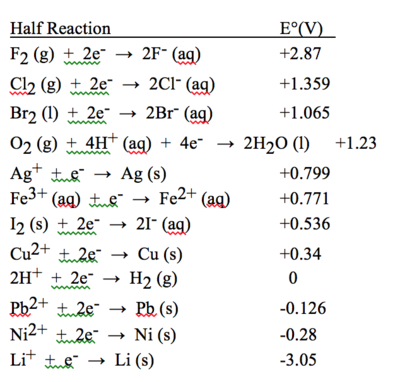
- AA) Cl2
- BB) Br2
- CC) F2
- DD) I2
- EE) All of the halogens have equal strength as oxidizing agents.
14Which one of the following types of elements is most likely to be a good oxidizing agent?
- AA) alkali metals
- BB) lanthanides
- CC) alkaline earth elements
- DD) transition elements
- EE) halogens
15Which one of the following is the best oxidizing agent?
- AA) H2
- BB) Na
- CC) O2
- DD) Li
- EE) Ca
16Which of the following reactions will occur spontaneously as written?
- AA) Sn4+ (aq) + Fe3+ (aq) → Sn2+ (aq) + Fe2+ (aq)
- BB) 3Fe (s) + 2Cr3+ (aq) → 2Cr (s) + 3Fe2+ (aq)
- CC) Sn4+ (aq) + Fe2+ (aq) → Sn2+ (aq) + Fe (s) ← I chose this one
- DD) 3Sn4+ (aq) + 2Cr (s) → 2Cr3+ (aq) + 3Sn2+ (aq)
- EE) 3Fe2+ (aq) → Fe (s) + 2Fe3+ (aq)
17Consider an electrochemical cell based on the reaction:
2H+ (aq) + Sn (s) → Sn2+ (aq) + H2 (g)
Which of the following actions would change the measured cell potential?- AA) increasing the pH in the cathode compartment
- BB) lowering the pH in the cathode compartment
- CC) increasing the [Sn2+] in the anode compartment
- DD) increasing the pressure of hydrogen gas in the cathode compartment
- EE) Any of the above will change the measure cell potential.
18Consider an electrochemical cell based on the reaction:
2H+ (aq) + Sn (s) → Sn2+ (aq) + H2 (g)
Which of the following actions would not change the measured cell potential?- AA) lowering the pH in the cathode compartment
- BB) addition of more tin metal to the anode compartment
- CC) increasing the tin (II) ion concentration in the anode compartment
- DD) increasing the pressure of hydrogen gas in the cathode compartment
- EE) Any of the above will change the measured cell potential.
19Cathodic protection of a metal pipe against corrosion usually entails
- AA) attaching an active metal to make the pipe the anode in an electrochemical cell.
- BB) coating the pipe with another metal whose standard reduction potential is less negative than that of the pipe.
- CC) attaching an active metal to make the pipe the cathode in an electrochemical cell.
- DD) attaching a dry cell to reduce any metal ions which might be formed.
- EE) coating the pipe with a fluoropolymer to act as a source of fluoride ion (since the latter is so hard to oxidize).
20One of the differences between a voltaic cell and an electrolytic cell is that in an electrolytic cell __________.
- AA) an electric current is produced by a chemical reaction
- BB) electrons flow toward the anode
- CC) a nonspontaneous reaction is forced to occur
- DD) O2 gas is produced at the cathode
- EE) oxidation occurs at the cathode
21__________ is reduced in the following reaction:
Cr2O72- + 6S2O32- + 14H+ → 2Cr3+ + 3S4O62- + 7H2O- AA) Cr6+
- BB) S2+
- CC) H+
- DD) O2-
- EE) S4O62-
22Which substance is serving as the oxidizing agent in the following reaction?
14H+ + Cr2O72- + 3Ni → 3Ni2+ + 2Cr3+ + 7H2O- AA) Ni
- BB) H+
- CC) Cr2O72-
- DD) H2O
- EE) Ni2+
23__________ electrons appear in the following half-reaction when it is balanced.
S4O62- → S2O32-- AA) 6
- BB) 2
- CC) 4
- DD) 1
- EE) 3
24The balanced half-reaction in which dichromate ion is reduced to chromium metal is a __________ process.
- AA) two-electron
- BB) six-electron
- CC) three-electron
- DD) four-electron
- EE) twelve-electron
25The electrode at which oxidation occurs is called the __________.
- AA) oxidizing agent
- BB) cathode
- CC) reducing agent
- DD) anode
- EE) voltaic cell
26In a voltaic cell, electrons flow from the __________ to the __________.
- AA) salt bride, anode
- BB) anode, salt bridge
- CC) cathode, anode
- DD) salt bridge, cathode
- EE) anode, cathode
27The standard cell potential (E°cell) for the voltaic cell based on the reaction below is __________ V.
Sn2+ (aq) + 2Fe3+ (aq) → 2Fe2+ (aq) + Sn4+ (aq)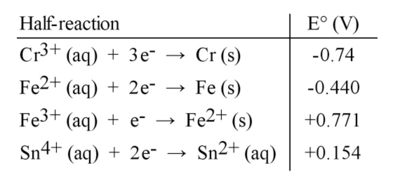
- AA) +0.46
- BB) +0.617
- CC) +1.39
- DD) -0.46
- EE) +1.21
28The standard cell potential (E°cell) for the voltaic cell based on the reaction below is __________ V.
Cr (s) + 3Fe3+ (aq) → 3Fe2+ (aq) + Cr3+ (aq)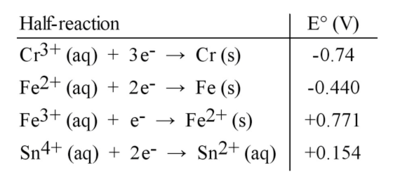
- AA) -1.45
- BB) +2.99
- CC) +1.51
- DD) +3.05
- EE) +1.57
29The standard cell potential (E°cell) of the reaction below is +0.126 V. The value of ΔG° for the reaction is __________ kJ/mol.
Pb (s) + 2H+ (aq) → Pb2+ (aq) + H2 (g)- AA) -24.3
- BB) +24.3
- CC) -12.6
- DD) +12.6
- EE) -50.8
30The standard cell potential (E°cell) of the reaction below is -0.34 V. The value of ΔG° for the reaction is __________ kJ/mol.
Cu (s) + 2H+ (aq) → Cu2+ (aq) + H2 (g)- AA) -0.34
- BB) +66
- CC) -130
- DD) +130
- EE) none of the above
31The standard cell potential (E°cell) of the reaction below is +1.34 V. The value of ΔG° for the reaction is __________ kJ/mol.
3Cu (s) + 2MnO4- (aq) + 8H+ (aq) → 3Cu2+ (aq) + 2MnO2 (s) + 4H2O (l)- AA) -24.3
- BB) +259
- CC) -259
- DD) +776
- EE) none of the above
32Galvanized iron is iron coated with __________.
- AA) magnesium.
- BB) zinc.
- CC) chromium.
- DD) phosphate.
- EE) iron oxide.
33The standard cell potential (E°) of a voltaic cell constructed using the cell reaction below is 0.76 V:
Zn (s) + 2H+ (aq) → Zn2+ (aq) + H2 (g)
With PH2 = 1.0 atm and [Zn2+] = 1.0 M, the cell potential is 0.66 V. The concentration of H+ in the cathode compartment is __________ M.- AA) 2.0 × 10⁻²
- BB) 4.2 × 10⁻⁴
- CC) 1.4 × 10⁻¹
- DD) 4.9 × 101
- EE) 1.0 × 10⁻¹²
34A voltaic cell is constructed with two silver-silver chloride electrodes, where the half-reaction is
AgCl (s) + e- → Ag (s) + Cl- (aq) E° = +0.222 V
The concentrations of chloride ion in the two compartments are 0.0222 M and 2.22 M, respectively. The cell emf is __________ V.- AA) 0.212
- BB) 0.118
- CC) 0.00222
- DD) 22.2
- EE) 0.232
35The standard cell potential (E°cell) for the reaction below is +0.63 V. The cell potential for this reaction is __________ V when [Zn2+] = 3.5 M and [Pb2+] = 2.0 × 10⁻⁴ M.
Pb2+ (aq) + Zn (s) → Zn2+ (aq) + Pb (s)- AA) 0.50
- BB) 0.84
- CC) 0.39
- DD) 0.76
- EE) 0.63
36The standard emf for the cell using the overall cell reaction below is +2.20 V:
2Al (s) + 3I2 (s) → 2Al3+ (aq) + 6I- (aq)
The emf generated by the cell when [Al3+] = 4.5 × 10⁻³ M and [I-] = 0.15 M is ________ V.- AA) 2.20
- BB) 2.32
- CC) 2.10
- DD) 2.39
- EE) 2.23
37The most difficult species to reduce and the poorest oxidizing agent is __________.
- AA) Fr+
- BB) F-
- CC) Li+
- DD) He
38 In a half reaction the amount of a substance that is reduced or oxidized is directly proportional to the number of electrons generated in the cell.
- ATrue
- BFalse
Information
- Description
- Originally chapter 20
- Author
- Dawn G
- Language
- English
- Views
- 1,283
- Tags
- Rating
- No ratings yet Rate this quiz