
1802542
Descripción

Fichas por Teresa Bui, actualizado hace más de 1 año

|
Creado por Teresa Bui
hace casi 12 años
|
|
| Pregunta | Respuesta |
| Distance | The amount of space between two points. |
| Origin | The starting point or reference point in which positions are described from. |
| Position | The current location of an object according to the origin or starting point. |
| Coordinates | The negative or positive numbers on geographic points used to describe a position |
| Speed | The distance an object travels divided by the time it takes. |
| Constant Speed | The speed of an object that travels the same distance every time unit or interval |
| Average Speed | The total distance divided by the total time |
| Velocity | The speed (the distance traveled over a period of time) with a specific direction. |
| Slope | A line made by the points on a graph |
| What is the formula for Speed? | Distance divided by Time d/t |
| What is the formula for Distance? | Speed times Time s x t |
| What is the formula for Time? | Distance divided by Speed d/s |
| Force | (F) an action (push/pull) that has the ability to change motion. |
| Friction | (f) a force that resists forward motion |
| Vector | A quantity that includes SIZE and direction |
| Magnitude | Describes the size of a vector |
| Net Force | (Fnet) the sum of all known forces on an object |
| Balanced Forces | When the sum of an object's forces are equal to zero. |
| Equilibrium | a STATE of balance forces or when forces=0 |
| Normal Force | (Fn) a force that a surface exerts on an object that is pressing on it |
| Tension | A pulling force that acts in a string, rope, or other object. |
| Compression | A squeezing force that can act on a spring |
| What are the types of Forces? | -Friction -Nuclear -Electromagnetic -Gravitational |
| What are the types of Friction? | -Static -Rolling -Sliding -Air Resistance -Viscous |
| What forces on present on a free body diagram/force diagram | Normal Force, Forward Force, Friction, Gravitational Force |
| Where are the forces located on the Free Body Diagram/Force Diagram | Normal Force(top), Forward Force(right), Friction(left), Gravitational Force(bottom) |
| Which forces on the Free Body Diagram/Force Diagram are Positive and Negative? | Normal Force, Forward Force are positive and Gravitational Force, Friction are negative |
| Inertia | A property of matter that an object has that resists a change in motion. More Mass=More Inertia Bowling Ball&Golf Ball, Bowling Ball is harder to push, because more INERTIA |
| Unbalanced Forces | A net force result that shows a change in motion; can be (+) or (-) Basically the object is moving |
| Acceleration | The rate that speed changes over time |
| Freefall | The motion of an object only acted on by the force of gravity; air resistance has little to no effect. |
| What is Newton's 1st Law? | An object at rest, will stay at rest, until an outside force changes its state. (Same with an object in motion) |
| What is Newton's 2nd Law? | Force causes acceleration, but mass resists acceleration (slows it down). Proves F=mxa formula |
| What is Newtons 3rd Law? | For every action, there is an equal and opposite reaction. |
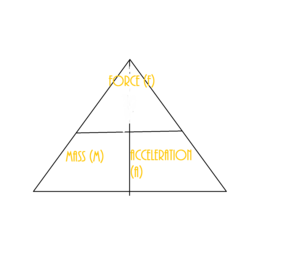
| What is the FIRST acceleration Formula? | Magic Triangle. F=mxa M=f/a A=f/m |
| What is the SECOND acceleration formula? | Speed2-Speed1 ------------------------- Time |
| Static Friction | No object movement |
| Sliding Friction | Friction that is applied to moving objects |
| Rolling Friction | Friction applied to rolling objects |
| Air Resistance Friction | The friction of motion through air |
| Viscous Friction | Friction with movement in liquids |
| Nuclear Force | The force that holds atoms together |
| Electromagnetic Force | force between positively charged and negatively charged objects |
| Gravitational Force | Force of attraction due to great distances in mass and difference |
¿Quieres crear tus propias Fichas gratiscon GoConqr? Más información.