
Mapa mental
Why Teach Art and Design?
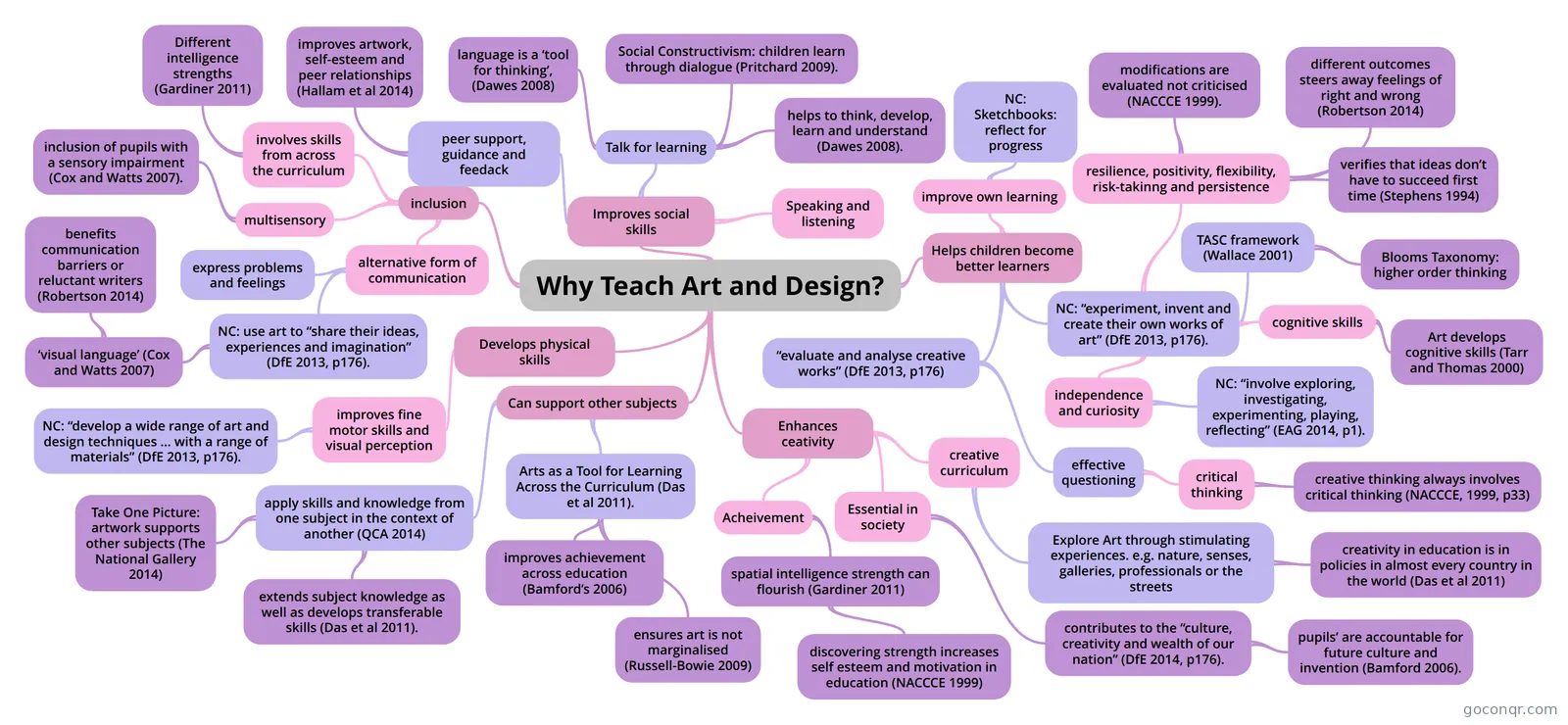
Mind map: why teach art and design
Contenido del mapa
Why Teach Art and Design?
Helps children become better learners
- NC: “experiment, invent and create their own works of art” (DfE 2013, p176).
- cognitive skills
- Art develops cognitive skills (Tarr and Thomas 2000)
- resilience, positivity, flexibility, risk-takinng and persistence
- modifications are evaluated not criticised (NACCCE 1999).
- verifies that ideas don’t have to succeed first time (Stephens 1994)
- different outcomes steers away feelings of right and wrong (Robertson 2014)
- TASC framework (Wallace 2001)
- Blooms Taxonomy: higher order thinking
- independence and curiosity
- NC: “involve exploring, investigating, experimenting, playing, reflecting” (EAG 2014, p1).
- cognitive skills
- “evaluate and analyse creative works” (DfE 2013, p176)
- effective questioning
- critical thinking
- creative thinking always involves critical thinking (NACCCE, 1999, p33)
- critical thinking
- effective questioning
- improve own learning
- NC: Sketchbooks: reflect for progress
- NC: “experiment, invent and create their own works of art” (DfE 2013, p176).
Enhances ceativity
- creative curriculum
- Explore Art through stimulating experiences. e.g. nature, senses, galleries, professionals or the streets
- creativity in education is in policies in almost every country in the world (Das et al 2011)
- Explore Art through stimulating experiences. e.g. nature, senses, galleries, professionals or the streets
- Essential in society
- contributes to the “culture, creativity and wealth of our nation” (DfE 2014, p176).
- pupils’ are accountable for future culture and invention (Bamford 2006).
- contributes to the “culture, creativity and wealth of our nation” (DfE 2014, p176).
- Acheivement
- spatial intelligence strength can flourish (Gardiner 2011)
- discovering strength increases self esteem and motivation in education (NACCCE 1999)
- spatial intelligence strength can flourish (Gardiner 2011)
- creative curriculum
Develops physical skills
- improves fine motor skills and visual perception
- NC: “develop a wide range of art and design techniques … with a range of materials” (DfE 2013, p176).
- improves fine motor skills and visual perception
Improves social skills
- peer support, guidance and feedack
- improves artwork, self-esteem and peer relationships (Hallam et al 2014)
- Talk for learning
- helps to think, develop, learn and understand (Dawes 2008).
- Social Constructivism: children learn through dialogue (Pritchard 2009).
- language is a ‘tool for thinking’, (Dawes 2008)
- Speaking and listening
- peer support, guidance and feedack
inclusion
- alternative form of communication
- NC: use art to “share their ideas, experiences and imagination” (DfE 2013, p176).
- ‘visual language’ (Cox and Watts 2007)
- benefits communication barriers or reluctant writers (Robertson 2014)
- ‘visual language’ (Cox and Watts 2007)
- express problems and feelings
- NC: use art to “share their ideas, experiences and imagination” (DfE 2013, p176).
- multisensory
- inclusion of pupils with a sensory impairment (Cox and Watts 2007).
- involves skills from across the curriculum
- Different intelligence strengths (Gardiner 2011)
- alternative form of communication
Can support other subjects
- Arts as a Tool for Learning Across the Curriculum (Das et al 2011).
- ensures art is not marginalised (Russell-Bowie 2009)
- improves achievement across education (Bamford’s 2006)
- apply skills and knowledge from one subject in the context of another (QCA 2014)
- Take One Picture: artwork supports other subjects (The National Gallery 2014)
- extends subject knowledge as well as develops transferable skills (Das et al 2011).
- Arts as a Tool for Learning Across the Curriculum (Das et al 2011).
Información
- Reseña de GoConqr
- Reasons for teaching art and design.
- Descripción
- Mapa Mental sobre Why Teach Art and Design?, creado por Amy Williams9517 el 31/10/2014.
- Creado por
- Amy Williams9517
- Visitas
- 139
- Valoración