
Mapa mental
Principles for teaching
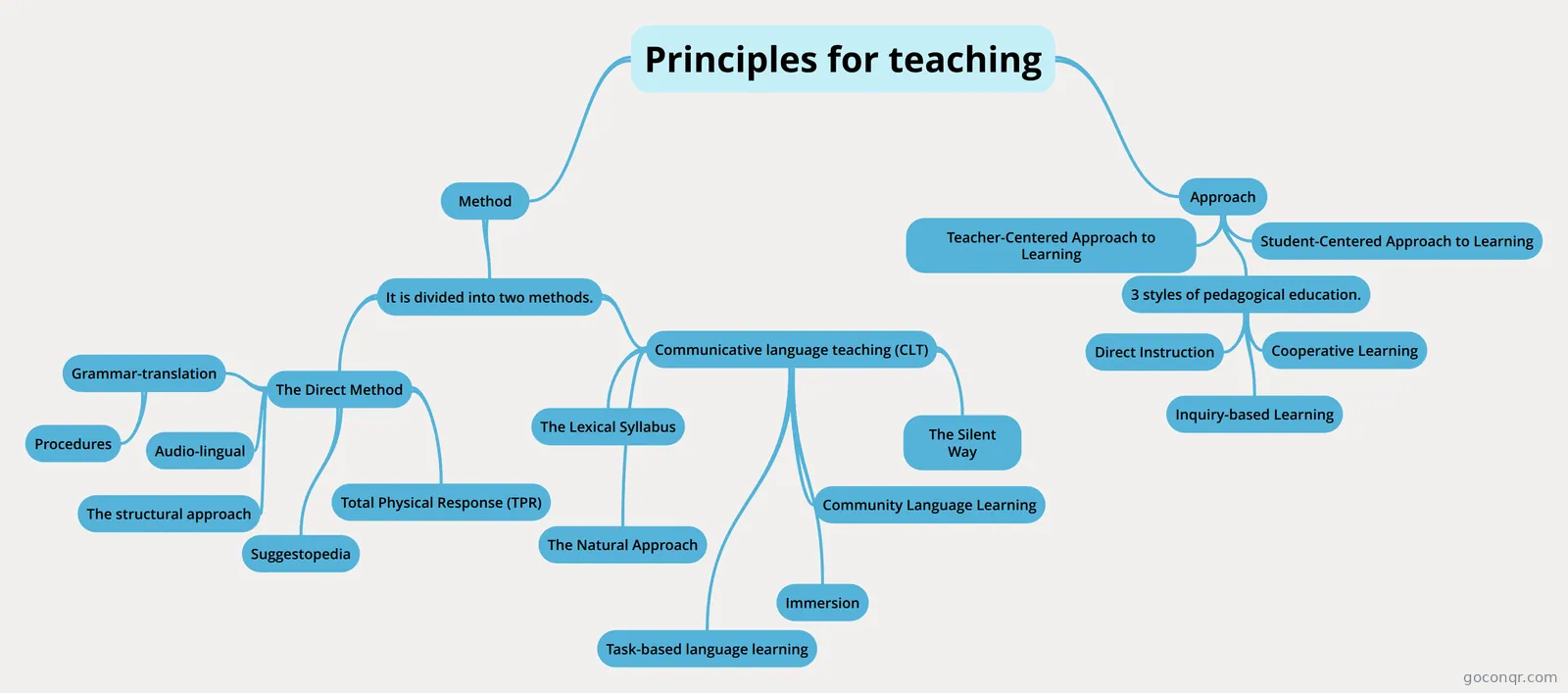
Mind map: Principles for teaching
Contenido del mapa
Principles for teaching
Approach
- Theoretical positions and beliefs about the nature of language, the nature of language learning,and the applicability of both to pedagogical settings.
- Teacher-Centered Approach to Learning
- in this case the teachers are key as they have the function to pass knowledge and information onto their students. In this model, teaching and assessment are viewed as two separate entities. learning the student will be assessed through exams.
- Student-Centered Approach to Learning
- The teacher’s primary role is to coach and facilitate student learning and overall comprehension of material. Teaching and assessment are connected; student learning is continuously measured during teacher instruction.
- 3 styles of pedagogical education.
- Direct Instruction
- Is that refers to the traditional teaching strategy that relies on explicit teaching through lectures and teacher-led demonstrations.
- Inquiry-based Learning
- Is the Inquiry-based learning is a teaching method that focuses on student investigation and hands-on learning. The teacher’s primary role is that of a facilitator,since is the support for students through the learning process. Inquiry-based learning is under the student-centered approach, in the rol of the students in their own learning process.
- Cooperative Learning
- Is a method of teaching and classroom management that emphasizes group work and a strong sense of communication. Is a method of teaching and classroom management that emphasizes group work and a strong sense of communication.
- Direct Instruction
Method
- A generalized set of classroom for accomplishing linguistic objective. methods tend to be primarily concerned with teacher and students roles and behaviors and secondarily with such features as linguistics and subject-matter objectives
- It is divided into two methods.
- The Direct Method
- It is the teaching that takes place entirely in the language being learned. The learner is not allowed to use his or her mother tongue.
- Grammar-translation
- Learning is largely by translation to and from the target language.
- Procedures
- The procedures grammar-translation: *The class reads a text written in the second language. *Student translate the passage from the second language to their mother tongue.*Student translate new words from the second language to their mother tongue.*Student are given a grammar rule and derived from the example they apply the rule by using the new words. *Student memorize the vocabulary of the second language. *Student memorize grammar rules. *Errors made by the student are corrected by providing the right answers. *This is the process (with variation) that is used when employing the grammar-translation method.
- Audio-lingual
- The theory behind this method is that learning a language means acquiring habits. There is much practice of dialogues of every situations.
- The structural approach
- This method sees language as a complex of grammatical rules which are to be learned one at a time in a set order.
- Suggestopedia
- Is that a language can be acquired only when the learner is receptive and has no mental blocks. By various methods it is suggested to the student that the language is easy - and in this way the mental blocks to learning are removed.
- Total Physical Response (TPR)
- Works by having the learner respond to simple commands such as "Stand up", "Close your book", "Go to the window and open it." The method stresses the importance of aural comprehension.
- Communicative language teaching (CLT)
- The focus of this method is to enable the learner to communicate effectively and appropriately in the various situations she would be likely to find herself in.
- The Silent Way
- The aim is that the teacher speaks very little but the student understand and learn.
- Community Language Learning
- In this method attempts are made to build strong personal links between the teacher and student so that there are no blocks to learning.
- Immersion
- Corresponds to a great extent to the situation we have at our school through various activities related to other matter
- Task-based language learning
- The focus of the teaching is on the completion of a task which in itself is interesting to the learners. Learners use the language they already have to complete the homework.
- The Natural Approach
- Does similarities between learning the first and second languages. Learning takes place by the students being exposed to language that is comprehensible.
- The Lexical Syllabus
- This approach is based on a computer analysis of language which identifies the most common words in the language.
- The Direct Method
Información
- Descripción
- Willis,D. (1990) The lexical syllabus. Colins Cobuild. http://es.slideshare.net/muhammadfauzan31521307elt-different-methods-approach http://teach.com/what7teacher-teach7teaching-methods/
- Creado por
- karen barranco
- Visitas
- 201
- Valoración