
129921


| Question | Answer |
| 10mm 1000mm 100cm 1000m 1000mg 1000g | 1cm 1m 1km 1g 1kg |
| 1000kg 100cl 1000ml 1000cm3 1000l | 1 tonne 1 litre 1 litre 1 litre 1m3 |
| 2.2 pounds 1 3/4 pints 1 gallon 5 miles 1 foot 1 inch | 1 kg 1 litre 4.5 litre's 8 pints 8 km 30 cm 2.54 cm |
| If you need to make a bigger number you... If you need to make a smaller number you... | need to divide the origional need to multiply the origional |
| EXAMPLE QUESTION: How many gallons are in 18 litres? | 8 gallons = 4.5 litres 18 / 4.5 = 4 gallons There are 4 gallons in 18 litres |
|
Image:
DST_Triangle (image/png)
|
D = Distance S = Speed T = Time |
|
Image:
MDV_Triangle (image/png)
|
M = Mass D = Density V = Volume |
| When expanding brakets... | -always put the letters alphabetically -always put the number infront of the letter/s |
| When you are asked to expand (p+10)(p+25) You use FOIL | First Inner Outer Last |
| EXAMPLE QUESTION: EXPAND THIS p(x+4) | px + 4p |
| EXAMPLE QUESTION: EXPAND THIS 2x(3+2z)-z(3x+1) | 6x+4xz-3xz-z 6x+xz-z |
| To factorise you have to... | find a number that all the numbers in the equation divide by, divide the numbers, put the left over numbers into a bracket and infront of the bracket put the number that the others can divide by. |
| EXAMPLE QUESTION: FACTORISE THIS 15p-10q-20pq | ALL OF THE NUMBERS DIVIDE BY 5 5(3p-2q-4pq) |
| EXAMPLE QUESTION: EXPAND THIS (y-2)(y+3) | y^2-2y+3y+1 y^2+y+1 |
| How do you facorise quadratics? TEAM | Times End Add Middle |
| EXAMPLE QUESTION: FACTORISE THIS QUADRATIC p^2+8p+16 | 4x4=16 4+4=8 (p+4)(p+4) (if you FOIL this it should end up how it began) |
| EXAMPLE QUESTION: FACTORISE THIS QUADRATIC 3x^2-7x+4 | -3x-4=12 -3+-4=-7 3x^2-3x¦-4x+4 (split it down the middle and factorise them seperately) 3x(x-1)-4(x-1) (the part of the equation in brackets has to be the same) (3x-4)(x-1) |
| How do you find the area of... A triangle A quadrilateral A parrallelogram A trapezium | b x h x 1/2 b x h b x h (push over to find right no. for b) 1/2 (top+bottom) x distance between |
| How do you find the circumference? | pi x diameter OR 2 x pi x radius |
| How do you find the... RADIUS DIAMETER | curcumference/2 x pi curcumference/pi |
| How do you find the area of a circle? | (pi x radius)^2 |
| How do you find the volume of any 2D shape? | length x width x height |
| How do you find the volume of a Prism? | area of cross section x length (you need to work out the area) |
| When looking at a shape, the plan is... | like a birds eye view |
| When looking at a shape, the elevation is... | looking at the side and the front |
| Parrallelogram nets look like | planes |
| To find out the pence per cm/^2/3 | you do cost/weight |
| How do you work out the MEAN MEDIAN MODE | overall amount / amount of numbers amount of numbers + 1 / 2 most common |
| To find any quartiles you | do thesame as the median but divide by 4 instead |
| What is the equation of the mean when working with frequency tables? | Efx / Ef E = total fx = multiplication across rows f = frequancy column |
| To find out the mode you | use x not f |
| To find out the median you | add together all of column x and divid by 2 |
| In group frequency table the equation for the mean is the same (Efx/Ef) but | to find fx you have to find the midpoint of each row in the x column and then times by f |
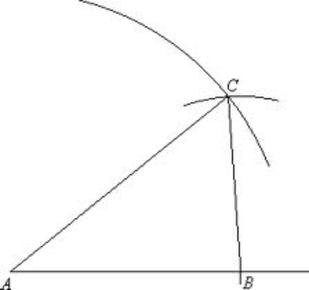
| Hw do you construct a triangle? (with or without measurements) | |
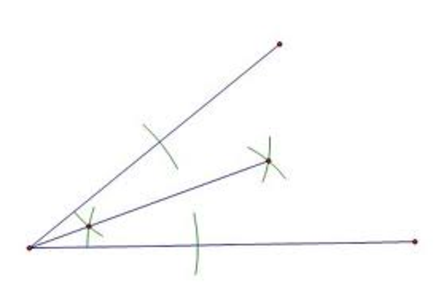
| How do you construct and angle bisector? |
Image:
angle_bisector (image/png)
|
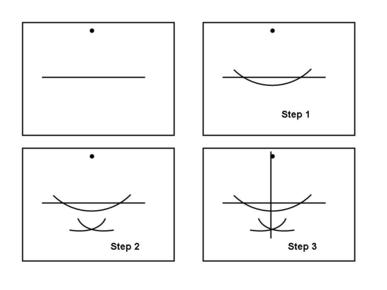
| How do you construct a bisector on a point off the line? | |
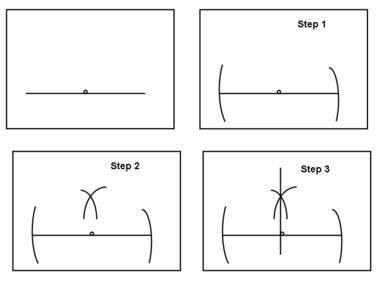
| How do you construct a bisector through any point on a line? | |
| When asked to construct a right angled triangle bisector on a line you... | extend the line and on the end of the origional line you place the pint of the compass and draw two curves on the line and then on each of these curves, place the point and draw two curves that meet. |
| What are loci? | Loci are a set of point that go arounf one point in any condition. |
| To find the length of the real object To find the length of the scale object | length of scale diagram x scale factor length of real object / scale factor |
| The scale factor is | largest / smallest |


Want to create your own Flashcards for free with GoConqr? Learn more.