
13937187
Description

Flashcards by Alexei Smith, updated more than 1 year ago

|
Created by Alexei Smith
over 7 years ago
|
|
| Question | Answer |
| EM Compatibility | How well devices can work simultaneously and in the same locale without interference |
| Signal Integrity | How well different parts of the same system can work without intereference |
| EMC Legislation (3) | EU directive on EMC FCC (USA) China follows EU |
| What must be considered if a circuit is electrically large? | Propagation delays |
| Electrical size is usually described in terms of... | Physical size compared to operating wavelength |
| Generally, a circuit is considered electrically small if: | Size < 1/10 λ |
| Capacitive crosstalk minimisation (4) | Avoid coupled length of trace Increase trace separation Operate at a lower frequency Use shielding |
| The propagation constant equation | γ = α + jβ |
| α in the propagation constant is... | The attenuation constant: the factor of reduction in amplitude per unit length of the (constant) medium |
| β in the propagation constant is... | Phase constant: the change in phase per unit length of (constant) medium |
| β in the propagation constant is mathematically equal to... | β = ω / c |
| Units of α in the propagation constant | Neper/metre x8.7 to get dB/m |
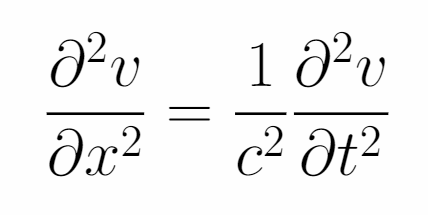
| The wave equation | |
| Difference between phasors and frequency domain | Phasors are a way of representing complex numbers through magnitude and phase, at a set frequency Frequency domain uses a set of phasors to represent a signal of multiple frequencies |
| An alternative to the phasor V = Aexp(jθ) | v(ωt - βx) = R[V(0) exp(j(ωt - βx))] |
| y = f(t ____) | y = f(t - x/c) where c is speed and x is displacement along the x axis |
| Phasor domain can only be applied to a transmission line if... | The properties of the medium remain constant. These are: permittivity, permeability & refractive index. |
| Inductive crosstalk minimisation (5) | Avoid coupled length of trace Increase trace separation Operate at a lower frequency Use shielding Minimise circuit loop areas |
| A inductive crosstalk shield must be... | Grounded at both ends to allow current flow |
| Inductive shields work best... | At high frequency: more current crosstalk current flows in the shield because it has a lower inductance, and therefore impedance. |
| Common method to reduce inductive crosstalk | Twisted pair transmission line It minimises loop effects because the adjacent loops cancel out Must be balanced to avoid ground loop |
| In an infinite lossless transmission line, energy is stored... | equally between the electric and magnetic fields |
| In an infinite lossless transmission line, the rate of energy storage is equal to... Because... | The rate of energy storage is equal to the rate of energy input Because there is no energy loss |
| The current in a infinite lossless transmission line is equal to... From this we can deduce... | V/Zo A load equal to Zo is equivalent |
| Terminating a finite transmission line with a load is the same as... | Connecting an infinite line of the same impedance |
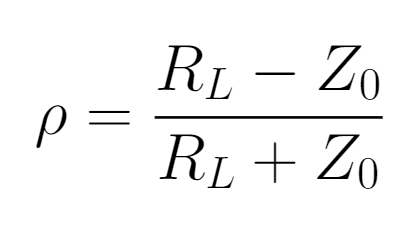
| Reflection coefficient equation | |
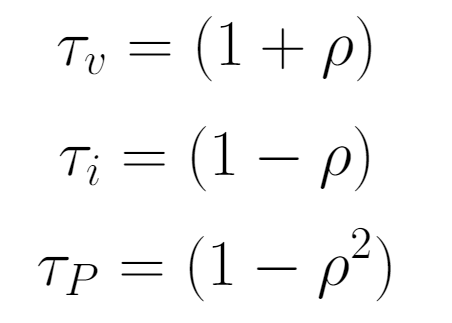
| Transmission coefficients | |
| Capacitive transmission line coupling induces... | A current shared equally between the near and far ends |
| Inductive transmission line coupling induces... | A voltage |
| The coupling voltage in a transmission line (far end) | Propagates at the same speed and the source signal, meaning its amplitude builds over time |
| Near end coupling signal duration is proportional to... | The coupled length |
| Near end coupling voltage has a duration: where: | 2T where T is the propagation delay of the line |
| Impedance coupling minimisation | Track impedance reduction Star connections - improves isolation Separate power supplies - best isolation |
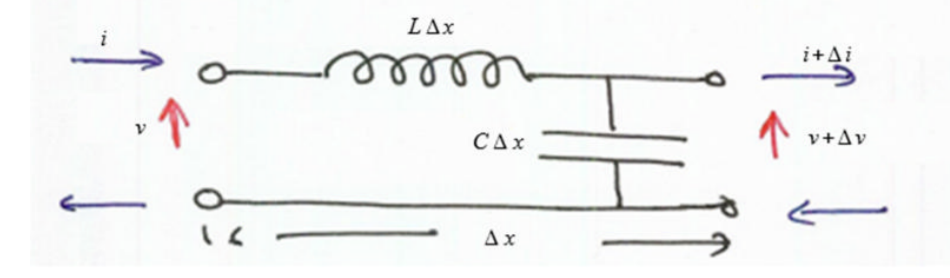
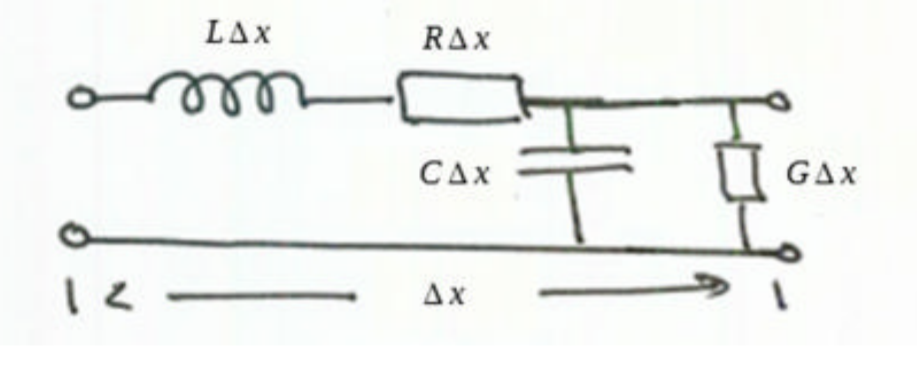
| Equivalent PUL circuit for a lossless transmission line | |
| Equivalent PUL circuit for a transmission line | |
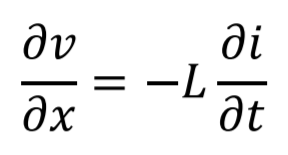
| Telegrapher's equation for L | Derive from differential L formula |
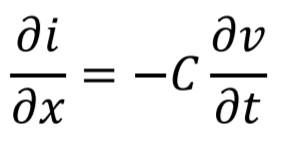
| Telegrapher's equation for C | Derive from differential C formula |
| What do the telegrapher's equations describe? | The voltage/current change in a lossless transmission line due to elemental L/C |
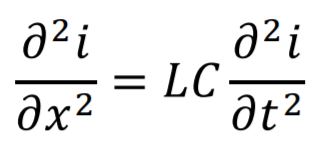
| 1D wave equation for the voltage on a lossless transmission line Derive by... | Derive by differentiating L tele and subbing in C tele (other way for i) |
| For a lossless transmission line, characteristic impedance is... | A real number |
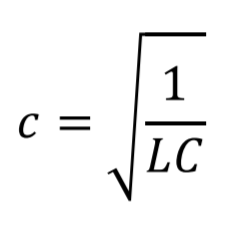
| Relationship between L, C and propagation velocity | |
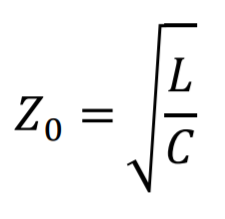
| Relationship between L, C and characteristic impedance | |
| Lumped element approximation can only be used if... | Circuit is electrically small |
Want to create your own Flashcards for free with GoConqr? Learn more.