
16307786
Description

Flashcards by Erin Vales, updated more than 1 year ago

|
Created by Erin Vales
about 7 years ago
|
|
| Question | Answer |
| Probability | the proportion of times that a certain event is expected to occur the study of randomness and uncertainty |
| Sample space S | the set of all possible outcomes of an experiment |
| Event | a subset of S or a collection of outcomes of an experiment each outcome is a simple event |
| Probability Rule A | Any probability is a number between 0 and 1 |
| Probability Rule B | All possible outcomes together must have probability |
| Probability Rule C | The probability that an event does not occur is 1 minus the probability that the event does occur P(A') = 1 - P(A) |
| Mutually Exclusive | If two events have no outcomes in common, that is they both cannot happen simultaneously, |
| Mutually Exclusive Events | The probability that one or the other of the two mutually exclusive events occur is the sum of their individual probabilities P(A or B) = P(A) + P(B) |
| Independent Events | If two events do not influence each other and if the knowledge about one does not help in the knowledge of the probability of the other, the events are said to be independent of each other |
| Independent Event Probability | If two events are independent, then the probability that they both happen is found by multiplying their individual probabilities P(A and B) = P(A) * P(B) |
| Discrete variable | If and only if it takes on a finite number of values or a countably infinite number of values - ex. number of students in a class |
| Continuous variable | when it takes on values which lie on a continuum or an interval of the real line - ex. amount of water in a gallon bucket |
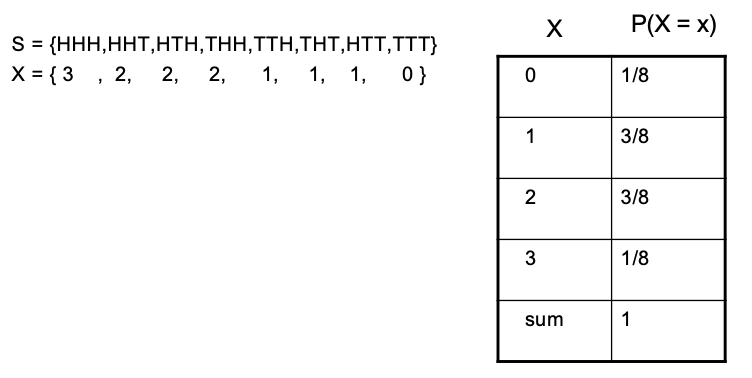
| Probability distribution of Discrete Random variable | expressed by a probability mass function (pmf) and a probability histogram |
| Parameter | When p(x) = P( X = x ) depends on a quantity which can take on various values |
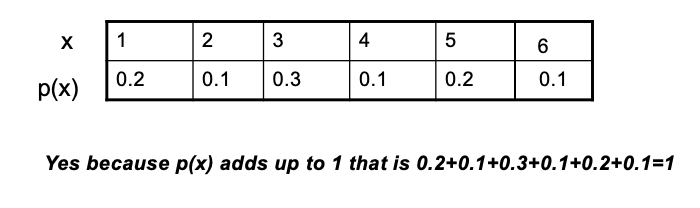
| Rule for PMF | If you have a probability model for a discrete random variable X... 1. each probability must be a number between 0 and 1 2. probabilities must add up to 1 |
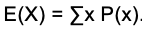
| Expected Value of Discrete Random variables | Def: The long term average value of a random variable. The expectation or mean of X is given by |
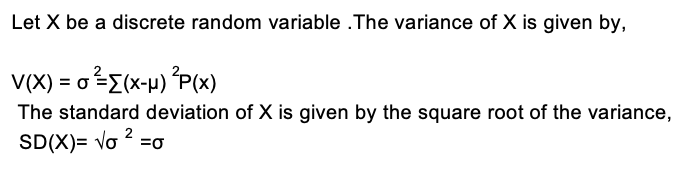
| Variance and Standard Deviation of Discrete random variables | |
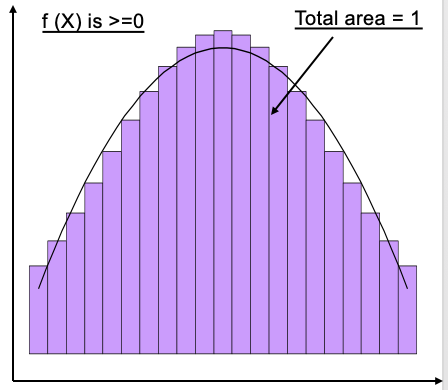
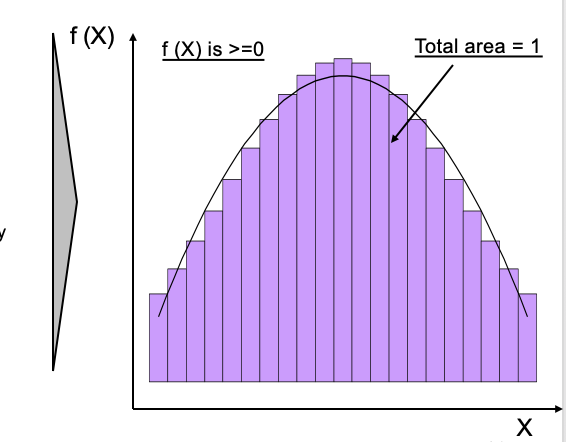
| Probability Density Function (pdf) | the mathematical model for a continuous random variable X |
| Probability Density Curve | the graph of the probability density function (pdf) the curve that smoothes out a histogram |
| Properties of a Property Density Function (pdf) | For any value of a random variable X for which X is defined, f(X) should be non-negative The total area under the probability density curve should be 1 |
Want to create your own Flashcards for free with GoConqr? Learn more.