
4034525


| Question | Answer |
| Describe the Turing Test. Explain how it demonstrates sense and perception. | In the Turing Test, a barrier divides a Judge and a Subject. The subject may be human or machine. The Judge is allowed to ask the Subject questions in order to determine if it is human or machine. If the Judge perceives the Subject to be machine, the machine is said to have passed the test. The Turing Test demonstrates how we rely on sensory input in order to construct our perception of an event. It also demonstrates that there is a discrepancy between reality and psychological experience. How we perceive the world may not actually be how the world really is. |
| Distinguish between sensation and perception. Use examples to aid your answer. | Sensation is a physical experience that refers to the sensory input which is received from stimulus events. Perception is the psychological experience of processing sensory input in order to construct meaning. We may use prior knowledge and existing representations to create perception. For example: Sensation = sweet Perception = this cookie tastes sweet |
| Our brain sorts information in two ways. What are the two ways? Describe them and explain the differences between them. | Sensory input can be sorted into bottom-up activation or top-down activation. Bottom-up activation refers to the processing of sensory input. For most people for a given sensation, the meaning is the same. Top-down activation is information processing that is influenced by cultural biases, expectation, ideas, crystallised intelligence and past experience. This phenomena of utilising existing mental representations is called spreading activation. Because of these individual differences, the meaning for a given sensation will be different from person to person. |
| What is the problem with top-down activation? | The brain is in fact a lazy interpreter. A majority of brain processing is dependent on spreading activation. This means that our perception is subject to manipulation by our individual framework. |
| What senses does a person have? | Vision Auditory Gustation Olfactory Proprioreception Pain Pressure Balance |
| What is the typical pathway from sensation to perception? | 1. Energy produced by a stimulus event enters the sensor/ transducer 2. Energy is converted into nerve impulses 3. Nerve impulses are sent through neurons 4. Nerve impulses terminate at the thalamus for brain processing |
| Each form of sensory input has a specialised receptor, particular neurons through which it is sent and particular areas in the brain for processing. To which sense or type of brain processing, do each area in the brain correspond to? | Frontal lobe - thought, planning movement Parietal lobe - spatial relations, motion, touch Temporal lobe - auditory, memory Occipital lobe - vision |
| The brain consists of white and grey matter. What do these terms mean? | A neuron is made up of a cell body and an axon. It can be myelinated. This means that it is surrounded by layers of fat. Grey matter refers to all the information storage units of a brain, the cell bodies and nuclei of neurons. White matter refers to all the information transmission units of a brain, the myelinated axons. |
| What is the corpus callosum? | The corpus callosum is a bundle of neuronal fibres that connects the left and right hemisphere. This enables the two hemispheres to communicate with one another. |
| What electromagnetic radiation are our eyes sensitive to? How does this relate to our vision of a 24-hour day? | Our eyes are sensitive to the visible light spectrum. The colours observed during the day are blue in the morning, which turn red and orange as the sun sets. This corresponds to the physical phenomena of wavelengths in the visible light spectrum where light of a longer wavelength is perceived as red, while light of a shorter wavelength as blue. |
| What terms do we use to describe vision? How would we describe the vision acuity of an infant, using these terms. | Vision can be described in terms of spatial frequency. This refers to the number of amalgamations in a visual panel. The greater the number of amalgamations in a cycle, the higher the spatial frequency and therefore the greater the ability to see detail. Infants on the other hand, have blurred vision. This is described as low spatial frequency. |
| In relation to the focusing of images, what types of vision impairment are there? | Myopia, commonly known as short-sightedness, focuses visual images before the retina. Hyperopia, commonly known as long-sightedness, focuses visual images behind the retina. |
| How is a visual field represented in the brain? | A visual field can be divided into left and right. Content in the left visual field is received by the right temporal eye (and the left nasal eye). This sends information to the right hemisphere. Content in the right visual field is received by the left temporal eye (and the right nasal eye). This sends information to the left hemisphere. A visual field can also be divided into upper and lower. Information from the upper visual field is sent to neurons below the calcarine sulcrus. Information from the lower visual field is sent to neurons above the calcarine sulcrus. |
| In relation to vision acuity, what types of defects in the visual field are there? | There are three types of defects: Scotomia refers to a localised degeneration in vision acuity. Quadrantanopia refers to degeneration in 1/4 of the visual field. Hemianopia refers to degeneration in 1/2 of the visual field. |
| The corpus callosum is a very important structure that enables the transmission of information between the left and right hemispheres. What happens if the corpus callosum is cut, like in split-brain patients? | Patients suffering from epilepsy, experience seizures that result from the misfiring of one neuron which leads to a cascade of misfires all over the brain. In severe cases, the corpus callosum is severed to prevent future seizures. If an object was held up in the left visual field of the subject, a split-brain patient would be unable to verbally identify the object. Though the right hemispheres identifies the object, it is unable to relay this information to the speech centre which is located in the left hemisphere. If, however, the subject was asked to pick up the object that was shown to them, a split-brain patient would be able to. This is because the motor centre is located in the right hemisphere. |
| Describe the colour-after effect. | ? |
| Outline the neuronal pathway that visual input takes in the brain. Distinguish between the two types of pathways that can take place from the thalamus. | 1. Retina receives sensory input 2. Sensory input is converted into nerve impulses which are sent through the optic tract 3. The thalamus (lateral geniculate nucleus) processes input into the parvocellular or magnocellular pathway to send to the primary visual cortex 5. The primary visual cortex sends information to their corresponding locations The P channel sends information ventrally to the temporal lobe in the 'what' pathway for identification and recognition of form, object and colour. The M channel sends information dorsally to the parietal lobe in the 'where' pathway to process spatial relations and motion. |
| What deficiencies affect the 'what' pathway? | Cognition deficiencies affecting the P channel are collectively termed agnosia and refers to the inability to recognise sensory information. There are two types of agnosia: Form agnosia refers to the inability to recognise an object from a visual stimulus. However subjects are very much capable of recalling it from memory. Object agnosia refers to the inability to recall an object from memory. However subjects are very much capable of recognising the visual stimulus. |
| Describe the McGurk effect. What does this demonstrate in terms of sense and perception? | The McGurk effect describes the interaction between the auditory and visual system. When we receive auditory input, we hear a particular sound. Yet when we pair this auditory stimulus with visual input, such as mouth movements, we hear a different sound. This demonstrates that our brain is a multi-sensory organ and doesn't rely on one form of sensory input to construct a psychological experience of a particular stimulus event. |
| Sound waves are wave functions. Describe its frequency and amplitude. | For a human, our ears are sensitive to sound in the wavelength: 20 - 20 000 Hz Frequency is described as pitch. Amplitude is described as loud or soft and is measured in decibels. |
| Outline how sound waves travel from the outer ear to the inner ear. | 1. Sound waves enter the auditory canal 2. Sound waves hit the ear drum (tympanic membrane) 3. A vibrating ear drum causes the hammer to strike the anvil 4. A vibrating anvil causes vibrations in the stirrup 5. The vibrations enter the oval window 6. The vibrations enter the semicircular canals full of fluid 7. Vibrations in the fluid cause the basilar membrane of the inner duct in the cochlea to move up and down 8. Vibrations are converted to nerve impulses 9. Nerve impulses are sent through the auditory nerve |
| What types of deafness are there? | There are two types of deafness: conduction and sensory-neural Conduction deafness refers to structural complications and is therefore easy to fix. Obstructions, perforations, infections or malformations can impair sound wave transmission. Sensory-neural deafness refers ? |
| Olfactory input enters through the mouth and nasal pharynx. But other senses are also involved in the perception of flavour. Describe an instance, and how this demonstrates sense and perception. | The perception of flavour is constructed from sensory input received by receptors in the nose and on the tongue. We often associate colour to a particular taste. If food-dyed sparkling water was given to a subject, they would perceive the flavour of coke. If a blindfolded subject drank glasses of red and white wine, they would perceive both glasses to have the same taste. This phenomena demonstrates two things about sense and perception. Firstly, that our brain is a lazy interpreter and is driven by top-down activation. Our perception of a flavour is driven by our expectation of the taste, based on the colour of the food or drink. Secondly, that perception is reliant on many forms of sensory input. |
| Outline the neuronal pathway that olfactory input takes in the brain. | 1. Olfactory input is received by receptors in the nasal cavity 2. Olfactory sensory neurons transmit nerve impulses to the glomerulus 3. Nerve impulses synapse at second-order olfactory neurons 4. Nerve impulses are sent through olfactory bulbs to the orbitofrontal cortex |
| It is often taught that our taste buds are divided into four sections: bitter, sweet, sour, salty Why is this incorrect? | All receptors on our tongue are the same. Some aren't specialised to receive 'bitter' input or 'sweet' input. This division into bitter, sweet, sour and salty is a mental representation the brain has constructed to aid in more effective transmission of information. |
| Often associated to vision is the concept of attention. We can attend to particular information or stimuli as a spotlight or focus on the whole array. Distinguish between serial and parallel processing. | Serial processing takes time. This often means searching through an array one object at a time. If the array size were to increase, this also increases the time spent conducting a serial search. Parallel processing is faster. This is characteristic of cognitive distractors which seem to 'jump out at you'. Similarly, there is an increase in the duration of a parallel search for a larger array size. But this increase is much lower than a serial search. |
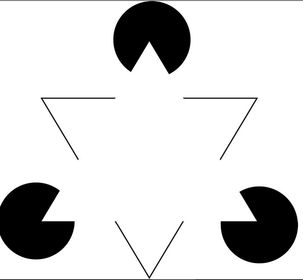
| What is amodal completion? And why does the brain do this? Explain using Kanzisa shapes. | Amodal completion refers to the grouping of fragments even if some or all are partially hidden. This is because our brain likes to construct meaning in the simplest and most logical way possible. For example, the brain will perceive a triangle to be in the centre, when there isn't one. The brain constructs, what it knows. |
| Little is actually known about form recognition. What is the most famous theory? | Biederman founded the "Recognition by Components" theory to explain form recognition. He postulated that all objects were comprised of a number of shapes which he alphabetised as '36 geons'. |
| What is the superiority effect? In what circumstances does it fail? | The superiority effect states that global percepts are attended to before local percepts. The effect however is not observed in lateralisation. |
| Humans have an inherent organised approach to the world. Gestalt proposed 7 organising principles, termed the Gestalt Laws. What are they? | 1. Proximity 2. Similarity 3. Figure ground separation 4. Closure 5. Good continuation 6. Symmetry 7. Common fate |
Want to create your own Flashcards for free with GoConqr? Learn more.