
Flashcards
Macroeconomics year 1
Cards in this deck (162)
- 1What is macroeconomics?How the economy as a whole works at aggregate level. e.g. why do the prices of all goods and services increase?
- 2What is a policy objective?Target/goal that policy makers ain to 'hit' or achieve.
- 3What are the 4 policy objectives?1. sustainable economic growth
2. Minimising unemployment
3. Controlled inflation (price stability)
4. Stable balance of payments - 4What is short run growth?growth of real output resulting from using up idle resources in an economy, including labour, thereby taking up the slack in an economy.
- 5What is long-run growth?Increase in the potential level of real output- leading to outward shift of PPF.
- 6Short term vs long term?In order to achieve sustainable growth, long run growth is better as you're increasing the capacity whereas short run, you may be still growing however you have a limit as to how much you can grow to.
- 7What is full employment?According to Beveridge's definition, full employment means 3% or less of the labour force is unemployed.
According to Free-market, it is the level of employment occurring at market-clearing real-wage rate, where the no. of workers whom employers wish to hire=no. of workers wanting to work - 8Why is minimising employment important?-increased wealth and standard of living
-Higher tax revenue
-lower government expenditure on benefits - 9What is inflation?persistent/continuing rise in average prices. Extreme inflation= hyperinflation e.g. Zimbabwe or Germany back in day. Target for UK is 2%.
- 10What is deflation?Persistent/continuing decrease in average prices
- 11What is disinflation?When the rate of inflation is falling, but still remains positive
- 12What is balance of payments?A record of all the currency flows into and out of a country in a particular time period.
- 13What are imports and exports?Imports= Goods, services produced in other countries and sold to people in the UK.
Exports= Goods, services sold to residents of other countries. - 14Hence, what does a 'stable balance of payments mean'?Where imports and exports are similar
- 15What is the biggest objective of the current government (Jan 2016)?-reducing the budget deficit, and eventually balancing it.
-more equitable distribution of income - 16Why was George Osborne recently criticized (Jan 2016)?He was criticized for cuts to government spending to reduce deficit. It had a negative impact on economic growth and the distribution of income.
- 17What is a policy conflict?Occurs when 2 policy objectives can't be achieved at the same time. Better performance in achieving one objective, the worse the performance in achieving the other. So trade-offs/ choices need to be made.
- 18What is trade-offs between policy objectives?Although it's impossible to achieve 2 conflicting objectives at the same time, it's possible to reach a compromise
- 19What are some examples of conflicting objectives?-economic growth and minimising unemployment vs controlled inflation
-Economic growth and minimising unemployment vs stable balance of payments
-economic growth vs greater income equality
-current living standards vs future living standards
-reduced budget deficit vs economic growth - 20What is the history behind the government objectives?1945-1979: full employment and increased income equality
1979-2010: controlled inflation
2009-present: recovery from recession and reducing budget deficit
*stable balance of payments hasn't been prioritised by recent governments - 21What are performance indicators?Provides information for judging success or failure of a type of government policy such as fiscal or monetary policy.
- 22How is economic growth measured?Measured using GDP- sum of all goods and services produced in the economy over a period of time
- 23What is real and nominal GDP and which is more reliable?Real GDP- macroeconomic measure of the value of economic output adjusted for price changes (i.e., inflation or deflation). This adjustment transforms the money-value measure, nominal GDP, into an index for quantity of total output
nominal- GDP measured at current market prices, without removing effects of inflation. Real is more reliable. - 24What is real GDP per capita?GDP divided by population (output per person)
- 25What is a recession?Fall in real GDP for 6 months or more
- 26how is employment measured?Claimant count- measuring unemployment according to those people on job seeker's allowance
Labour Force Survey (LFS)- quarterly sample survey of households in the UK. It provides info on the UK labour market. - 27How is price stability measured?Consumer price index (CPI)- official measurement used to calculate the rate of consumer price inflation in the UK
Retail price index (RPI)- older measure used to calculate the same thing though slightly different. CPI often lower that RPI. - 28How is balance of payments measured?via current account- compares imports and exports. Balance of trade= difference between money value of import+ exports. It is the largest component of a country's balance of payments on current account.
- 29What is a balance of trade deficit and surplus?deficit- money value of imports>money value of exports
surplus- money value of exports>money value of imports - 30What is an index number?e.g. CPI- it enables comparisons to be made. They are designed to convert complex info into a single, easily comparable series of numbers.
- 31What is the base year?Usually 100- year that all other years are compared to
- 32How do they construct CPI?-Use family expenditure survey to measure changes in prices of a basket of goods (calculated by ONS) bought by average family
-Items are weighed according to relative importance e.g. a 10% rise in petrol is given a much greater weight than 10% rise in tape - 33What are some of the limitations of CPI?-an average figure- different people experience different inflation
-Doesn't include house price (mortgage) which is a huge cost to a household
-Some people have different spending patterns - 34What is national income?The monetary value of the total output of an economy in a particular period of time.
- 35What is the nominal national income?Expressed in current prices whilst real is adjusted for inflation.
- 36What are the 3 ways of measuring national income?1. National income
2. National Output
3. National expenditure
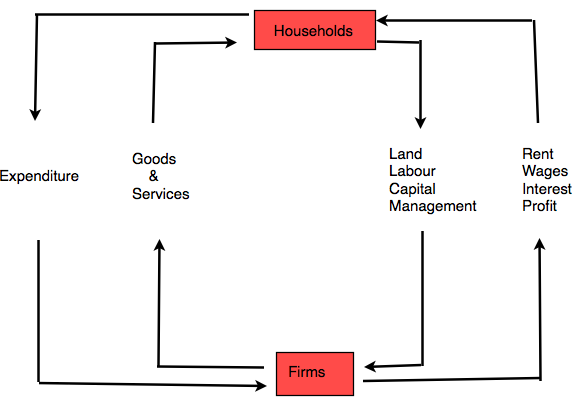
They all equal each other - 37What is the circular flow of income?
- 38Describe what is happeningHouseholds provide firms with factors of production
In return they expect the rewards or payments of the factor of production
Households use incomes to buy goods and services- consumption or expenditure
Firms produce and supply the goods and services - 39What effect does increasing savings have on economic activity and what is the effect of investment also?Increasing savings reduces economic activity as there is less buying and selling in the economy whilst investment increases economic activity
- 40Why are savings designated as a withdrawal in the circular flow of income and why is investment an injection?Savings (S) are withdrawals because households don't spend all their income on goods and services. Other withdrawals are taxes (T) and imports (M). Investment (I) is an injection because money is put in. Other injections are gov spending (G) and exports. (X)
- 41What is an injection?Spending entering the circular flow of income
- 42What is a closed and open economy?Closed- no international trade. Open is the opposite of this
- 43What happens if: withdrawals>injections withdrawals< injections withdrawals=injections1. output and income falls
2. output and income rise
3. equilibrium (income stays the same) - 44What happens if consumers and businesses are more confident about the future?Savings would decrease, investment will increase so national income would increase
- 45What is the Keynesian economic policies?Policies by John Maynard Keynes - increasing government spending to boost the economy
- 46What is macroeconomic equilibrium?when injections= withdrawals
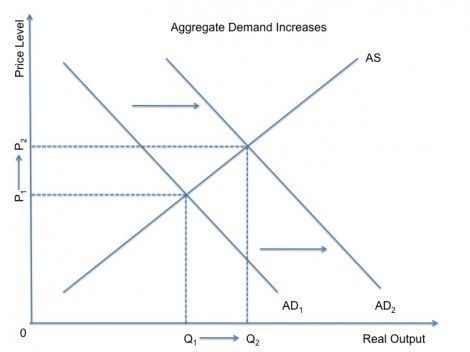
when AD=AS - 47What is aggregate demand and what is aggregate supply?AD= Total planned spending on real output produced within the economy
AS= The total value of real output that producers are prepared to supply at different average price levels - 48How can an increase in AD show reducing unemployment?
- 49What is an economic shock?A sudden, unexpected event hitting the economy and disturbing AD and/or AS. This could be from within the UK or abroad.
- 50Give an example of an economic shockSevere winter flooding, collapse in uk house prices , war in middle east or break up of Eurozone.
- 51What is the equation for calculating AD?C+I+G+(X-M)
- 52What is consumption (C)?Total planned spending by households on goods and services in an economy.
- 53What factors cause consumption to change?-Income and wealth e.g. pay, house prices
-Rate of interest, lower rates more borrowing
-Availability of credit (how easy it is to borrow, how much you can borrow)
-Future income and wealth expectations-confidence
-inflation expectations- anticipated inflation should lead to higher con now - 54What is a credit crunch?Where borrowers (both individuals and businesses) find it difficult to borrow money. It invariably leads to a bad recession. e.g 2007-2008
- 55How do they measure savings and what are the 2 types of measurement?They measure savings as a percentage of disposable income. Personal savings ratio and household savings ratio.
- 56What factors impact savings?-current level of income
-expected level of income-lower confidence more saving
-gov tax and welfare-influences income
-Interest rate- high the more savings
-Available saving schemes-trust in banks/ taxation on savings/ schemes such as ISAs - 57What do firms invest in?-capital equipment, machinery and premises (fixed capital)
-stocks of raw materials, components (inventories) - 58What factors influence investment?-business expectations (state of economy)- increased confidence=more investment
-interest rates-affect cost of borrowing
-availability of credit
-rate of technical progress (increases investment)
-Relative prices of capital and labour- low wages makes labour more attractive and machinery less so
-gov policies- taxation on profits, subsidising - 59Why do businesses invest in new machinery?-To replace old stock with a more updated version
-To meet increasing demand - 60What is the accelerator?A change in the level of investment in new capital goods is induced by a change in the rate of growth of national income or aggregate demand. Changes in national income leads to greater changes in investment.
- 61What is economic activity?Production and consumption of goods and services in an economy, and the employment of labour, capital and other inputs that produce output.
- 62What is the multiplier?The relationship between a change in aggregate demand resulting to a larger change in national income.
- 63What effect does withdrawals have on the multiplier effect?The greater the withdrawals/leakages, the less significant the multiplier effect because there is less income in the economy.
- 64How do you work out the multiplier?change in national income (y) / initial change in AD
- 65What does the impact of a change in a component of AD depend on? What do economists refer to?The size of the multiplier
Gov spending multiplier
Investment multiplier
Export multiplier - 66What does the value of the multiplier depend on?•Propensity to import
•Propensity to save
•Propensity to tax
•Amount of spare capacity
•Avoiding crowding out - 67What is the marginal propensity to consume?The fraction of an increase in disposable income that people plan to spend on domestically produced consumer goods.
It is the % of each extra pound consumed. - 68Does this vary?Poorer people tend to have a higher MPC so taxing rich and re-distributing to the poor should increase overall consumption.
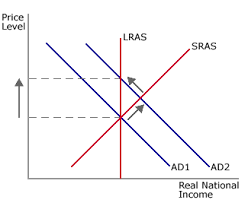
- 69What is the LRAS?The equivalent of a ppf. It illustrates the productive capacity of an economy (max level of output attained when all resources are fully utilised). Shown through a vertical line.
- 70What causes the LRAS to shift?Technology, productivity/better management, attitudes to hard work, quantity of entrepreneurs, size of labour force, mobility of factors of production, existence of economic incentives
- 71What does the SRAS show?Shows the AS when the level of capital is fixed, though the utilisation of existing factors of production can be altered so as to change the level of output. The upwards slope suggests all firms aim to maximise profits, and in the short run the cost of producing extra output units rises as firms produce more output.
- 72What is the main determinant of SRAS?Cost
- 73What are examples of widespread changes in costs for businesses?changes in wage rate, interest rates, changes in prices of imported raw materials, changes in business tax, changes in productivity, exchange rates
- 74What are supply side influences?relates to changes in potential output which is affected by available factors of production. e.g. productivity and changes in size of labour force. It shifts the position of SRAS or LRAS.
- 75What are demand side influences?Relates to impacts of changes in aggregate demand on the economy. Part of Keynesian economics. It shifts the position of AD.
- 76what is this diagram showing?A rise in AD will lead to an increase in economic growth until LRAS is reached- short term growth. Further rise in AD after LRAS is reached will not increase economic growth but would just lead to inflation. May be possible to temporarily increase output beyond capacity but to continue to do this will require long term growth.
- 77What is the trend growth rate?Rate at which output can grow, on a sustainable basis, without putting upward or downward pressure on inflation. It reflects the average annual % increase in the productive capacity of the economy. In the UK it's approximately 2.5%.
- 78What is the economic cycle/business cycle/trade cycle?Upswing and downswing in aggregate economic activity taking place over 4-12 years. It is shown on a diagram as when the GDP growth fluctuates around the trend growth.
- 79What are seasonal fluctuation?Where there is a variation of economic activity resulting from seasonal changes in the economy.
- 80—peak- contraction-trough-recovery-boom
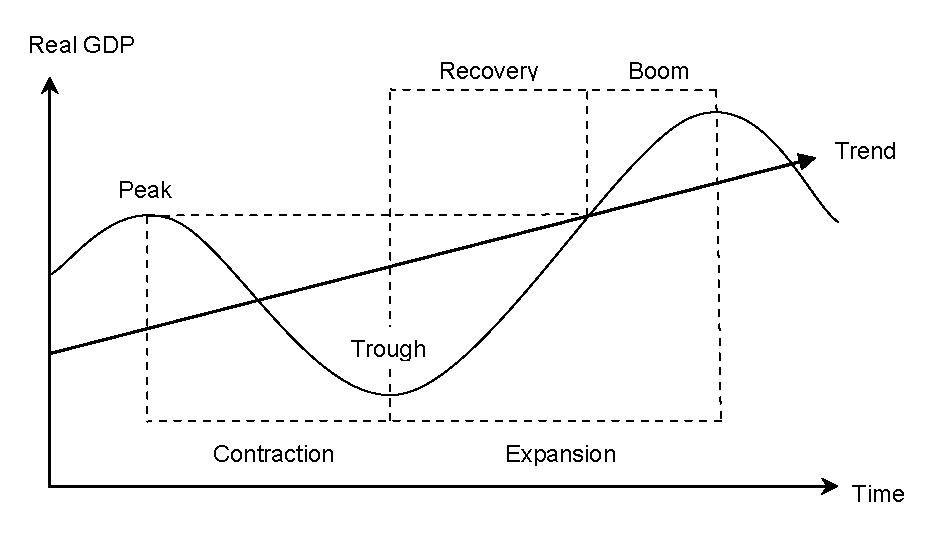
- 81What is the actual output and the trend level of output?Level of real output produced in the economy in a particular year. The trend level of output is what the economy is capable of producing when working at full capacity. Actual output differs from the trend level of output when there are output gaps.
- 82What is economic recovery?When short-run economic growth takes place after a recession. It gives way for the 'BOOM' phase. This is where the level of real output becomes greater than the trend level of output.
- 83What is economic performance?Success or failure in achieving economic policy objectives.
- 84What is an upswing and downswing?Upswing=increase in economic activity (growth)
downswing= decrease - 85What is a -ve and +ve output gap?A positive output gap is when the level of actual real output is greater than the trend level. vice versa.
- 86What is seasonal unemployment?Unemployment arising in different seasons of the year caused by factors such as the weather. e.g. seaside resorts, end of the Christmas period. Common in tourism, agriculture and construction.
- 87What is cyclical unemployment/ demand-deficit unemployment/ Keynesian unemployment?Unemployment caused by a lack of aggregate demand in the economy. Occurs when the government goes into a recession or depression (where there is a negative output gap).
- 88What can the government do about this?Raise AD by lowering interest rates, increasing government spending, reduce taxes etc. Encouraging investment and exports will create growth and jobs.
- 89What is frictional/transitional/search unemployment?Unemployment that is usually short term and occurs when a worker switches between jobs. Workers may leave job and is a 'time lag' before they find new positions. May be due to geographical or occupational immobility of labour.
- 90What is geographical immobility of labour caused by?family ties, local friendships discouraging from moving to other parts of the country, ignorance about whether job vacancies exist in other parts of the country, cost of moving and difficulties of obtaining housing.
- 91What is occupational immobility of labour caused by?difficulties in training for jobs that require different skills, race discrimination, restrictive practices- certain requirements.
- 92What is structural unemployment?Long term unemployment occurring when some industries are declining, even though other industries are growing. Also occurs within a growing industry if automation reduces demand for labour. Also associated with occupational and geographical immobility of labour. e.g. steel workers
- 93What is deindustrialisation?The decline of manufacturing industries, together coal mining.
- 94What can the government do to minimise frictional unemployment?increasing efficiency of job search process (making it easier to locate job vacancies), improve occupational and geographical mobility, tightening benefit rules to pressurise unemployed into finding and accepting work. e.g. unemployment benefit to jobseeker's allowance.
- 95What can the government do to minimise structural unemployment?-occupational re-training
-Regional financial assistance e.g. Nissan to Sunderland
-Relocation assistance for individuals - 96What causes inflation?1. Rising demand in comparison to supply (Demand pull)
2. Rising costs (cost push inflation) - 97What is demand-pull inflation?A rice in price level caused by an increase in aggregate demand- also known as demand inflation
- 98What is cost push inflation?A rise in price level cause by an increase in costs of production- also known as cost inflation. Causes the SRAS to shift to the left.
- 99Outline a situation that demonstrated cost-push inflation1970s UK:
-wages rose faster than productivity, companies saw a rise in cost per unit so they raised their prices. As a result the cost of living rose so workers sought higher wages- wage price spiral - 100What are the main causes of cost push inflation?-widespread increases in wages and salaries not matched by rises in labour productivity- wage cost inflation
-Increase in cost of raw materials
-Increase in indirect tax- VAT (Jan 2011)
-Depreciation in level of currency (more expensive imports). - 101What factors cause the average wages to fall?-increased migration-increase supply of labour-price of labour (wages) decrease
-Fall in AD
Productivity not increasing - 102In terms of global commodity prices and inflation, what is the status of the economy?-In the UK average wages haven't risen significantly so it has little impact on inflation. The biggest influence is import-cost inflation- prices of raw materials, energy and food rising.
- 103What are deflationary policies?Designed to reduce AD "deflate the economy" and are unlikely to result in deflation. They may do this in a negative output gap if demand-pull inflation is getting too high (out of control).
- 104Why is international trade good for consumers and businesses?-allows consumers to access a wider range of products
-Allows businesses access to resources to produce a wider range of products
-allows businesses to produce and sell more and thus benefit from economies of scale- e.g. risk bearing
-allows consumers to pay lower prices for products.
End result= higher living standards and economic welfare - 105What are the four parts of the current account?-trade in goods
-trade in services
-transfers
-investment income - 106What are imports and exports monetary wise?An import is a flow of money out of the country whereas an export is a flow of money into the country
- 107What is a current account deficit?Occurs when currency outflows exceed currency inflows. Imports more than exports. e.g. Italy, UK, USA
- 108What is a current account surplus?Occurs when the currency inflows are greater than the currency outflows. Exports greater than imports. e.g. Nigeria, Germany
- 109what is the balance of trade in goods?part of the current account measuring payments for exports and imports of goods. It measures the extent to which imports exceed exports or vice versa.
- 110what is the balance of trade in services?part of the current account and is the difference between the payments for the exports of services and the payments for the imports of services
- 111what is net investment income?it is the main components of primary income flows In the current accounts of the balance of payments. it is the earnings from investments overseas. for example interest on loans made by UK banks to foreign companies, dividends received by UK investors buying foreign shares, profits returned from UK companies branched overseas like Tesco HSBC.
- 112what are transfers?they are payments flowing between countries, it can be between individuals or government transfers
- 113who does the government give money to?other countries in the form of aid, the EU, World Bank, IMF,WTO, foreign embassies and consulates, troops abroad
- 114what effect would a current account deficit or surplus have on the economy?a deficit would mean that aggregate demand will fall because imports are greater than exports. This results in lower economic growth and less employment. A surplus will have the opposite effect.
- 115What factors influence the current account?Productivity - rise in productivity means lower costs-lower prices and increased competitiveness.
Inflation- more internationally competitive
Exchange rate- impact on the comparative price of the UK products and services
Economic activity abroad- rising foreign economic growth should increase the demand for UK exports. - 116In a positive output gap, what would be the status of the indicators?economic growth rises-good
unemployment falls-good
inflation rises-bad
current account deficit rises-bad - 117How about in a negative output gap?economic growth falls-bad
unemployment rises-bad
inflation falls-good
current account deficit decreases-good - 118How often would the government change their policy objectives?Usually, in a run-up to the election- economic growth and lower unemployment is usually popular. After the election they may decide to choose controlling inflation. e.g. what Margaret Thatcher did.
- 119What affect does higher interest rates have on consumption?Reduces household consumption
-it encourages savings
-the cost of existing borrowing and new borrowing increases e.g. mortgage and credit
-consumers have less to spend and are less likely to buy on credit.
asset prices may fall e.g. houses and shares and a reduction of confidence and thus spending - 120What affect does higher interest rates have on business investment?reduces business investment
-borrowing to invest becomes more expensive and thus less profitable. Many businesses finance new capital goods through borrowing. Business confidence in future demand would fall. - 121What affect does higher interest rates have on the exchange rate?Strengthens the exchange rate
-higher interest rates attract inflows of capital from abroad ('hot money'). This increases the demand for the currency which strengthens it. Stronger exchange rate may reduce exports and increase imports- lower AD. - 122What are policy instruments?Tools used to try to achieve a policy objective
- 123What is the monetary policy?Controlling the macroeconomy through changes in monetary instruments such as interest rates, money supply and exchange rates.
- 124What is the Bank of England?The central bank in the UK that is in charge of the monetary policy
- 125What is the monetary policy objective and what instrument is used?The objective is to control inflation and the instrument used are interest rates.
- 126How does the bank of England control the monetary policy?There are many different interest rates in the economy. They adjust the base rate (rate of interest they charge on commercial banks on their deposits- 0.5%). The high street banks then adjust their interest rates by a similar amount.
- 127What is expansionary monetary policy?Uses lower interest rates to increase AD. Most likely to be pursued at times of lower AD and inflation (-ve output gap).
- 128What is contractionary monetary policy?Uses higher interest rates to decrease AD.
- 129What is the exchange rate?The price of a currency e.g. the pound, measured in terms of another currency such as the dollar.
- 130What is quantitative easing briefly?Increase in the money supply, bank purchases assets like gov bonds.
- 131What is the fiscal policy?Involves the use of taxation, government spending and the budget balance to achieve the government's policy objectives.
- 132How is a budget deficit expansionary?Since gov spending is greater than taxation- injection is greater than withdrawal.
- 133What 3 main aspects of microeconomic policy can be achieved through government spending and taxation?1. correct a market failure
2. to redistribute income and wealth from the rich to the poor
3. to support specific regions or industries which need financial support - 134What are expansionary and contractionary fiscal policy?expansionary- increasing AD through increasing government spending relative to tax revenue. A gov may deliberately run a budget deficit to increase AD. e.g. Obama in 2009 and Chinese gov in April 2014
Contractionary- reducing AD through decreasing government spending relative to tax revenue - 135What are supply side fiscal policies?Used to increase the economy's ability to produce and supply goods e.g. spending on infrastructure or financial support for investment or retraining schemes for unemployed workers. It allows the economy to grow without any inflation.
- 136What does this depend upon?In order for this to work, there must be a high enough AD level.
- 137What are some supply-side objectives?-improve incentives to look for work and invest in people's skills
-increase labour and capital productivity
-increase occupational and geographical immobility of labour to reduce the unemployment rate
-increase investment and research and development spending
-sustainable non-inflationary growth - 138What are the main UK taxes?1. Income tax
2. VAT
3. National insurance
4. Excise duties (alcohol, cigarettes, petrol)
5. Corporation tax
6. Business rates
7. Council tax - 139What are the main reasons for taxation?1. Allocation- tax on demerit goods to discourage consumption- 'polluter must pay' principle- taxes used to discourage and reduce the production and consumption of negative externalities.
2. Distribution- to solve inequity- e.g. taxing to the richer- progressive tax - 140What is direct tax?Levied directly on income and wealth and firms. It cannot be shifted by the person legally liable to pay the tax onto someone else e.g. income, corporation, inheritance tax.
- 141What is indirect tax?Levied on spending. It can be shifted by the person legally liable to pay the tax onto someone else e.g. VAT, alcohol, petrol.
- 142what are the main areas of government spending?Social protection (welfare and pensions_, health, education, debt investment, defence, public order and safety, social services
- 143What is a progressive tax?As income rises, a greater proportion of income is taken in tax. Can favour poorer people as the government could use this to redistribute wealth. e.g. income tax and usually inheritance tax
- 144What is a regressive tax?When the proportion if income paid in tax falls as income increases. e.g. cigarettes, petrol duties
- 145What is a proportional tax?When the proportion of income paid in tax stays the same as income increases.
- 146What is the difference between a budget deficit and national debt?Budget deficit is the flow of public sector borrowing (how much G>T in a year). The budget deficit adds to the national debt which is the stock of accumulated debt that has built up over the years.
- 147Why are they so bad?-borrowing has to be paid back in the future with interest (an opportunity cost).
-In theory the larger the debt the greater the risk lenders face and this may lead to higher future borrowing costs. - 148What are supply side policies?Deliberate government action to improve national economic performance by increasing the capacity of the economy. This usually leads to a supply side improvement.
- 149What are supply side improvements?Changes taken by private sector firms to become more efficient and competitive e.g. increased investment and innovation.
- 150Are supply side policies popular?They are popular with free market economists as they often involve the government getting out of the way (not intervening) and thus making it easier for markets to operate. An example of supply side policies is privatisation of Royal Mail, shale gas tax cuts and national infrastructure plan
- 151What is the relationship between microeconomic policies and the macroeconomy?Microeconomic policies are designed to make markets and industries operate more efficiently. If this is successful these policies will have a macroeconomic effect.
- 152What are the 2 broad approaches of supply side policies?-Policies focussing on the labour market
-Policies focussing on product markets - 153What is labour market supply side policies?Aimed at improving the quantity and quality of labour in the economy. This involves lowering income tax, raising threshold where you start paying tax should incentivise people to work. Welfare reforms - lowering welfare levels and tightening up on the eligibility for benefits such as jobseekers- increase quantity of labour.
- 154How can labour increase the capacity of our economy and our international competitiveness?If they are more skilled, flexible and mobile- more productive and innovative.
- 155What is product market supply side policies?aka industrial policies. Designed to improve competition, efficiency, and productivity. Examples of this are privatisation, deregulation, marketization (commercialisation), internal markets
- 156What does privatisation mean?The sale or transfer of assets such as nationalised industries from the public sector to the private sector e.g. Royal mail.
- 157What does deregulation mean?The removal of regulations/restrictions to promote competition in a market e.g. loosening of planning permission regulations
- 158What is marketization?Shifting of economic activity from the sate sector to the private sector e.g. school catering
- 159What are internal markets?Have been created in education and healthcare where hospitals and schools are funded according to the number of patients and pupils they attract.
- 160What are some other examples of industrial policies?-toughening up of competition policy to prevent monopoly market failure (CMA)
-encouraging free international trade increases competition, and lowers prices for consumers
-encouraging entrepreneurship and capital spending. These should all increase competition, productivity and efficiency. - 161What is the impact of supply side policies?They increase the capacity of the economy. They can also increase productivity and efficiency. They can increase the underlying trend rate of growth of the economy. This allows AD to increase in the long term without creating demand pull inflation. They can also decrease business costs and increase international competitiveness and thus improve the current account of the balance of payments. This all should create jobs and reduce unemployment.
- 162What are supply side policies most needed for?Continued and long-term economic growth. However, on their own it isn't enough; they need to be accompanied by rise in AD. They can take a long time to work. This may be resisted by various stakeholders e.g. unions
Information
- Description
- A Levels Economics Flashcards on Macroeconomics year 1, created by Nkolika Ezepue on 10/01/2016.
- Created by
- Nkolika Ezepue
- Views
- 456
- Rating