
Mind map
Waves - Physics
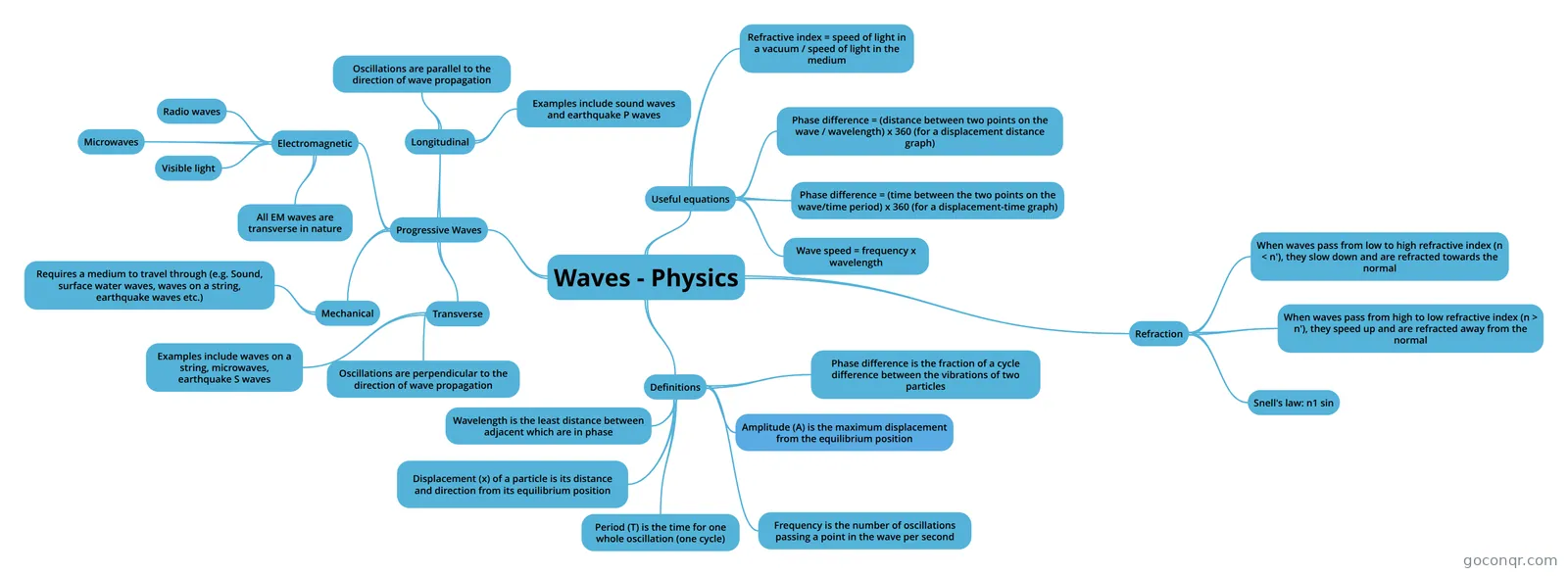
Mind map: waves physics
Map content
Waves - Physics
Progressive Waves
- Mechanical
- Requires a medium to travel through (e.g. Sound, surface water waves, waves on a string, earthquake waves etc.)
- Electromagnetic
- Radio waves
- All EM waves are transverse in nature
- Visible light
- Microwaves
- Transverse
- Oscillations are perpendicular to the direction of wave propagation
- Examples include waves on a string, microwaves, earthquake S waves
- Longitudinal
- Oscillations are parallel to the direction of wave propagation
- Examples include sound waves and earthquake P waves
- Mechanical
Definitions
- Displacement (x) of a particle is its distance and direction from its equilibrium position
- Amplitude (A) is the maximum displacement from the equilibrium position
- Frequency is the number of oscillations passing a point in the wave per second
- Period (T) is the time for one whole oscillation (one cycle)
- Phase difference is the fraction of a cycle difference between the vibrations of two particles
- Wavelength is the least distance between adjacent which are in phase
Useful equations
- Phase difference = (distance between two points on the wave / wavelength) x 360 (for a displacement distance graph)
- Phase difference = (time between the two points on the wave/time period) x 360 (for a displacement-time graph)
- Wave speed = frequency x wavelength
- Refractive index = speed of light in a vacuum / speed of light in the medium
Refraction
- When waves pass from low to high refractive index (n < n'), they slow down and are refracted towards the normal
- When waves pass from high to low refractive index (n > n'), they speed up and are refracted away from the normal
- Snell's law: n1 sin
Information
- Description
- Year 11 Physics Mind Map on Waves - Physics, created by Tyler Lowe on 09/02/2019.
- Created by
- Tyler Lowe
- Views
- 253
- Tags
- Rating