
Mind map
Cell Transportation
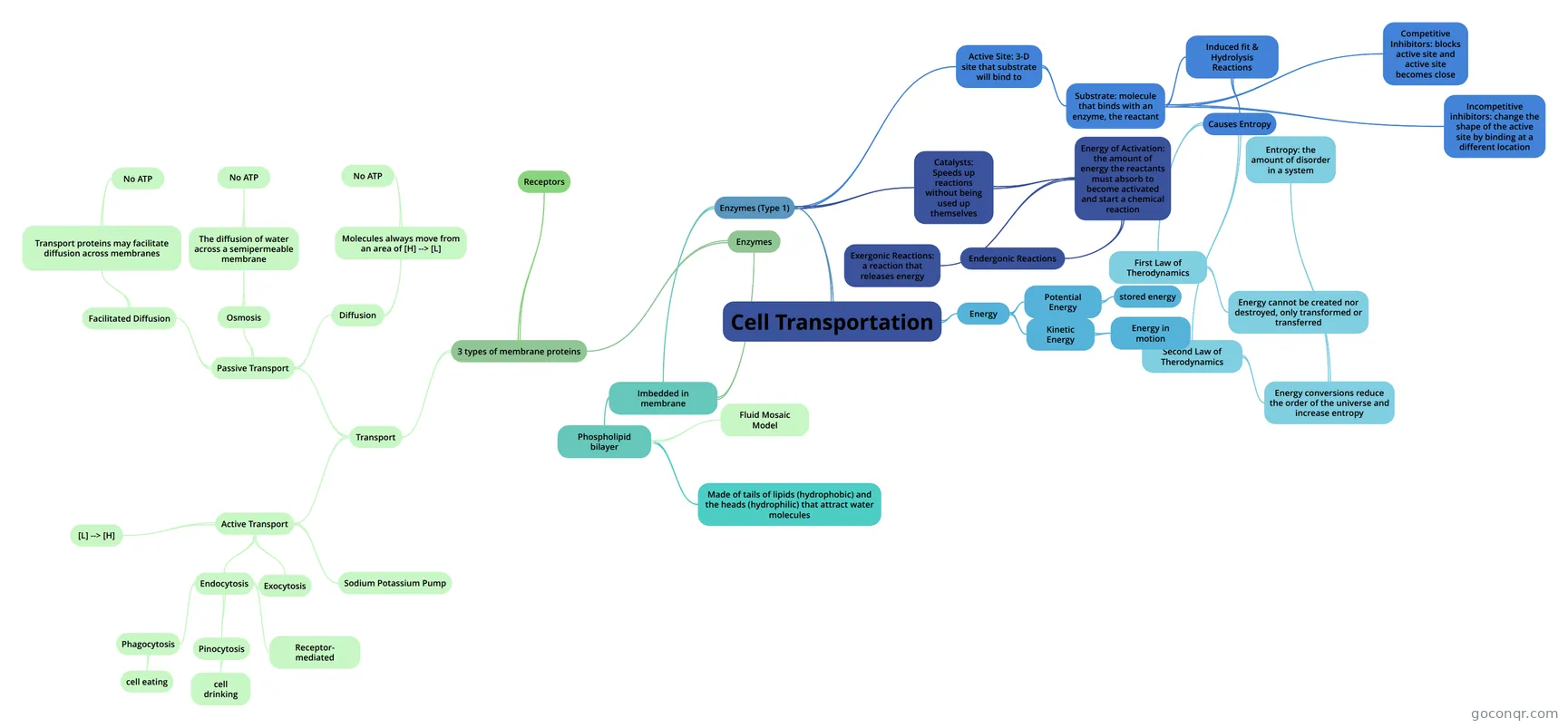
Mind map: Cell transportation
Map content
Cell Transportation
Enzymes (Type 1)
- Catalysts: Speeds up reactions without being used up themselves
- Energy of Activation: the amount of energy the reactants must absorb to become activated and start a chemical reaction
- Endergonic Reactions
- Exergonic Reactions: a reaction that releases energy
- Energy of Activation: the amount of energy the reactants must absorb to become activated and start a chemical reaction
- Active Site: 3-D site that substrate will bind to
- Substrate: molecule that binds with an enzyme, the reactant
- Induced fit & Hydrolysis Reactions
- Causes Entropy
- First Law of Therodynamics
- Energy cannot be created nor destroyed, only transformed or transferred
- Second Law of Therodynamics
- Energy conversions reduce the order of the universe and increase entropy
- Entropy: the amount of disorder in a system
- Energy conversions reduce the order of the universe and increase entropy
- First Law of Therodynamics
- Causes Entropy
- Competitive Inhibitors: blocks active site and active site becomes close
- Incompetitive inhibitors: change the shape of the active site by binding at a different location
- Induced fit & Hydrolysis Reactions
- Substrate: molecule that binds with an enzyme, the reactant
- Imbedded in membrane
- Phospholipid bilayer
- Fluid Mosaic Model
- Made of tails of lipids (hydrophobic) and the heads (hydrophilic) that attract water molecules
- Enzymes
- 3 types of membrane proteins
- Receptors
- Transport
- Passive Transport
- Diffusion
- Molecules always move from an area of [H] --> [L]
- No ATP
- Molecules always move from an area of [H] --> [L]
- Osmosis
- The diffusion of water across a semipermeable membrane
- No ATP
- The diffusion of water across a semipermeable membrane
- Facilitated Diffusion
- Transport proteins may facilitate diffusion across membranes
- No ATP
- Transport proteins may facilitate diffusion across membranes
- Diffusion
- Active Transport
- Endocytosis
- Phagocytosis
- cell eating
- Pinocytosis
- cell drinking
- Receptor- mediated
- Phagocytosis
- Exocytosis
- [L] --> [H]
- Sodium Potassium Pump
- Endocytosis
- Passive Transport
- 3 types of membrane proteins
- Phospholipid bilayer
- Catalysts: Speeds up reactions without being used up themselves
Energy
- Potential Energy
- stored energy
- Kinetic Energy
- Energy in motion
- Potential Energy
Information
- Description
- Mind Map on Cell Transportation, created by od008 on 10/02/2015.
- Created by
- od008
- Views
- 45
- Tags
- Rating