
Mind map
Long-term responses to Earthquakes
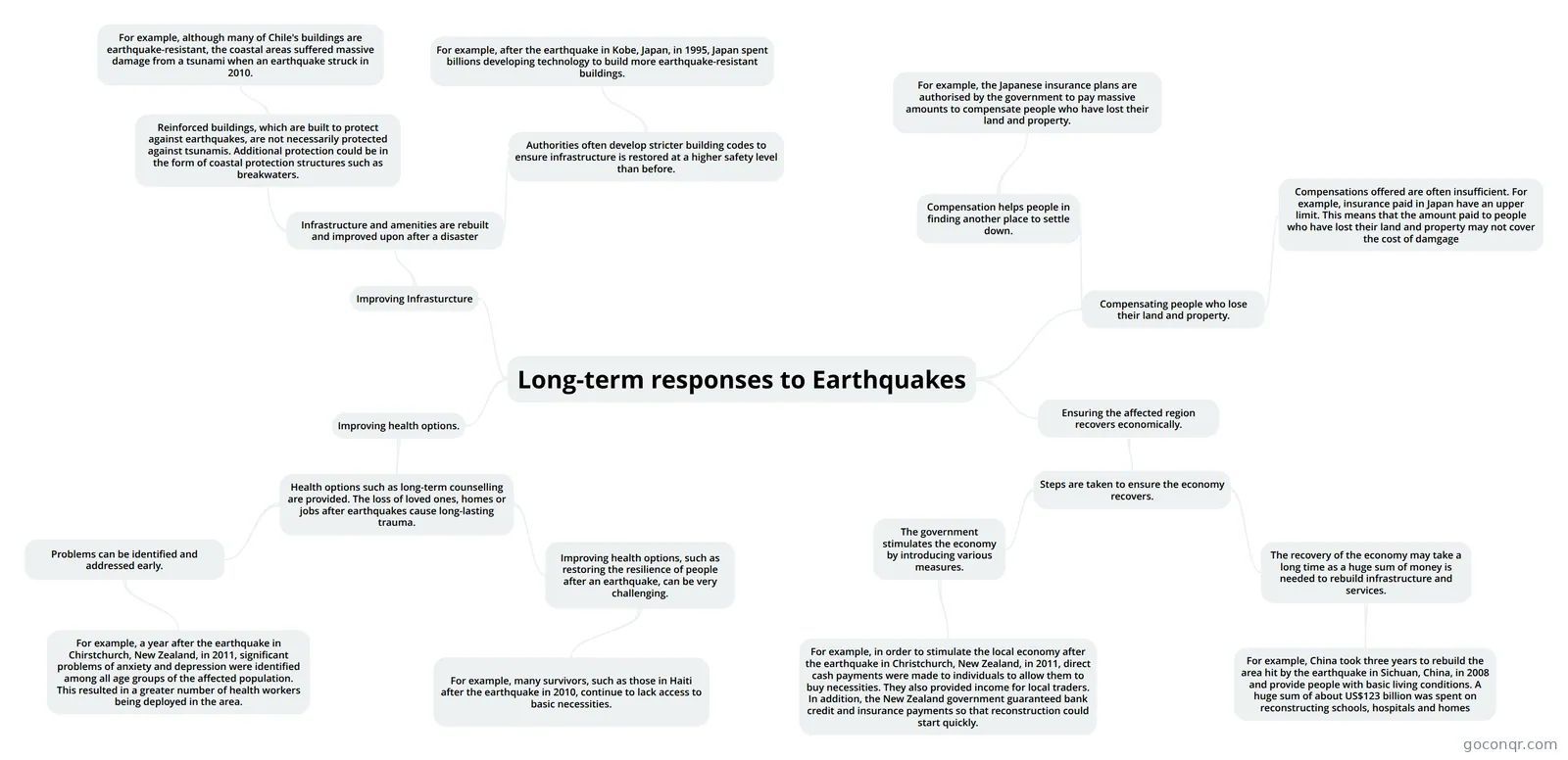
Mind map: long-term responses to earthquakes
Map content
Long-term responses to Earthquakes
Improving Infrasturcture
- Infrastructure and amenities are rebuilt and improved upon after a disaster
- Authorities often develop stricter building codes to ensure infrastructure is restored at a higher safety level than before.
- For example, after the earthquake in Kobe, Japan, in 1995, Japan spent billions developing technology to build more earthquake-resistant buildings.
- Reinforced buildings, which are built to protect against earthquakes, are not necessarily protected against tsunamis. Additional protection could be in the form of coastal protection structures such as breakwaters.
- For example, although many of Chile's buildings are earthquake-resistant, the coastal areas suffered massive damage from a tsunami when an earthquake struck in 2010.
- Authorities often develop stricter building codes to ensure infrastructure is restored at a higher safety level than before.
- Infrastructure and amenities are rebuilt and improved upon after a disaster
Compensating people who lose their land and property.
- Compensation helps people in finding another place to settle down.
- For example, the Japanese insurance plans are authorised by the government to pay massive amounts to compensate people who have lost their land and property.
- Compensations offered are often insufficient. For example, insurance paid in Japan have an upper limit. This means that the amount paid to people who have lost their land and property may not cover the cost of damgage
- Compensation helps people in finding another place to settle down.
Ensuring the affected region recovers economically.
- Steps are taken to ensure the economy recovers.
- The government stimulates the economy by introducing various measures.
- For example, in order to stimulate the local economy after the earthquake in Christchurch, New Zealand, in 2011, direct cash payments were made to individuals to allow them to buy necessities. They also provided income for local traders. In addition, the New Zealand government guaranteed bank credit and insurance payments so that reconstruction could start quickly.
- The recovery of the economy may take a long time as a huge sum of money is needed to rebuild infrastructure and services.
- For example, China took three years to rebuild the area hit by the earthquake in Sichuan, China, in 2008 and provide people with basic living conditions. A huge sum of about US$123 billion was spent on reconstructing schools, hospitals and homes
- The government stimulates the economy by introducing various measures.
- Steps are taken to ensure the economy recovers.
Improving health options.
- Health options such as long-term counselling are provided. The loss of loved ones, homes or jobs after earthquakes cause long-lasting trauma.
- Problems can be identified and addressed early.
- For example, a year after the earthquake in Chirstchurch, New Zealand, in 2011, significant problems of anxiety and depression were identified among all age groups of the affected population. This resulted in a greater number of health workers being deployed in the area.
- Improving health options, such as restoring the resilience of people after an earthquake, can be very challenging.
- For example, many survivors, such as those in Haiti after the earthquake in 2010, continue to lack access to basic necessities.
- Problems can be identified and addressed early.
- Health options such as long-term counselling are provided. The loss of loved ones, homes or jobs after earthquakes cause long-lasting trauma.