
Mind map
STANDARD SECURITIES
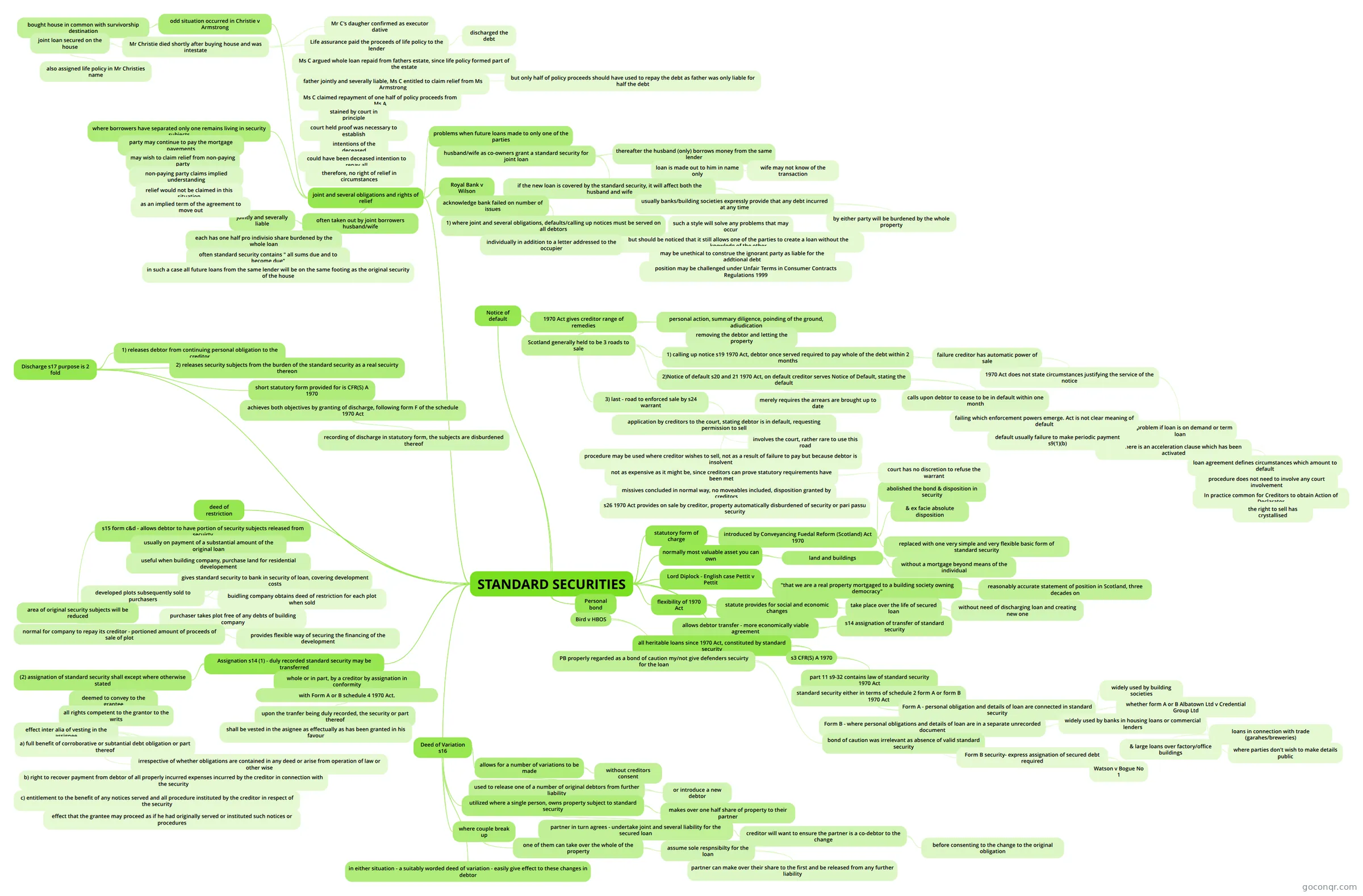
Mind map: standard securities
Map content
STANDARD SECURITIES
statutory form of charge
- introduced by Conveyancing Fuedal Reform (Scotland) Act 1970
- abolished the bond & disposition in security
- & ex facie absolute disposition
- replaced with one very simple and very flexible basic form of standard security
- introduced by Conveyancing Fuedal Reform (Scotland) Act 1970
normally most valuable asset you can own
- land and buildings
- without a mortgage beyond means of the individual
- land and buildings
Lord Diplock - English case Pettit v Pettit
- "that we are a real property mortgaged to a building society owning democracy"
- reasonably accurate statement of position in Scotland, three decades on
- "that we are a real property mortgaged to a building society owning democracy"
flexibility of 1970 Act
- statute provides for social and economic changes
- take place over the life of secured loan
- without need of discharging loan and creating new one
- take place over the life of secured loan
- allows debtor transfer - more economically viable agreement
- s14 assignation of transfer of standard security
- statute provides for social and economic changes
all heritable loans since 1970 Act, constituted by standard security
- s3 CFR(S) A 1970
- part 11 s9-32 contains law of standard security 1970 Act
- standard security either in terms of schedule 2 form A or form B 1970 Act
- Form A - personal obligation and details of loan are connected in standard security
- widely used by building societies
- whether form A or B Albatown Ltd v Credential Group Ltd
- Form B - where personal obligations and details of loan are in a separate unrecorded document
- widely used by banks in housing loans or commercial lenders
- loans in connection with trade (garahes/breweries)
- & large loans over factory/office buildings
- where parties don't wish to make details public
- & large loans over factory/office buildings
- loans in connection with trade (garahes/breweries)
- Form B security- express assignation of secured debt required
- Watson v Bogue No 1
- widely used by banks in housing loans or commercial lenders
- Form A - personal obligation and details of loan are connected in standard security
- standard security either in terms of schedule 2 form A or form B 1970 Act
- part 11 s9-32 contains law of standard security 1970 Act
- s3 CFR(S) A 1970
Personal bond
- Bird v HBOS
- PB properly regarded as a bond of caution my/not give defenders secuirty for the loan
- bond of caution was irrelevant as absence of valid standard security
- PB properly regarded as a bond of caution my/not give defenders secuirty for the loan
- Bird v HBOS
Deed of Variation s16
- allows for a number of variations to be made
- without creditors consent
- used to release one of a number of original debtors from further liability
- or introduce a new debtor
- utilized where a single person, owns property subject to standard security
- makes over one half share of property to their partner
- partner in turn agrees - undertake joint and several liability for the secured loan
- creditor will want to ensure the partner is a co-debtor to the change
- before consenting to the change to the original obligation
- creditor will want to ensure the partner is a co-debtor to the change
- where couple break up
- one of them can take over the whole of the property
- assume sole respnsibilty for the loan
- partner can make over their share to the first and be released from any further liability
- assume sole respnsibilty for the loan
- one of them can take over the whole of the property
- in either situation - a suitably worded deed of variation - easily give effect to these changes in debtor
- allows for a number of variations to be made
deed of restriction
- s15 form c&d - allows debtor to have portion of security subjects released from secuirty
- usually on payment of a substantial amount of the original loan
- useful when building company, purchase land for residential developement
- gives standard security to bank in security of loan, covering development costs
- developed plots subsequently sold to purchasers
- buidling company obtains deed of restriction for each plot when sold
- purchaser takes plot free of any debts of building company
- buidling company obtains deed of restriction for each plot when sold
- useful when building company, purchase land for residential developement
- area of original security subjects will be reduced
- normal for company to repay its creditor - portioned amount of proceeds of sale of plot
- provides flexible way of securing the financing of the development
- normal for company to repay its creditor - portioned amount of proceeds of sale of plot
- usually on payment of a substantial amount of the original loan
- s15 form c&d - allows debtor to have portion of security subjects released from secuirty
Discharge s17 purpose is 2 fold
- 1) releases debtor from continuing personal obligation to the creditor
- 2) releases security subjects from the burden of the standard security as a real secuirty thereon
- short statutory form provided for is CFR(S) A 1970
- achieves both objectives by granting of discharge, following form F of the schedule 1970 Act
- recording of discharge in statutory form, the subjects are disburdened thereof
- achieves both objectives by granting of discharge, following form F of the schedule 1970 Act
Assignation s14 (1) - duly recorded standard security may be transferred
- whole or in part, by a creditor by assignation in conformity
- with Form A or B schedule 4 1970 Act.
- upon the tranfer being duly recorded, the security or part thereof
- shall be vested in the asignee as effectually as has been granted in his favour
- upon the tranfer being duly recorded, the security or part thereof
- with Form A or B schedule 4 1970 Act.
- (2) assignation of standard security shall except where otherwise stated
- deemed to convey to the grantee
- all rights competent to the grantor to the writs
- effect inter alia of vesting in the assignee
- a) full benefit of corroborative or subtantial debt obligation or part thereof
- irrespective of whether obligations are contained in any deed or arise from operation of law or other wise
- b) right to recover payment from debtor of all properly incurred expenses incurred by the creditor in connection with the security
- c) entitlement to the benefit of any notices served and all procedure instituted by the creditor in respect of the security
- effect that the grantee may proceed as if he had originally served or instituted such notices or procedures
- a) full benefit of corroborative or subtantial debt obligation or part thereof
- effect inter alia of vesting in the assignee
- all rights competent to the grantor to the writs
- deemed to convey to the grantee
- whole or in part, by a creditor by assignation in conformity
Notice of default
- 1970 Act gives creditor range of remedies
- personal action, summary diligence, poinding of the ground, adjudication
- removing the debtor and letting the property
- Scotland generally held to be 3 roads to sale
- 1) calling up notice s19 1970 Act, debtor once served required to pay whole of the debt within 2 months
- failure creditor has automatic power of sale
- 1970 Act does not state circumstances justifying the service of the notice
- No problem if loan is on demand or term loan
- where there is an acceleration clause which has been activated
- loan agreement defines circumstances which amount to default
- procedure does not need to involve any court involvement
- In practice common for Creditors to obtain Action of Declarator
- the right to sell has crystallised
- In practice common for Creditors to obtain Action of Declarator
- procedure does not need to involve any court involvement
- loan agreement defines circumstances which amount to default
- where there is an acceleration clause which has been activated
- No problem if loan is on demand or term loan
- 1970 Act does not state circumstances justifying the service of the notice
- failure creditor has automatic power of sale
- 2)Notice of default s20 and 21 1970 Act, on default creditor serves Notice of Default, stating the default
- calls upon debtor to cease to be in default within one month
- failing which enforcement powers emerge. Act is not clear meaning of default
- default usually failure to make periodic payment s9(1)(b)
- failing which enforcement powers emerge. Act is not clear meaning of default
- merely requires the arrears are brought up to date
- calls upon debtor to cease to be in default within one month
- 3) last - road to enforced sale by s24 warrant
- application by creditors to the court, stating debtor is in default, requesting permission to sell
- involves the court, rather rare to use this road
- procedure may be used where creditor wishes to sell, not as a result of failure to pay but because debtor is insolvent
- not as expensive as it might be, since creditors can prove statutory requirements have been met
- court has no discretion to refuse the warrant
- missives concluded in normal way, no moveables included, disposition granted by creditors
- s26 1970 Act provides on sale by creditor, property automatically disburdened of security or pari passu security
- not as expensive as it might be, since creditors can prove statutory requirements have been met
- application by creditors to the court, stating debtor is in default, requesting permission to sell
- 1) calling up notice s19 1970 Act, debtor once served required to pay whole of the debt within 2 months
- personal action, summary diligence, poinding of the ground, adjudication
- 1970 Act gives creditor range of remedies
joint and several obligations and rights of relief
- often taken out by joint borrowers husband/wife
- jointly and severally liable
- each has one half pro indivisio share burdened by the whole loan
- often standard security contains " all sums due and to become due"
- in such a case all future loans from the same lender will be on the same footing as the original security of the house
- often standard security contains " all sums due and to become due"
- each has one half pro indivisio share burdened by the whole loan
- jointly and severally liable
- problems when future loans made to only one of the parties
- husband/wife as co-owners grant a standard security for joint loan
- thereafter the husband (only) borrows money from the same lender
- loan is made out to him in name only
- wife may not know of the transaction
- loan is made out to him in name only
- if the new loan is covered by the standard security, it will affect both the husband and wife
- usually banks/building societies expressly provide that any debt incurred at any time
- by either party will be burdened by the whole property
- such a style will solve any problems that may occur
- but should be noticed that it still allows one of the parties to create a loan without the knowledg of the other
- may be unethical to construe the ignorant party as liable for the addtional debt
- position may be challenged under Unfair Terms in Consumer Contracts Regulations 1999
- may be unethical to construe the ignorant party as liable for the addtional debt
- but should be noticed that it still allows one of the parties to create a loan without the knowledg of the other
- usually banks/building societies expressly provide that any debt incurred at any time
- thereafter the husband (only) borrows money from the same lender
- husband/wife as co-owners grant a standard security for joint loan
- odd situation occurred in Christie v Armstrong
- bought house in common with survivorship destination
- joint loan secured on the house
- also assigned life policy in Mr Christies name
- Mr Christie died shortly after buying house and was intestate
- Mr C's daugher confirmed as executor dative
- Life assurance paid the proceeds of life policy to the lender
- discharged the debt
- Ms C argued whole loan repaid from fathers estate, since life policy formed part of the estate
- but only half of policy proceeds should have used to repay the debt as father was only liable for half the debt
- father jointly and severally liable, Ms C entitled to claim relief from Ms Armstrong
- Ms C claimed repayment of one half of policy proceeds from Ms A
- stained by court in principle
- court held proof was necessary to establish
- intentions of the deceased
- could have been deceased intention to repay all
- therefore, no right of relief in circumstances
- could have been deceased intention to repay all
- intentions of the deceased
- court held proof was necessary to establish
- stained by court in principle
- Ms C claimed repayment of one half of policy proceeds from Ms A
- joint loan secured on the house
- bought house in common with survivorship destination
- Royal Bank v Wilson
- acknowledge bank failed on number of issues
- 1) where joint and several obligations, defaults/calling up notices must be served on all debtors
- individually in addition to a letter addressed to the occupier
- 1) where joint and several obligations, defaults/calling up notices must be served on all debtors
- acknowledge bank failed on number of issues
- where borrowers have separated only one remains living in security subjects
- party may continue to pay the mortgage payements
- may wish to claim relief from non-paying party
- non-paying party claims implied understanding
- relief would not be claimed in this situation
- as an implied term of the agreement to move out
- relief would not be claimed in this situation
- non-paying party claims implied understanding
- may wish to claim relief from non-paying party
- party may continue to pay the mortgage payements
- often taken out by joint borrowers husband/wife
Information
- Description
- Mind Map on STANDARD SECURITIES, created by mary1503 on 14/04/2013.
- Created by
- mary1503
- Views
- 173
- Rating