
Mind map
AQA A Level Psychology
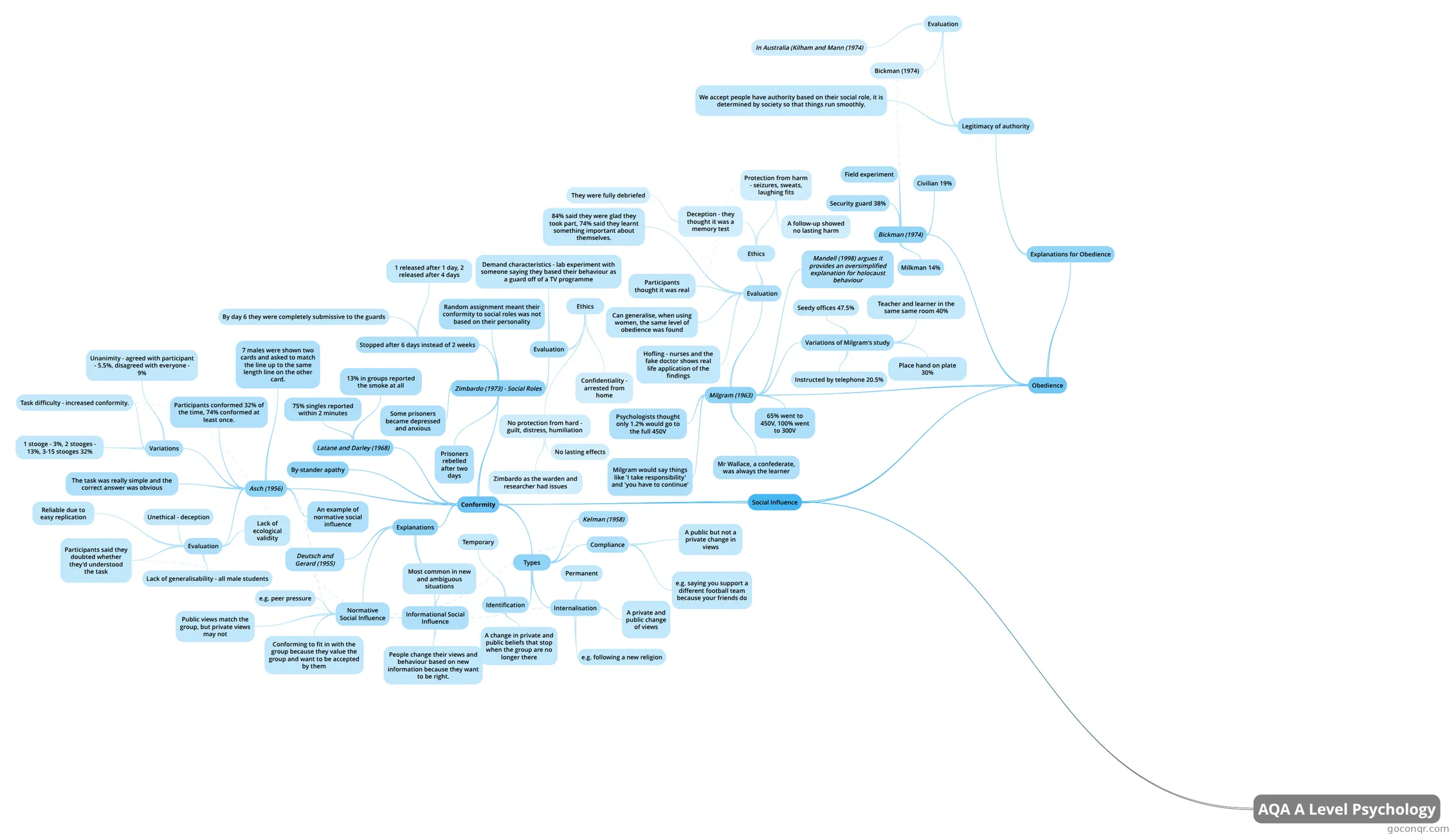
Mind map: AQA A Level Psychology social influence
Map content
AQA A Level Psychology
Social Influence
- Conformity
- Types
- Compliance
- A public but not a private change in views
- e.g. saying you support a different football team because your friends do
- Kelman (1958)
- Internalisation
- A private and public change of views
- e.g. following a new religion
- Permanent
- Identification
- Temporary
- A change in private and public beliefs that stop when the group are no longer there
- Compliance
- Explanations
- Deutsch and Gerard (1955)
- Normative Social Influence
- Conforming to fit in with the group because they value the group and want to be accepted by them
- Public views match the group, but private views may not
- e.g. peer pressure
- Informational Social Influence
- People change their views and behaviour based on new information because they want to be right.
- Most common in new and ambiguous situations
- Asch (1956)
- An example of normative social influence
- 7 males were shown two cards and asked to match the line up to the same length line on the other card.
- The task was really simple and the correct answer was obvious
- Participants conformed 32% of the time, 74% conformed at least once.
- Variations
- 1 stooge - 3%, 2 stooges - 13%, 3-15 stooges 32%
- Unanimity - agreed with participant - 5.5%, disagreed with everyone - 9%
- Task difficulty - increased conformity.
- Evaluation
- Lack of ecological validity
- Lack of generalisability - all male students
- Reliable due to easy replication
- Participants said they doubted whether they'd understood the task
- Unethical - deception
- By-stander apathy
- Latane and Darley (1968)
- 75% singles reported within 2 minutes
- 13% in groups reported the smoke at all
- Zimbardo (1973) - Social Roles
- Stopped after 6 days instead of 2 weeks
- By day 6 they were completely submissive to the guards
- 1 released after 1 day, 2 released after 4 days
- Prisoners rebelled after two days
- Some prisoners became depressed and anxious
- Random assignment meant their conformity to social roles was not based on their personality
- Evaluation
- Ethics
- No protection from hard - guilt, distress, humiliation
- No lasting effects
- Zimbardo as the warden and researcher had issues
- Confidentiality - arrested from home
- No protection from hard - guilt, distress, humiliation
- Demand characteristics - lab experiment with someone saying they based their behaviour as a guard off of a TV programme
- Ethics
- Stopped after 6 days instead of 2 weeks
- Types
- Obedience
- Milgram (1963)
- Mr Wallace, a confederate, was always the learner
- Psychologists thought only 1.2% would go to the full 450V
- 65% went to 450V, 100% went to 300V
- Milgram would say things like 'I take responsibility' and 'you have to continue'
- Evaluation
- Ethics
- Protection from harm - seizures, sweats, laughing fits
- A follow-up showed no lasting harm
- Deception - they thought it was a memory test
- They were fully debriefed
- Protection from harm - seizures, sweats, laughing fits
- Participants thought it was real
- Can generalise, when using women, the same level of obedience was found
- Hofling - nurses and the fake doctor shows real life application of the findings
- 84% said they were glad they took part, 74% said they learnt something important about themselves.
- Ethics
- Variations of Milgram's study
- Seedy offices 47.5%
- Teacher and learner in the same same room 40%
- Place hand on plate 30%
- Instructed by telephone 20.5%
- Mandell (1998) argues it provides an oversimplified explanation for holocaust behaviour
- Bickman (1974)
- Field experiment
- Security guard 38%
- Milkman 14%
- Civilian 19%
- Explanations for Obedience
- Legitimacy of authority
- We accept people have authority based on their social role, it is determined by society so that things run smoothly.
- Evaluation
- In Australia (Kilham and Mann (1974)
- Bickman (1974)
- Legitimacy of authority
- Milgram (1963)
- Conformity
Information
- Description
- A level Psychology Mind Map on AQA A Level Psychology, created by Molly Walker on 06/06/2017.
- Created by
- Molly Walker
- Views
- 487
- Tags
- Rating