
Description


|
Created by Emma Lloyd
over 7 years ago
|
|
Page 1
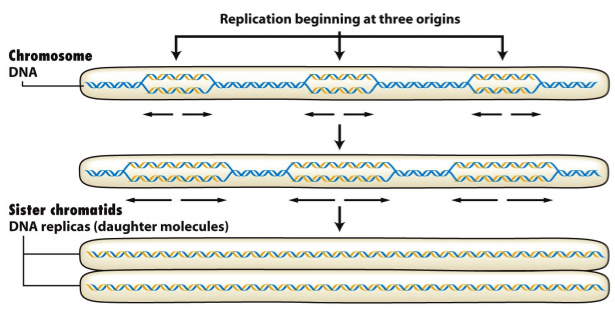
- Eukaryotic DNA polymerases are slower than those in bacteria. They synthesise DNA at 100-200 base pairs per second. Eukaryotes have several DNA polymerases like alpha, delta, etc. - Okazaki fragments are 100-200 bases in length - Eukaryotes have many origins of replication per chromosome, each generating bilateral replication forks - Linear chromosomes means there is a problem completing the lagging strand on each end of the chromosome
Page 2
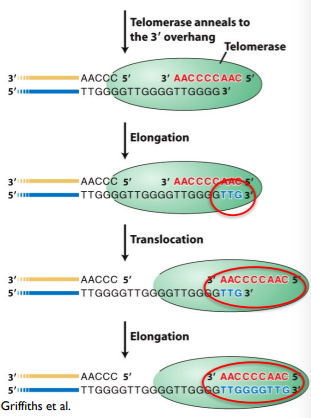
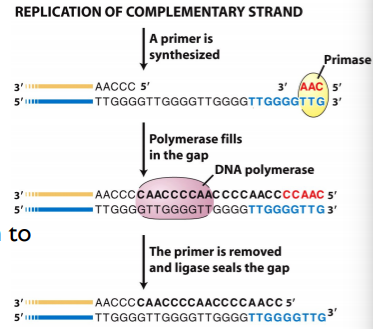
In linear DNA fragments, the 5' end becomes shortened in each daughter DNA molecule. This is because, when the primer required between Okazaki fragments is removed, the DNA polymerase cannot fill the gap. Repeated DNA replication results in a shorter DNA molecule. If this is not corrected, eukaryotes would become extinct so they have developed a mechanism to preserve the ends of chromosomes: When linear chromosomes are replicated, the internal gaps between bases are filled once the primer is degraded but not the terminal gap. There is an overhang on the 3' end as the 5' end is too short. So, on the end of the 3' strands there is an overhang which contains contain a highly repeated sequence. For example, in humans, the sequence TTAGGG is repeated in tandem 100 to over 1000 times. This repeated sequence is known as a telomere and matching DNA bases can bind to it which lengthens the short 5' end. A special RNA containing enzyme called telomerase can make additional copies of the repeated sequence on the 3' end, replacing those lost during replication. The RNA acts as a template for DNA synthesis. Telomerase is a specialised reverse transcriptase. The strand extended by telomerase acts as a template for lagging-strand synthesis. The action of telomerase and the lagging strand machinery restores the telomere length to that of before replication.
Page 3
Not all cells have telomerase activity. - Only germ cells and a few other actively dividing cells have telomerase activity. Germ cells can replicate indefinitely whilst somatic cells do not normally have telomerase activity. - At birth, telomeres are 10,000 base pairs in length. There are enough repeats to allow DNA replication during the lifetime of the organism. The number of divisions of cells in culture is inversely proportional to the 'age' of the cells. If telomeres become too short programmed cell death (apoptosis) will be triggered. Telomeres may be important in determining the life span of an organism. Telomerase activity is present in cancer cells. This allows cancer cells to divide indefinitely. Telomerase inhibitors are currently in clinical trials for treatment of certain cancers.
Page 4
DNA replication in the clinical world HIV-I encodes its own version of DNA polymerase - Reverse Transcriptase. Reverse transcriptase can use either RNA or DNA as a template. The action of reverse transcriptase is essential for the HIV-I life cycle. Like all DNA polymerases, reverse transcriptase requires a 3' OH group. Reverse transcriptase does not have 3'-5' exonuclease activity. Nucleoside analogues have been explored as HIV-I treatments. They are nucleosides that lack a 3'-OH group. Hence, when these are incorporated into a growing chain, the replication stops. Nivirapine is a nonnucleoside reverse transcriptase inhibitor, hence has been explored as HIV-I treatment. Herpres virus has also got an analogue (guanosine analogue) that inhibits the viral DNA polymerase Many chemotherapy protocols for cancer exploit drugs that effect DNA replication either directly or indirectly. Inhibitors of topisomerases have been used to inhibit topisomerase I to prevent cancer. DNA replication in a test tube has been harnessed to allow the determination of the sequence of genes and genomes (DNA sequencing), analysis of miniature quantities of DNA and rapid gene cloning.
Want to create your own Notes for free with GoConqr? Learn more.