
Notes
Biology 2.13
Content of the notes (1)
Page 1
Insects
Waterproofing over body surfaces. Rigid outer skeleton and a waterproof cuticle over it.
Small surface area to volume ratio. Minimise area water is lost.
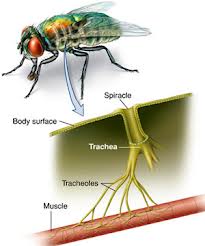
Gases move into trachea and tracheoles down concentration gradient.
Movement of muscles creates mass movement of air in and out of tracheae. This ventilation speeds up gas exchange.
Spiracles are pores on the body surface.They are opened and closed by a valve.
Fish
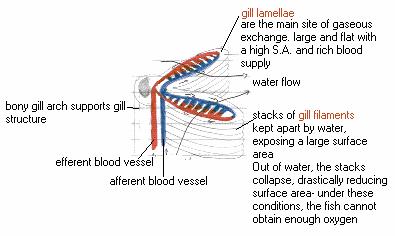
Gills made of gill filaments stacked up in a pile.
Gill filament contains many gill lamellae on it at right angles to the filament.
Water flows in the opposite direction to the blood flow (countercurrent flow).
This means that there is always a constant concentration gradient.
Leaves
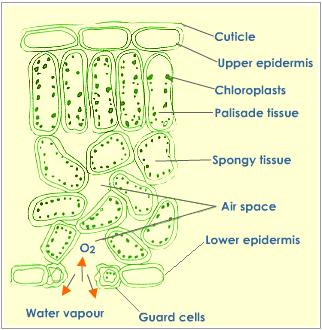
Thin,flat shape with large surface area.
Diffusion takes place in the gas phase(air) which is rapid
Many stomata (pores) in lower epidermis mostly, stomata can open and close.
Features of a transport system
A suitable medium for transport
A form of mass transport
A closed system of tubular vessels
A mechanism for moving transport medium within vessels
A mechanism to maintain mass flow movement
A means of controlling flow
Hepatic portal vein - stomach to liver
Hepatic vein - liver
Renal vein - kidney
Artery
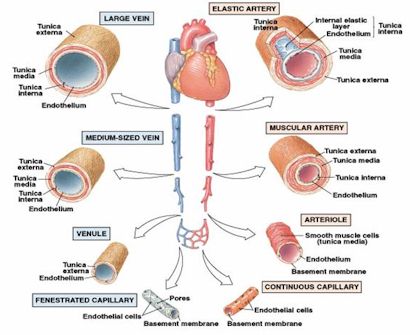
Thick muscle layer
can be constricted and dilated
Thick elastic layer
Maintain high blood pressure with recoil action
Thick wall
resists bursting with high pressure
No valves
constant high pressure
Vein
Thin muscle layer
constriction and dilation no control of blood
Thin elastic layer
pressure too low for recoil action
Thin wall
pressure too low for any bursting
Valves throughout
prevent back flow
Capillary
Only lining layer
small distance for diffusion
Numerous and branched
large surface area
Narrow diameter
no cell is far from one
Narrow lumen
red blood cells squeezed through
Spaces between endothelial cells
allow white blood cells to escape
Capillary
Tissue-fluid
-at arteriole end of capillary hydrostatic pressure is high and forces water and molecules out of capillary
-hydrostatic pressure decreases and osmotic pressure is greater , osmosis causes water to re-enter the capillary at the venule end of the capillary
-excess tissue fluid is returned to the circulatory system via the lymphatic system.
Movement of water through roots
Apoplastic pathway
When water is drawn in from roots it can travel from cell to cell via the cellulose cell walls due to its cohesive properties. Casparian strips are found in the cell walls to prevent this and force water into cytoplasm.
Symplastic pathway
Water can also move via the cytoplasm of each cell by osmosis , passing through plasmodesma to reach a new cell
Movement of water up stems
Cohesion-Tension theory
Water evaporates off leaves in transpiration.
Due to cohesion water molecules stick together and form a continuous pathway across mesophyll cells. Molecules of water are drawn up the stem due to evaporation of water - transpiration pull
Causes diameter of trunks to decrease during the day due to more tension . If air enters, water cannot be drawn up. Also water does not leak out as it is under tension.
Transpiration
Light - stomata open in the light as photosynthesis is occurring
Temperature - increases kinetic energy/speed of water molecules and the amount of water that the air can hold
Humidity - affects the water potential gradient between the air inside the leaf and outside the leaf
Air movement - reduces water potential of the air as it prevents accumulation of water around the stomata
Xerophytes
Thick cuticle
reduce water lost through cuticle
Rolled leaves
traps a region of still air
no water potential gradient
hairs on leaves
traps a region of still air around stomata
water potential gradient is reduced
Stomata in pits/grooves
traps moist air
reduce water potential gradient
reduced surface area to volume ratio
rate of water loss reduced
Gas Exchange
Circulatory system
Water in plants
Information
- Description
- A level Biology (Unit 2) Note on Biology 2.13, created by Olivia22 on 12/04/2013.
- Created by
- Olivia22
- Views
- 655
- Tags
- Rating