
Flashcards
UNIT 6.6 HALF-LIFE

Cards in this deck (10)
- 1Is it possible to determine which nuclei / atom will decay next in a radioactive sample?There are billions upon billions of atoms in even the smallest amount of a radioactive sample so the chance
that one atom will undergo decay is high.
However, it is impossible to determine which radioactive nuclei / atom will decay next because the process is random.
- 2What is radioactive half-life?The half-life of a radioactive source is the time taken for half its radioactive atoms to decay (or for the activity to halve from its original value.)
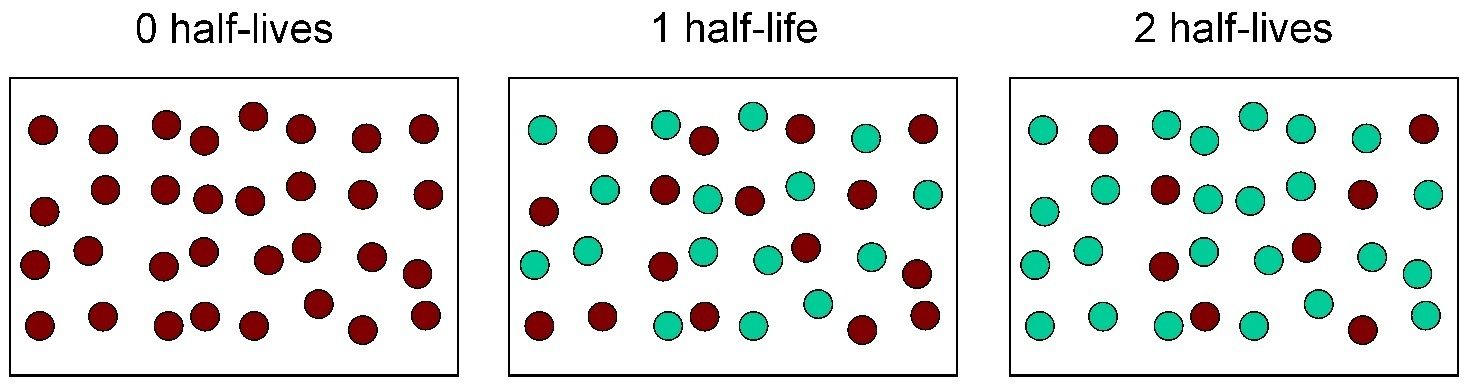
- 3A radioactive source has a half-life of 30 minutes. What percentage of the source remains after two hours?The half-life of a radioactive source is the time taken for half its radioactive atoms to decay. Therefore:
0 minutes = 100% source present
30 minutes = 50% source present
60 minutes = 25% source present
90 mins minutes = 12.5% source present
120 minutes = 6.25% source present - 4Cobalt-60 has a half life of 5 years. A sample of cobalt-60 has an activity of 2,000 Bq. What will the activity be after 15 years?The half-life of a radioactive source is the time taken for half its radioactive atoms to decay. Therefore:
At 0 years the activity = 2,000 Bq
At 5 years the activity = 1,000 Bq
At 15 years the activity = 500 Bq - 5What does the activity of a radioactive source mean?Activity is a measure of number of radioactive decays per second.
It is measured in becquerel (Bq).
1 becquerel =
1 radioactive decay per second.
The activity of a sample of radioactive material will depend on 2 things:
1. The number of radioactive / unstable atoms present.
2. The half life of the atoms.
- 6—The half-life of a radioactive source is the time taken for half its radioactive atoms to decay (or for the activity to halve from its original value.)
Starting activity = 20,000 Bq
Half of 20,000 is 10,000
Time to reach 10,000 Bq = 60 seconds
Therefore half-life = 60 seconds
- 7Use the table above to answer the following 3 questions.Use the table above to answer the following 3 questions.

- 8From the table, suggest which isotope should be used to monitor the thickness of aluminium sheet in a factory and explain why.Isotope: Strontium–90 (beta emitter).
Reason: Because fewer beta particles will pass through when the thickness of aluminium increases. The half life is fairly long so the source will last a reasonable amount of time.
- 9From the table, select which isotope should be injected as a medical tracer to monitor internal organs by using a camera outside the body.Isotope: Technetium-99 (γ – emitter).
Reason: because it’s a gamma emitter, it passes out of the body easily, causing little ionising radiation damage, when compared to alpha or beta radiation. The half life is short so it will not remain in the body for a long time.
- 10From the table, suggest which isotope is best suited for use in a smoke detector and explain why.Isotope: Americium-241 (alpha emitter).
Reason: Gamma radiation is more penetrating than alpha and beta so it would not be blocked by smoke. It has a longer half life than Polonium so the detector will keep working for a longer period of time.
Information
- Description
- This topic covers the random nature of radioactive decay and introduces the concept of half-life. Learners will plot decay curves and use them to determine the half-lives of radioactive materials. Different uses of radioactive materials will be studied, the uses being related to their half-lives and their penetrating powers.
- Created by
- Mr S Lee · Mar 2018
- Updated
- Mar 25, 2018
- Views
- 276
- Tags
- Rating