
11188175
Descrição

Quiz por Rieul Gendron, atualizado more than 1 year ago
|
|
Criado por Rieul Gendron
quase 9 anos atrás
|
|
Questão 1
Questão
The minimum control speed in air (VMCA), flaps 10, is [blank_start]64[blank_end] KIAS, while the minimum control speed on ground (VMCG), flaps 10, is [blank_start]50[blank_end] KIAS.
Responda
-
64
-
50
Questão 2
Questão
The best angle of climb speed (VX), flaps 0, is [blank_start]87[blank_end] KIAS.
The best rate of climb speed (VY), flaps 0, is [blank_start]100[blank_end] KIAS.
The best single-engine rate of climb speed (VYSE), flaps 10, is [blank_start]80[blank_end] KIAS.
Responda
-
87
-
100
-
80
Questão 3
Questão
The maximum flaps extended speed (VFE) for flaps 10 is [blank_start]103[blank_end] KIAS, whereas for greater than flaps 10, it is [blank_start]93[blank_end] KIAS.
Responda
-
103
-
93
Questão 4
Questão
State the maximum operating speed (VMO) for the following altitudes:
Sea level to 6,700 feet: [blank_start]166[blank_end] KIAS
10,000 feet: [blank_start]156[blank_end] KIAS
15,000 feet: [blank_start]141[blank_end] KIAS
20,000 feet: [blank_start]126[blank_end] KIAS
25,000 feet: [blank_start]112[blank_end] KIAS
Responda
-
166
-
156
-
141
-
126
-
112
Questão 5
Questão
The maneuvering speed (VA) between sea level and 18,000 feet is [blank_start]132[blank_end] KIAS and the gust penetration speed (VB) between sea level and 18,000 feet is [blank_start]132[blank_end] KIAS.
Responda
-
132
-
132
Questão 6
Questão
On the airspeed indicator, there is a red horizontal line. This represents the [blank_start]minimum control speed in air[blank_end].
On the airspeed indicator, there is also a blue horizontal line. This represents the [blank_start]best rate of climb speed, single engine[blank_end].
Responda
-
minimum control speed in air
-
minimum control speed on ground
-
maximum operating speed
-
maximum flaps extended speed
-
best rate of climb speed, single engine
-
best rate of climb speed, two engines
-
minimum control speed in air
-
minimum control speed on ground
Questão 7
Questão
On the airspeed indicator, the barber pole represents the [blank_start]maximum operating speed[blank_end]. On the other hand, the bottom of the red vertical tape represents the [blank_start]maximum flaps extended speed[blank_end].
Responda
-
maximum operating speed
-
stall speed in the clean configuration
-
stall speed in the landing configuration
-
maximum flaps extended speed
-
maximum flaps extended speed
-
minimum flaps extended speed
-
stall speed in the landing configuration
-
stall speed in the clean configuration
Questão 8
Questão
On the airspeed indicator, the top of the thermometer tape represents the [blank_start]stall speed in the landing configuration[blank_end].
Responda
-
stall speed in the landing configuration
-
stall speed in the clean configuration
-
landing reference speed
-
approach speed
Questão 9
Questão
Select the correct limits for the following table.
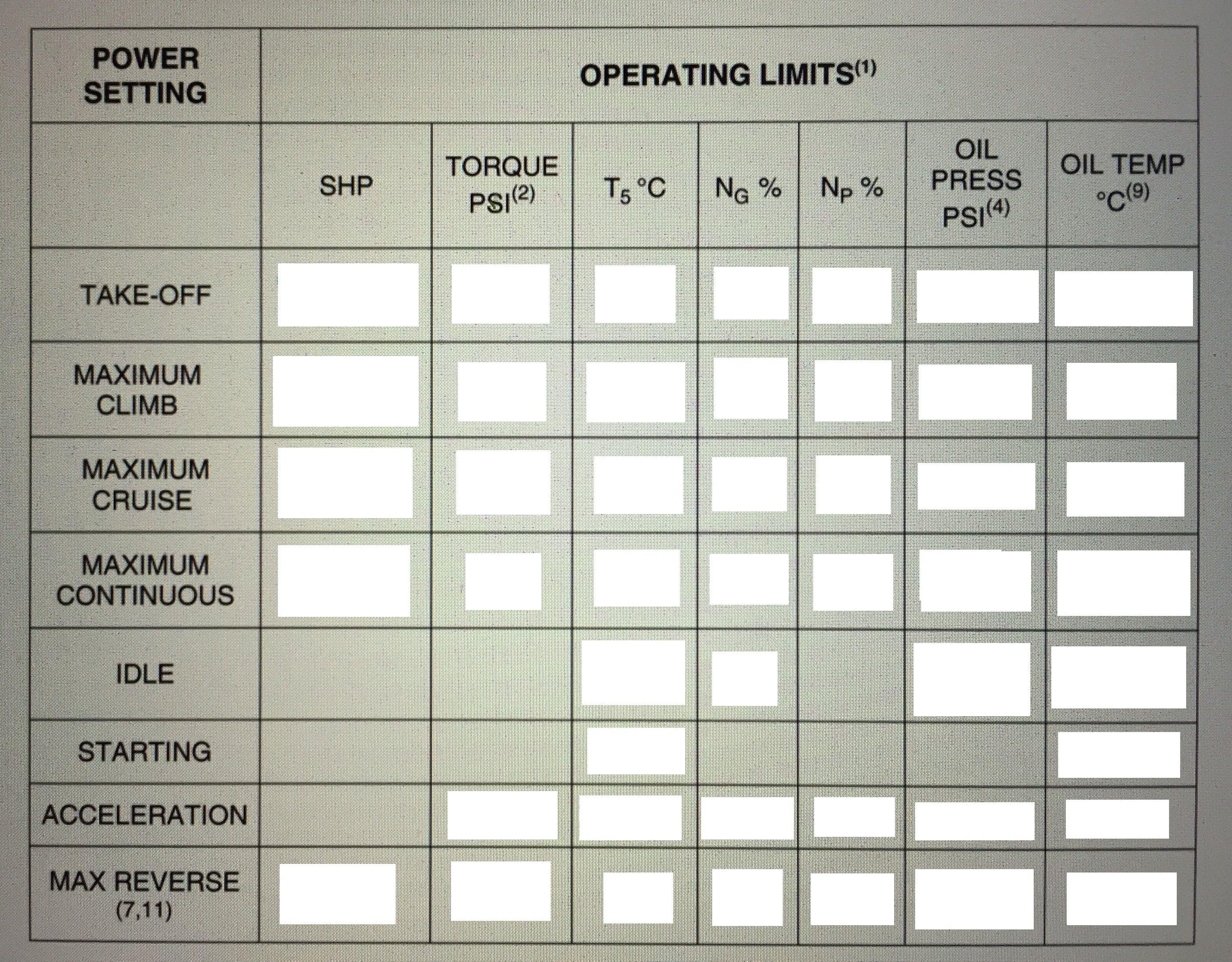
Responda
-
45
-
48.5
-
50
-
68.4
-
52
-
740
-
765
-
790
-
795
-
1090
-
685
-
740
-
765
-
790
-
1090
Questão 10
Questão
Select the correct limits for the following table.
Responda
-
660
-
685
-
740
-
765
-
101.6
-
102.6
-
91
-
110
-
91
-
96
-
110
-
101.6
Questão 11
Questão
Select the correct limits for the following table.
Responda
-
740
-
765
-
790
-
685
-
740
-
765
-
790
-
1090
-
90 to 92
-
94 to 96
-
98 to 100
Questão 12
Questão
Select the correct limits for the following table.
Responda
-
40 MIN
-
-40 to 99
-
0 to 99
-
10 to 99
-
85 to 105
-
40 MIN
-
-40 to 99
-
-40 MIN
-
0 to 40
-
-40 MIN
-
40 MIN
-
0 to 99
-
10 to 99
-
-40 to 99
-
0 to 99
-
10 to 99
-
40 to 99
-
-40 MIN
-
40 MIN
-
0 to 99
-
10 to 99
Questão 13
Questão
Unintentional, momentary pilot errors that result in torque settings between 50 and 61 PSI torque during two engine operations are harmful to the engine.
Responda
- True
- False
Questão 14
Questão
At idle, if the T5 temperature approaches the 685 degrees Celsius idle limit, either [blank_start]increase[blank_end] NG or [blank_start]reduce[blank_end] engine loads to stay below the idle temperature limit.
Responda
-
increase
-
decrease
-
reduce
-
increase
Questão 15
Questão
How long is reverse power operation limited to?
Responda
-
2 seconds
-
25 seconds
-
60 seconds
-
120 seconds
Questão 16
Questão
Select all those that apply when the following conditions are met:
Ground running of engines (except during maneuvering or taxiing) in ambient temperatures of 32 degrees Celsius and above.
Responda
-
Aircraft must be headed into wind
-
Operation in other than forward thrust must be kept to a minimum
-
Operation in other than forward thrust must not exceed one minute
-
Operation in other than forward thrust must not exceed two minutes
-
Aircraft must be headed perpendicular to wind
-
Operation of the power levers aft of the idle stop is forbidden
Questão 17
Questão
In-flight operation of the power lever aft of idle is prohibited.
Responda
- True
- False
Questão 18
Questão
Starting temperatures above [blank_start]850[blank_end] degrees Celsius are undesirable and should be reported and investigated for cause.
Responda
-
850
Questão 19
Questão
For engine start, temperatures between 980 and 1090 degrees Celsius are acceptable provided the temperature decreases to below 980 degrees Celsius within [blank_start]2[blank_end] second(s).
Responda
-
2
-
1
-
4
-
10
-
25
Questão 20
Questão
Propellers must be set to MAX RPM for every takeoff and every landing.
Responda
- True
- False
Questão 21
Questão
Propeller levers must be set to the MAX RPM position no later than [blank_start]500[blank_end] feet above [blank_start]ground level[blank_end] for visual approaches.
Propeller levers must be set to the MAX RPM position no later than [blank_start]500[blank_end] feet above [blank_start]minimum descent altitude (MDA)[blank_end] for instrument approaches.
Responda
-
500
-
1000
-
200
-
ground level
-
sea level
-
minimum descent altitude (MDA)
-
500
-
1000
-
2000
-
200
-
minimum descent altitude (MDA)
-
ground level
-
sea level
-
airfield elevation
Questão 22
Questão
In an emergency when jet fuel is not available, any grade of AVGAS may be used, but only at specific mixture ratios.
Responda
- True
- False
Questão 23
Questão
What is the maximum fuel temperature and maximum ambient temperature for takeoff when using AVGAS?
Responda
-
20 degrees Celsius
-
25 degrees Celsius
-
30 degrees Celsius
-
35 degrees Celsius
Questão 24
Questão
What is the maximum operating altitude when using AVGAS?
Responda
-
8,000 feet
-
10,000 feet
-
12,000 feet
-
15,000 feet
Questão 25
Questão
At least one boost pump per tank must be serviceable at all times when AVGAS is being used.
Responda
- True
- False
Questão 26
Questão
Text sometimes appears outboard of the torque indicators on the primary flight display during various phases of flight.
Select the correct indication for each phase by completing the table.
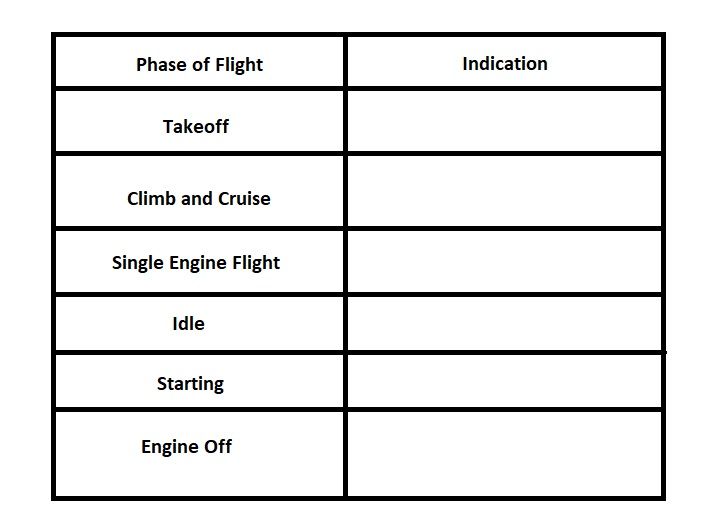
Responda
-
T/O (white)
-
T/O (green)
-
No indication is shown
-
T/O (white)
-
T/O (green)
-
No indication is shown
-
CLMB (white)
-
S/E (white)
-
S/E (green)
-
T/O (white)
-
IDL (white)
-
IDL (green)
-
No indication is shown
-
START (white)
-
START (green)
-
IDL (white)
-
IDL (green)
-
OFF (white)
-
OFF (green)
-
IDL (white)
Questão 27
Questão
If a blue colour appears on the engine parameters NP display, what is this telling the pilot?
Responda
-
The propeller operation is locked in beta range (abnormal)
-
The propeller operation is in beta range (advisory)
-
The NP value is out of the normal range for this phase of flight (abnormal)
-
The prop lever is not in the minimum governing position
Questão 28
Questão
When a generator is capacity-limited, the maximum load reading is
Responda
-
50 amps
-
100 amps
-
160 amps
-
200 amps
Questão 29
Questão
What is suggested to prolong generator life?
Responda
-
Engine RPM below 59% NG should be avoided, especially at high OAT (>15 degrees Celsius) and high current generator loads (>100 Amps).
-
Engine RPM above 55% NG should be avoided, especially at high OAT (>32 degrees Celsius) and high current generator loads (>100 Amps).
-
Engine RPM below 59% NG should be avoided, especially at high OAT (>15 degrees Celsius) and low current generator loads (<100 Amps).
-
Engine RPM below 55% NG should be avoided, especially at high OAT (>30 degrees Celsius) and high current generator loads (>200 Amps).
Questão 30
Questão
If extended engine operation at low RPM is necessary under high current loads, what is suggested be done? Select ALL possible suggested actions.
Responda
-
Shed unnecessary electrical loads
-
Switch off one generator
-
Switch off both generators
-
Feather one propeller
-
Feather both propellers
-
Set power levers to idle
Questão 31
Questão
What is meant by cross-generator starting?
Responda
-
Starting one engine while the generator of the other running engine is online and producing power.
-
Starting an engine while its generator is online.
-
Starting one engine while the generators of both engines are online.
-
Starting one engine while the generator of the other running engine is offline.
Questão 32
Questão
Cross generator starting is forbidden under all circumstances.
Responda
- True
- False
Questão 33
Questão
What action must be taken following a cross generator start?
Responda
-
The cross generator start must be recorded in the aircraft logs.
-
No action needs to be taken.
-
Switch off the generator of the engine that was initially running, and then switch it back on after 5 seconds.
-
Reduce the power on the engine that was initially running.
Questão 34
Questão
The starter duty cycle limitations are:
[blank_start]25[blank_end] second(s) ON, [blank_start]1[blank_end] minute(s) OFF, then
[blank_start]25[blank_end] second(s) ON, [blank_start]1[blank_end] minute(s) OFF, then
[blank_start]25[blank_end] second(s) ON, followed by a [blank_start]30[blank_end] minute(s) cooling period.
Responda
-
25
-
10
-
15
-
30
-
1
-
10
-
25
-
30
-
25
-
10
-
15
-
30
-
1
-
2
-
25
-
30
-
25
-
10
-
50
-
30
-
30
-
1
-
5
-
25
Questão 35
Questão
What is the maximum operating altitude of the DHC-6-400 according to the POH?
Responda
-
10,000 feet
-
15,000 feet
-
20,000 feet
-
25,000 feet
-
27,500 feet
Questão 36
Questão
Fill in the blanks using numbers only; do not use spaces or commas.
The maximum takeoff weight is [blank_start]12500[blank_end] lbs.
The maximum ramp and taxi weight is [blank_start]12600[blank_end] lbs.
The maximum landing weight is [blank_start]12300[blank_end] lbs.
The maximum zero fuel weight is [blank_start]12300[blank_end] lbs.
Responda
-
12500
-
12600
-
12300
-
12300
Questão 37
Questão
Fill in the blanks using numbers only; do not use spaces or commas.
The maximum permissible baggage compartment load for the forward baggage compartment is [blank_start]285[blank_end] lbs.
The maximum permissible baggage compartment load for the aft baggage compartment is [blank_start]500[blank_end] lbs, which includes the [blank_start]150[blank_end] lbs limit on the extension shelf.
Responda
-
285
-
500
-
150
Questão 38
Questão
The maximum permissible baggage compartment load for the lower portion of the aft baggage compartment (i.e., the area NOT on the shelf) is 350 lbs.
Responda
- True
- False
Questão 39
Questão
Fill in the blanks using numbers only; do not use spaces or commas.
The maximum permissible floor loading value for the forward and rear baggage compartments is [blank_start]100[blank_end] pounds per square foot, whereas for the cabin it is [blank_start]200[blank_end] pounds per square foot.
Responda
-
100
-
200
Questão 40
Questão
Select all that apply.
The approved flap takeoff setting(s) is/are:
Responda
-
0
-
10
-
20
-
37
Questão 41
Questão
Select all that apply.
For normal operations, the approved flap landing setting(s) is/are:
Responda
-
0
-
10
-
20
-
37
Questão 42
Questão
Choose the correct answer.
At a gross weight of 12,500 lbs and flaps RETRACTED, the flight load factors to which the DHC-6 airplane has been designed are (normal category):
Responda
-
+3.17g to -1.5g
-
+2.0g to -1.5g
-
+1.5g to -3.17g
-
+1.5g to -2.0g
Questão 43
Questão
Choose the correct answer.
At a gross weight of 12,500 lbs and flaps EXTENDED, the flight load factors to which the DHC-6 airplane has been designed are (normal category):
Responda
-
+2.0g to -1.5g
-
+3.17g to -1.5g
-
+1.5g to -3.17g
-
+3.17g to -2.0g
Questão 44
Questão
Select ALL that apply.
The Twin Otter is certified in the Normal Category.
Accordingly, the following are NOT approved:
Responda
-
Spins
-
Lazy eights
-
Chandelles
-
Turns with an angle of bank exceeding 45 degrees
-
Turns with an angle of bank exceeding 60 degrees
-
Stalls
Questão 45
Questão
Take-off is always prohibited with any red or amber CAS message present.
Responda
- True
- False
Questão 46
Questão
Engine start is prohibited if the Hydraulic Power Fail CAS message is present.
Responda
- True
- False
Questão 47
Questão
Regarding TCAS I, The flight crew must NOT use a TA on the PFD traffic display to initiate evasive maneuvering as it lacks the resolution necessary for use in evasive maneuvering.
Responda
- True
- False
Questão 48
Questão
Pilots are authorized to deviate from an ATC clearance when responding to terrain or obstacle alerts generated by the TAWS.
Responda
- True
- False
Questão 49
Questão
It is acceptable to navigate based on TAWS terrain data on the Primary Flight Displays.
Responda
- True
- False
Questão 50
Questão
Select all that apply.
The following limitations apply when the weather radar system is operated while the
aircraft is on the ground:
Responda
-
Do not operate the weather radar system during aircraft refuelling.
-
Do not operate the weather radar system when any refuelling operations are being carried out within 100 feet (30 m).
-
Do not operate the weather radar system when personnel are standing forward of the wings within 30 feet (10 m) of the aircraft.
-
Do not operate the weather radar system when personnel are standing behind the wings within 30 feet (10 m) of the aircraft.
Questão 51
Questão
Dispatch of the aircraft with any equipment inoperative is only permitted in accordance with:
Responda
-
the guidance provided in an operator-specific Minimum Equipment List (MEL) that is derived from the MMEL (Master Minimum Equipment List).
-
the guidance provided in the MMEL (Master Minimum Equipment List) that is derived from an operator-specific Minimum Equipment List (MEL).
-
the guidance provided in an operator-specific Minimum Equipment List (MEL) or the MMEL (Master Minimum Equipment List).
Questão 52
Questão
A Minimum Equipment List (MEL) may be more restrictive than the Master Minimum Equipment List (MMEL).
Responda
- True
- False
Quer criar seus próprios Quizzes gratuitos com a GoConqr? Saiba mais.