
Quiz
Auditory System
Este quiz tem tipos de pergunta que abrem no player de sempre.
Perguntas do quiz (55)
1Sound is a fluctuation of air pressure in [[blank_start]Pa[blank_end]].
- APa
2The [blank_start]sound pressure[blank_end] is a local pressure deviation of a compressible sound transmission medium which occur by spreading of sound.
- Asound pressure
3The human hearing threshold is approximately
- A20 µPa
- B40 µPa
- C20 Pa
- D40 Pa
- E50 hPa
4The human pain threshold is approximately [blank_start]1.000.000[blank_end] times higher than the hearing threshold.
- A10^6
- B10^3
- C10^9
5The sound [blank_start]frequency[blank_end] is the number of pressure fluctuations per second. Unit: [[blank_start]Hz[blank_end]]
- Afrequency
- BHz
6Speed of sound:
c = [blank_start]lambda[blank_end] * [blank_start]f[blank_end]- Alambda
- Bf
7The speed of sound [blank_start]increases[blank_end] with the density of the medium.
- Aincreases
- Bdecreases
8In transition from one medium to another, sound can be
- Aabsorbed
- Btransmitted
- Creflected
9Sound intensity level:
L = [blank_start]20[blank_end] * [blank_start]log10[blank_end]([blank_start]p[blank_end] / [blank_start]p0[blank_end])
Doubling of p results in an increase of sound intensity by [blank_start]6[blank_end] dB.
Loudness is perceived in a [blank_start]logarithmic[blank_end] gradation.- A20
- B10
- Clog10
- Dlog2
- Eln
- Fp
- Gp0
- H6
- Ilogarithmic
- Jexponential
- Klinear
10Humans have their highest sensitivity between [blank_start]1[blank_end] and [blank_start]4[blank_end] [blank_start]kHz[blank_end].
Human speech is roughly between [blank_start]1[blank_end] and [blank_start]2[blank_end] [blank_start]kHz[blank_end].- AkHz
- BHz
- CkHz
- DHz
- E1
- F2
- G10
- H20
- I4
- J40
- K10
- L20
- M1
- N2
- O10
- P20
- Q2
- R20
- S40
- T4
11The communication channel correlates with the [blank_start]body volume[blank_end].
- Abody volume
12Hearing range:
Babies: [blank_start]20[blank_end] - [blank_start]20.000[blank_end] Hz
Young adult: ... - [blank_start]15.000[blank_end] Hz
Older people: ... - [blank_start]5.000[blank_end] Hz- A20
- B10
- C200
- D100
- E1000
- F20.000
- G40.000
- H10.000
- I15.000
- J5.000
- K2.000
13The external ear consists of the [blank_start]pinna[blank_end] to capture sound and the [blank_start]ear canal[blank_end] to transmit sound.
- Apinna
- Bear canal
14Pinna and ear canal amplify frequencies between [blank_start]2 and 4 kHz[blank_end] by a factor of [blank_start]8[blank_end].
This [blank_start]is not[blank_end] uniformly effective for every direction.- Ais not
- Bis
- C2 and 4 kHz
- D1 and 4 kHz
- E8 and 10 kHz
- F2 and 8 kHz
- G8
- H4
- I2
- J16
15External ear and middle ear are separated by the [blank_start]tympanum[blank_end].
- Atympanum
16The middle ear is connected to the [blank_start]pharynx[blank_end] (jaw) by the [blank_start]Eustachian tube[blank_end].
- Apharynx
- BEustachian tube
17The middle ear
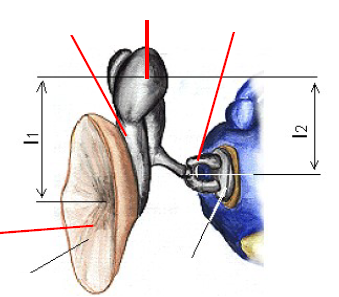
- Atympanum
- Bmalleus
- Cincus
- Dstapes
18The middle ear is filled with [blank_start]air[blank_end].
It works as an impedance [blank_start]converter[blank_end] to balance different air pressures between outer and inner ear.
It also allows impedance [blank_start]matching[blank_end] of sound traveling in air to acoustic waves traveling in a system of fluids and membranes in the inner ear.
The area of the tympanum is much [blank_start]bigger[blank_end] than the stapes footplate and the chain of ossicles (malleus, incus, stapes) work as a [blank_start]lever[blank_end].- Aair
- Bconverter
- Cmatching
- Dbigger
- Elever
19Besides the sense of hearing the inner ear contains two more organs of perception:
- Sense of linear [blank_start]acceleration[blank_end]
- Sense of [blank_start]rotation[blank_end]
They all use [blank_start]hair cells[blank_end] in [blank_start]fluids[blank_end] to detect sound or balance.- Ahair cells
- Bfluids
- Cacceleration
- Drotation
20The labyrinth in the inner ear:
The membranous labyrinth is filled with [blank_start]K+[blank_end] rich [blank_start]endolymph[blank_end].
The bony labyrinth is filled with [blank_start]Na+[blank_end] rich [blank_start]perilymph[blank_end].
The hair cells are contained in the [blank_start]membranous[blank_end] labyrinth.- Amembranous
- Bbony
- Cendolymph
- Dperilymph
- EK+
- FCl-
- GCa2+
- HNa+
21The three scalae of the cochlea
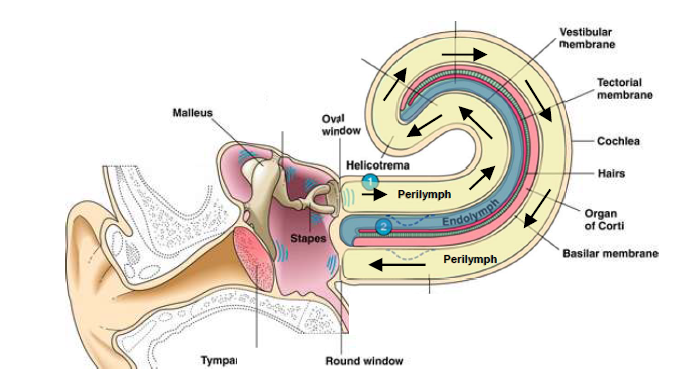
- Ascala vestibuli
- Bscala tympani
- Cscala media
22Inner hair cells:
- [blank_start]1[blank_end] row
- [blank_start]ca. 3.500[blank_end] cells
- provide [blank_start]neural output[blank_end]
Outer hair cells:
- [blank_start]3[blank_end] rows
- [blank_start]ca. 12.000[blank_end] cells
- provide [blank_start]amplification[blank_end]- A1
- Bca. 3.500
- Cneural output
- D3
- Eca. 12.000
- Famplification
23There are roughly [blank_start]30.000[blank_end] spiral ganglion cells, which belong to the [blank_start]peripheral[blank_end] nervous system.
Afferent SGC lead to the [blank_start]cochlear nucles[blank_end].
Most afferent SGC innervate [blank_start]exactly 1 IHC[blank_end].
Efferent SGC come from the [blank_start]superior olivary complex[blank_end].
Most efferent SGCs innervate [blank_start]multiple OHCs[blank_end].- A30.000
- B20.000
- C3.000
- D200.000
- Eperipheral
- Fcentral
- Gcochlear nucles
- Hexactly 1 IHC
- Isuperior olivary complex
- Jmultiple OHCs
24[blank_start]Outer[blank_end] hair cells possess a unique motor protein called [blank_start]prestin[blank_end], which causes them to contract every time they are depolarized.
- Aprestin
- BOuter
25The mechanical frequency analysis in the cochlea is done via the basilar membrane.
The base is [blank_start]100µm[blank_end] wide, [blank_start]thick and taut[blank_end] and sensitive to [blank_start]high[blank_end] frequencies.
The apex is [blank_start]500 µm[blank_end] wide, [blank_start]thin and floppy[blank_end] and sensitive to [blank_start]low[blank_end] frequencies.
Different stiffness at different points results in different frequencies creating vibration maxima at different points!
This is a [blank_start]passive[blank_end] frequency analysis.
There are also [blank_start]more[blank_end] hair cells (and therefore a [blank_start]higher[blank_end] resolution) at positions corresponding to low frequencies.- A100µm
- Bthick and taut
- Chigh
- Dlow
- Ethin and floppy
- F500 µm
- Gpassive
- Hactive
- Imore
- Jless
- Khigher
- Llower
26The hair cells' organelles that respond to fluid motion are called [blank_start]stereocilia[blank_end].
Hair cells cannot create APs but they can induce APs in nerve cells from mechanical energy. When the stereocilia are lifted up [blank_start]K+[blank_end]-channels open and the cells are depolarized causing transmitter release at the synapse to the SGC.- Astereocilia
- BK+
27Ascending pathway
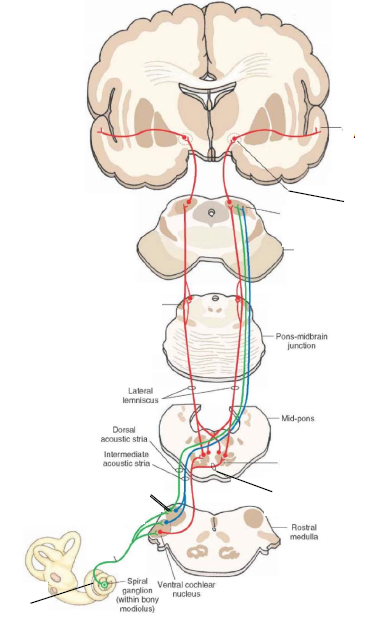
- Acochlea
- Bcochlear nucleus
- Ctrapezoid body
- Dsuperior olivary complex
- Elateral lemniscus
- Finferior colliculus
- Gmedial geniculate body
- Hauditory cortex
28The descending pathway of the auditory system is possibly involved in selective attention. It uses [blank_start]inhibition[blank_end] by negative feedback.
The pathway is called the [blank_start]olivocochlear[blank_end] pathway.- Aolivocochlear
- Binhibition
29Cell types of the cochlear nucleus:
[blank_start]Bushy[blank_end] cells receive input via large [blank_start]excitatory[blank_end] [blank_start]Endbulbs of Held[blank_end] and send output to the [blank_start]superior olivary nucleus[blank_end] via large synapses, called [blank_start]Calyx of Held[blank_end].
Bushy cells have the largest synapses in the brain, which leads to [blank_start]great[blank_end] temporal precision and an [blank_start]exact[blank_end] resolution (1 spike for 1 spike).- ABushy
- BPyramidal
- CHeld
- Dexcitatory
- Einhibitory
- FEndbulbs of Held
- GCalyx of Held
- Hsuperior olivary nucleus
- Iinferior colliculus
- Jlateral lemniscus
- KCalyx of Held
- LEndbulbs of Held
- Mgreat
- Npoor
- Oexact
- Pimprecise
30Tonotopy is not only found in the cochlear nucleus or the superior olivary complex but preserved all the way to the primary auditory cortex.
- AVerdadeiro
- BFalso
31Two cues are used for sound localization:
ILD: [blank_start]Interaural level difference[blank_end]
ITD: [blank_start]Interaural time difference[blank_end]
ILD works best for [blank_start]low[blank_end] frequencies
ITD works best for [blank_start]high[blank_end] frequences- AInteraural level difference
- BInteraural time difference
- Chigh
- Dlow
32Which brain regions are important for sound localization?
- ALateral superior olive
- BMedial superior olive
- CInferior colliculus
- DCochlear nucleus
- ETrapezoid body
- FLateral lemniscus
- GMedial geniculate body
- HAuditory Cortex
33Neurons in the lateral superior olive (LSO) are most sensitive to [blank_start]high[blank_end] frequencies and [blank_start]mainly[blank_end] responsible for [blank_start]ILD[blank_end] detection.
They integrate [blank_start]excitatory[blank_end] signals from the ipsilateral ear with [blank_start]inhibitory[blank_end] input from the contralateral ear.
The ILD [blank_start]can[blank_end] be analyzed frequency-specific.
Neurons in the medial superior olive (MSO) are most sensitive to [blank_start]low[blank_end] frequencies and responsible for [blank_start]ITD[blank_end] detection.
One model to explain this mechanism is the [blank_start]Jeffress Model[blank_end].- Ahigh
- Bmainly
- Cexclusively
- DILD
- Eexcitatory
- Finhibitory
- Gcan
- Hcannot
- Ilow
- JITD
- KJeffress Model
- LHeld Model
- MRanvier Model
34The Jeffress Model
Which neuron will fire if the sound comes from midright?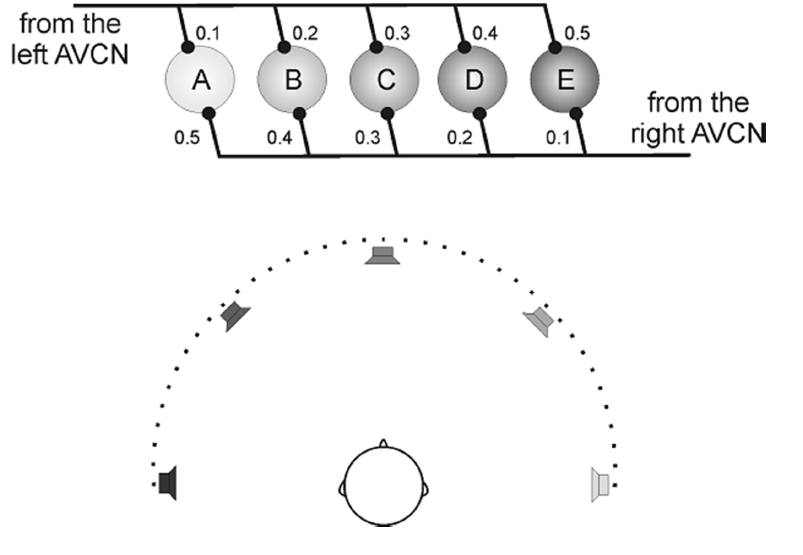
- AB
35Sound localization:
There is strong evidence for the Jeffress Model for ITD processing in [blank_start]birds[blank_end].
In mammals it is called into question, e.g. by the fact that [blank_start]the MSO receives also inhibitory input[blank_end].- Abirds
- Breptils
- Cmammals
- Dfish
- Ethe MSO receives also inhibitory input
- Fthe LSO receives also inhibitory input
- Gthe MSO is not capable of summation
- Hthe LSO is not capable of summation
36Primary auditory cortex (A1): Brodman [blank_start]41[blank_end] and [blank_start]42[blank_end]
- A41
- B42
37Auditory belt areas (including secondary auditory cortex A2) are [blank_start]less[blank_end] precise in their tonotopic organization.
They process [blank_start]combinations of[blank_end] frequencies and temporal sequences of sound.
A2 includes [blank_start]Wernicke's area[blank_end].- AWernicke's area
- BBroca's area
- Cless
- Dalso
- Ecombinations of
- Fisolated
38During development the synaptic density peaks at [blank_start]2-4[blank_end] years.
After that the brain needs to specialize its functions.
In juveniles synaptic potentials have a [blank_start]longer[blank_end] duration and synaptic plasticity is [blank_start]higher[blank_end].- A2-4
- B1-2
- C4-6
- Dlonger
- Eshorter
- Fhigher
- Glower
39Continuous noise input during the critical period of development result in a [blank_start]disrupted[blank_end] tonotopic organization and a degraded [blank_start]frequency response selectivity[blank_end] for neurons in the adult auditory cortex.
- Adisrupted
- Bbetter
- Cfrequency response selectivity
- Damplitude response selectivity
- EILD detection
- FITD detection
40There are two types of hearing loss:
(1) [blank_start]Conductive[blank_end] hearing loss:
- damage of tympanic membrane
- occlusion of the ear canal
(2) [blank_start]Sensory-neural[blank_end] hearing loss:
- damage to hair cells
- damage to auditory nerve- AConductive
- BSensory-neural
41The most common cause for hearing loss is
- Aa loss of hair cells.
- Bdamage to the auditory nerve.
- Can occlusion of the mid ear canal.
- Ddamage to the tympanic membrane.
42Early hearing loss leads to
(1) [blank_start]Delayed[blank_end] development with synaptic [blank_start]overshoot[blank_end]
(2) [blank_start]Increased[blank_end] elimination of synaptic function- ADelayed
- BPremature
- Covershoot
- Dundershoot
- EIncreased
- FLess
43Patients with a cochlear implant can often get the [blank_start]rhythm[blank_end] of a piece of music but have great difficulty recognizing a [blank_start]melody[blank_end].
- Arhythm
- Bmelody
44The problem with bilateral cochlear implants is
(a) [blank_start]their limited range[blank_end] which limits ILD coding
(b) [blank_start]lack of synchronization of the implants[blank_end] which limits ITD coding- Alack of synchronization of the implants
- Btheir limited range
45Components of a cochlear implant:
[blank_start]Microphone[blank_end] --> [blank_start]Sound processor[blank_end] --> [blank_start]Transmitter[blank_end] --> [blank_start]Receiver[blank_end] --> [blank_start]Electrode array[blank_end]- AMicrophone
- BSound processor
- CTransmitter
- DReceiver
- EElectrode array
46The ratio of tympanum vs. [blank_start]stapes[blank_end] foot plate is [blank_start]17[blank_end]:1.
The leverage effect is [blank_start]1.3[blank_end].- Astapes
- Bmalleus
- Cincus
- D17
- E20
- F13
- G1.3
- H3.1
- I1.7
47The cochlea has [blank_start]2.5[blank_end] coils and its length can vary between [blank_start]28 and 41[blank_end] mm.
- A2.5
- B2
- C3
- D3.5
- E28 and 41
- F30 and 45
- G15 and 38
48Outer hair cells [blank_start]contract[blank_end] upon depolarization due to their motor protein [blank_start]prestin[blank_end].
Inner hair cells release [blank_start]glutamate[blank_end] upon depolarization.- Aprestin
- Bcontract
- Cglutamate
49The Organ of Corti is located in the scala [blank_start]media[blank_end] and contains the [blank_start]basilar[blank_end] and the [blank_start]tectorial[blank_end] membrane (alphabetic order). The hair cells are located on the [blank_start]basilar[blank_end] membrane.
- Amedia
- Bbasilar
- Ctectorial
- Dbasilar
50The hair cells are [blank_start]logarithmically[blank_end] distributed on the [blank_start]basilar[blank_end] membrane. More hair cells are located towards the [blank_start]apex[blank_end] where [blank_start]low[blank_end] frequencies are coded.
- Alogarithmically
- Bexponentially
- Clinearly
- Dbasilar
- Etectorial
- Fapex
- Gbase
- Hlow
- Ihigh
51Inner hair cells contain stretch-activated [blank_start]K+[blank_end] channels. Upon depolarization voltage-gated [blank_start]Ca2+[blank_end] channels open and lead to the release of [blank_start]glutamate[blank_end].
- AK+
- BNa+
- CCa2+
- DCa2+
- EK+
- FNa+
- Gglutamate
- Hdopamine
- Iglycine
- JGABA
52Cochlear hair cells have [blank_start]v[blank_end]-shaped [blank_start]tuning[blank_end] curves that describe their best frequencies.
- Av
- Btuning
53Bushy cells improve [blank_start]phase locking[blank_end] compared to the signals that come from the auditory nerve.
- Aphase locking
54The Jeffress model contains a [blank_start]delay-line[blank_end] and a [blank_start]coincidence[blank_end] detector.
It is called into question because the medial superior olive receives inhibitory [blank_start]glycine[blank_end] input.- Aglycine
- Bdelay-line
- Ccoincidence
55There are studies about the regeneration of hair cells upon the [blank_start]adenoviral[blank_end] expression of Atoh1/Math1.
- Aadenoviral
Informações
- Descrição
- Master Neuroscience (From Membrane to Brain [Lecture]) Quiz sobre Auditory System, criado por Lukas Paulun em 23-11-2018.
- Autor
- Lukas Paulun
- Idioma
- Deutsch
- Visualizações
- 136
- Histórico
- Criado em 23 nov 2018 · atualizado em 6 jan 2019
- Etiquetas
- Avaliação
- Ainda sem avaliações Avalie este quiz