
22659491
Description

Quiz by Siobhan Pett, updated more than 1 year ago

|
Created by Siobhan Pett
over 5 years ago
|
|
Question 1
Question
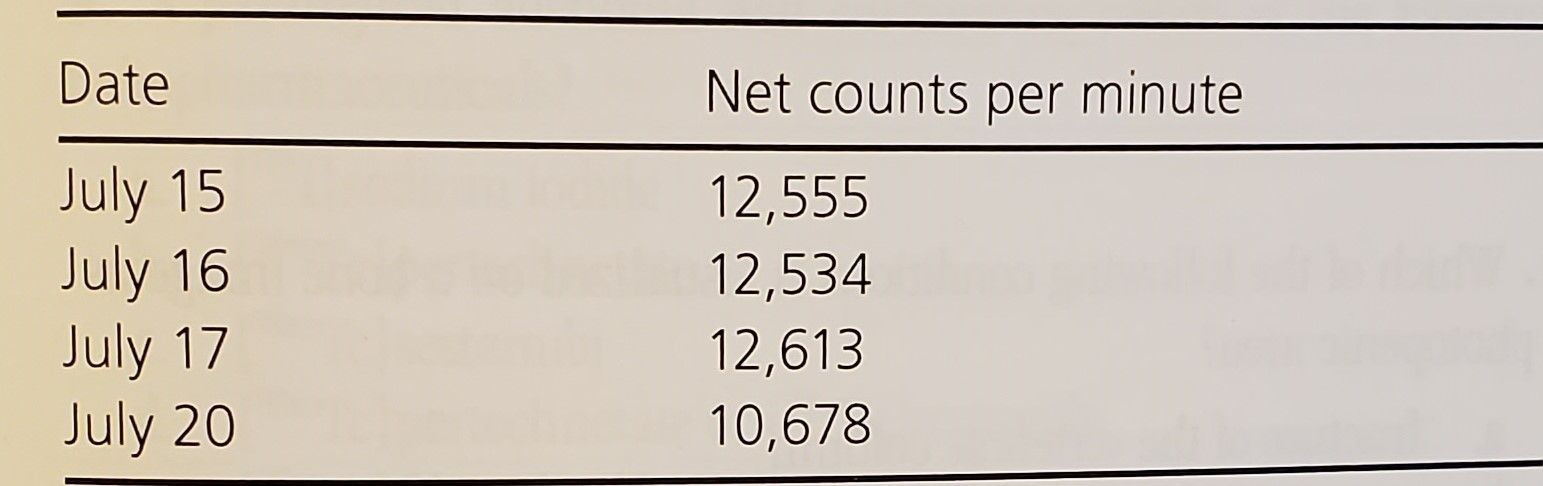
A Cs-137 reference standard is counted daily with a scinitillation spectrometer using the same window, gain, and high voltage setting. On the basis of the data provided, what should the technologist do on July 20?
Image:
E1 Q88 (binary/octet-stream)
Answer
-
use the spectrometer for clinical studies
-
arrange for repair of the instrument
-
change the gain setting
-
change the fine gain setting
-
recalibrate the operating voltage
Question 2
Question
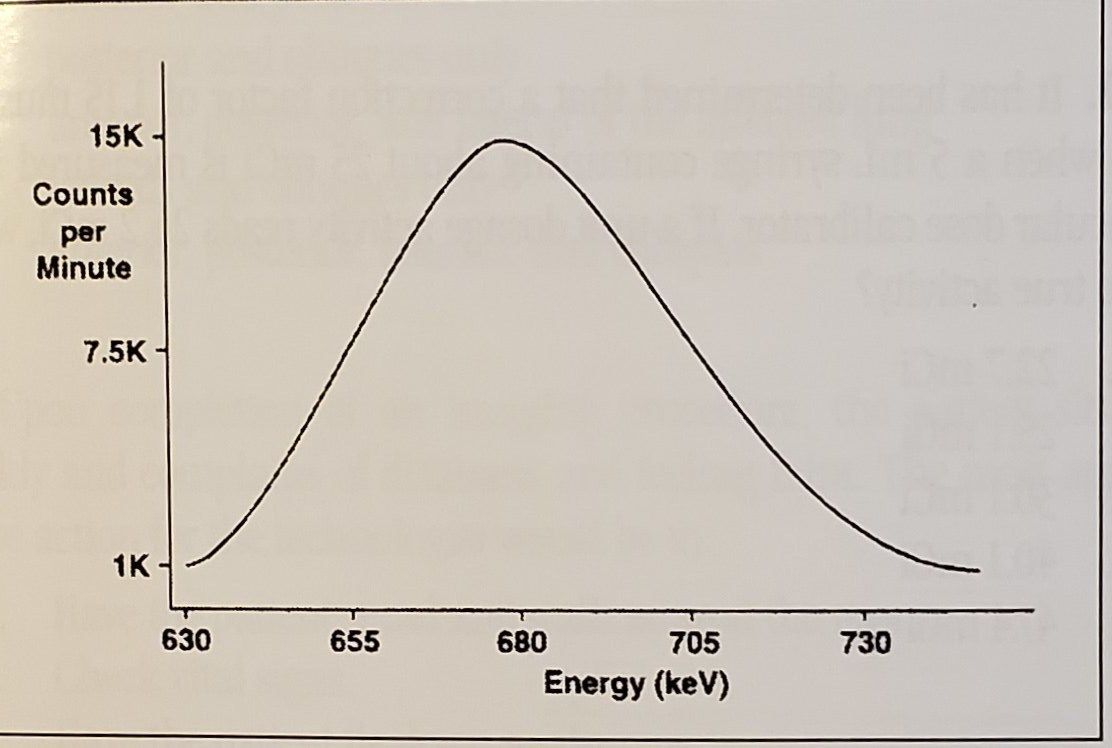
Based on the graph, the full width at half maximum (FWHM) is:
Answer
-
2500 cpm
-
680 keV
-
7500 cpm
-
50 keV
-
500 cpm
Question 3
Question
Coincidence loss is likely to occur when using a well counter if the:
Answer
-
energy of the radionuclide is below 50 keV
-
energy of the radionuclide is above 300 keV
-
activity of the source is below 37 kBq
-
activity of the source is above 74 MBq
-
activity of the source is between 37 kBq and 37 MBq
Question 4
Question
To assure a maximum error of 2% at the 95% confidence interval, all samples that are measured in a well counter should be counted for a time interval that produces at least:
Answer
-
7500 counts
-
5000 counts
-
1000 cpm
-
500 cpm
-
10,000 counts
Question 5
Question
An energy resolution test is performed on a well counter using Cs-137. If the FWHM is determined to be 53 keV and the photopeak energy is 662 keV, what is the percentage energy resolution of the instrument?
Answer
-
0.08%
-
12.5%
-
1.3%
-
8%
-
25%
Question 6
Question
What energies will be accepted by a 15% window placed around a centerline of 159 keV?
Answer
-
135-183 keV
-
144-174 keV
-
151-167 keV
-
147-171 keV
-
156-189 keV
Question 7
Question
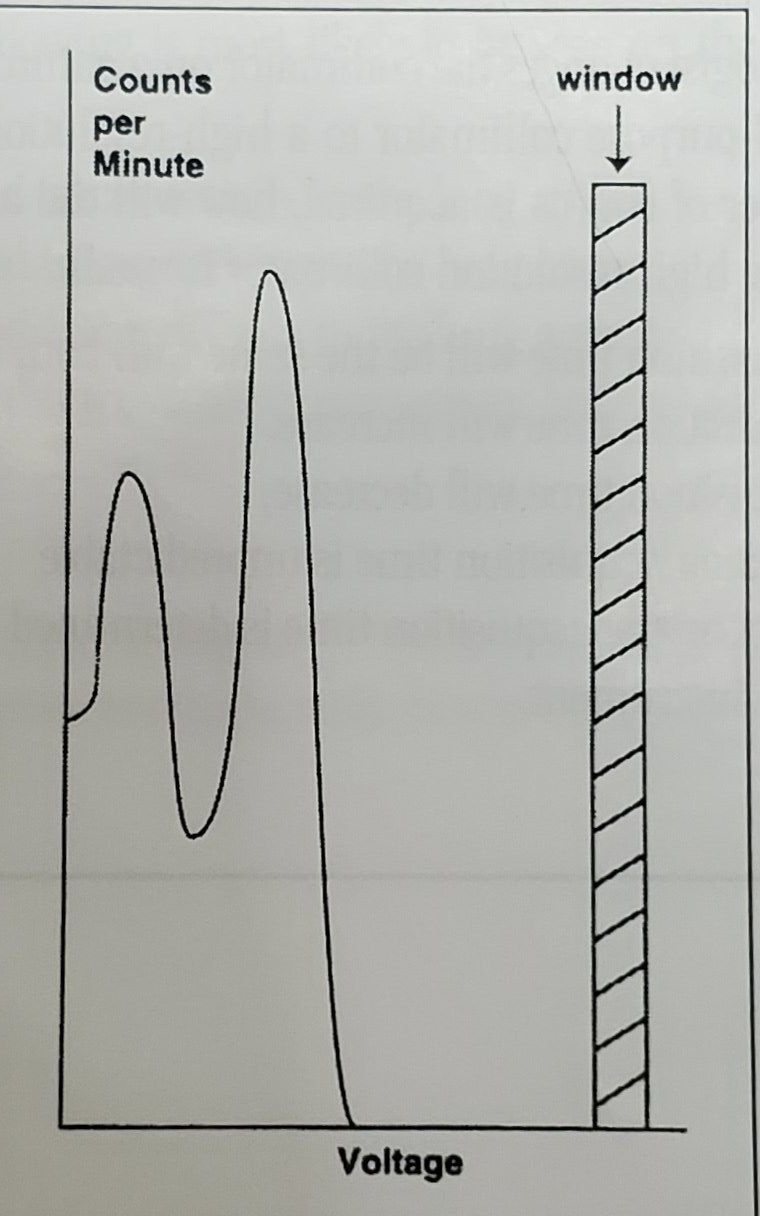
The gamma spectrum shown here was obtained at a voltage of 800. To move the photopeak into the window, which of the following actions should be taken?
Image:
E4 Q87 (binary/octet-stream)
Answer
-
the voltage should be decreased
-
the voltage should be increased
-
the window should be widened
-
the window should be moved
-
the high voltage should be turned off
Question 8
Question
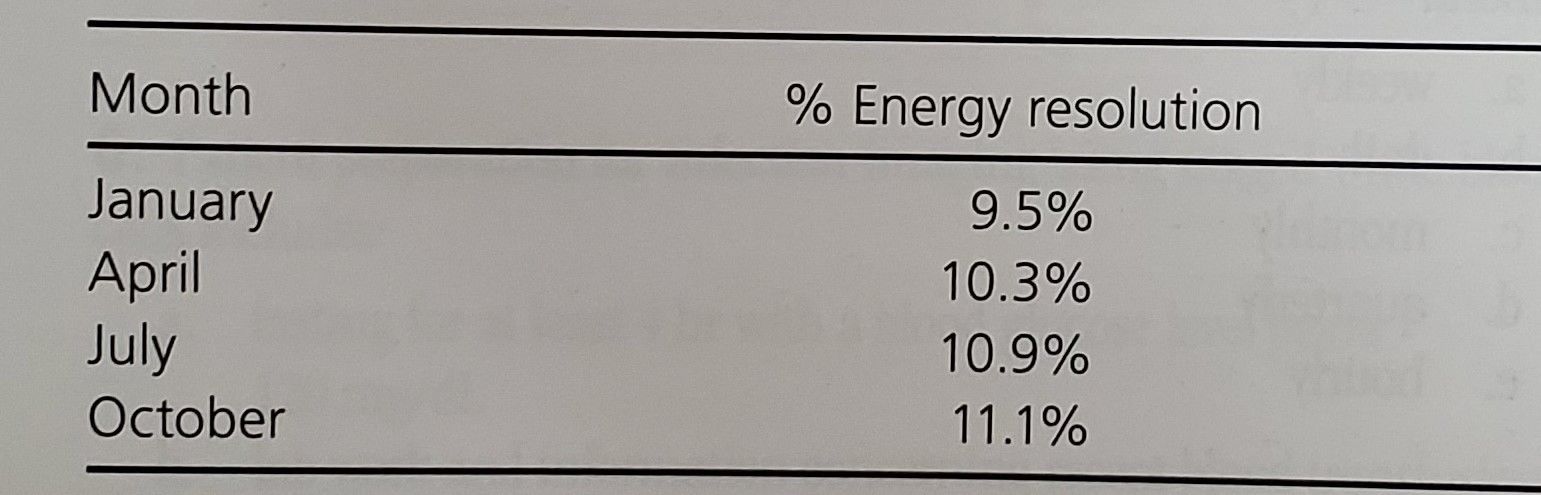
These are the results of energy resolution tests for the last 4 quarters. According to these data, which of the following statements is true?
Image:
E4 Q88 (binary/octet-stream)
Answer
-
the energy resolution of the instrument is improving
-
the test is erroneous
-
the results indicate the instrument should no longer be used
-
the test should be performed with a different radionuclide
-
the energy resolution of the instrument is worsening
Question 9
Question
On the basis of the well counter calibration curve shown here, what is the operating voltage of the instrument?
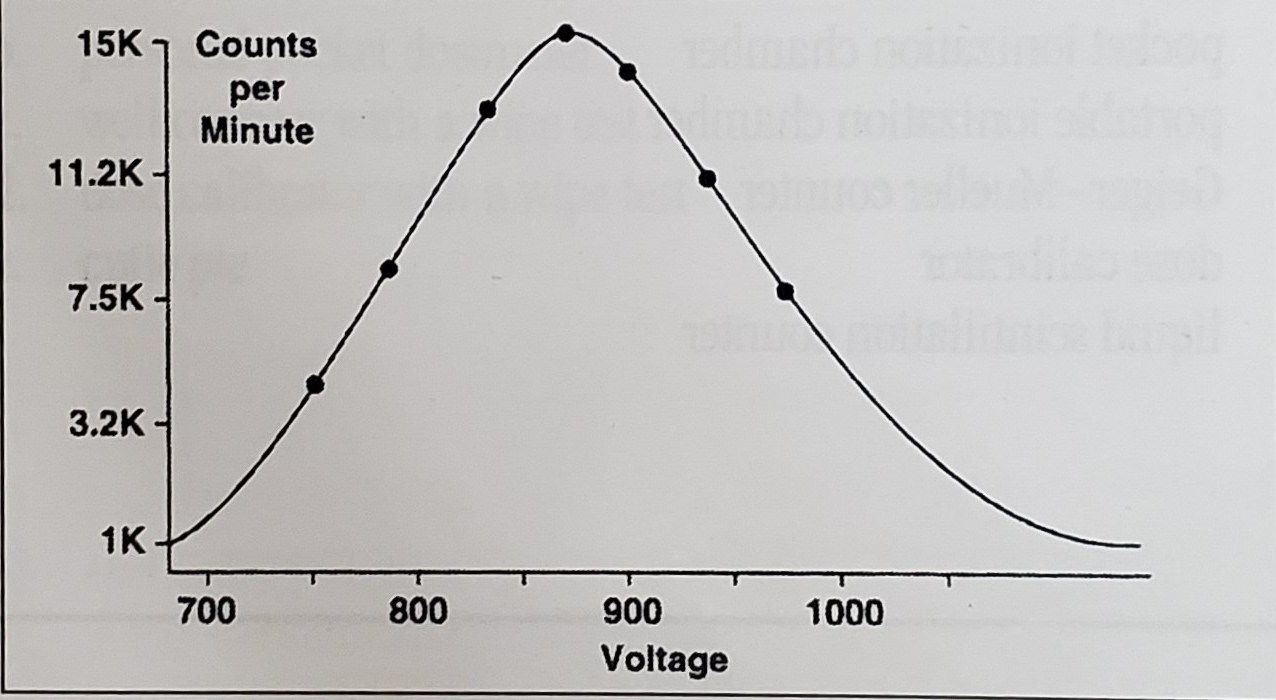
Answer
-
875
-
850
-
800
-
1000
-
900
Question 10
Question
What is the standard maximum acceptable % energy resolution measured with a Cs-137 source for a NaI(Tl) scintillation detector?
Answer
-
8%
-
12%
-
20%
-
22%
-
25%
Question 11
Question
A 10% window for 662 keV is set on a spectrometer with a lower-level discriminator (LLD) and an upper-level discriminator (ULD). If each increment on the discriminator dial equals 1 keV, what should the settings be for the LLD and ULD?
Answer
-
LLD = 596; ULD = 728
-
LLD = 657; ULD = 667
-
LLD = 652; ULD = 672
-
LLD = 629; ULD = 695
-
LLD = 667; ULD = 677
Question 12
Question
What is added to NaI crystals to allow them to scintillate at room temperature?
Answer
-
Tl
-
Xe
-
Ce
-
Ag
-
BGO
Question 13
Question
As the sample volume is increased, well-counter counting efficiencies are:
Answer
-
reduced
-
improved
-
unchanged
-
increased to a point, then reduced
-
unpredictable
Question 14
Question
Which of the following is not a property of a NaI(Tl) crystal?
Answer
-
the scintillating material has low efficiency for detecting high energy photons
-
the crystal is hygroscopic
-
the crystal density gives it high stopping power for low to high energy photons
-
the crystalline structure is transparent to its own light
-
the crystal is sensitive to mechanical and thermal stress
Question 15
Question
What is the purpose of performing the energy resolution on a well counter?
Answer
-
Evaluate how much peak broadening occurs in a detector
-
Evaluate the statistical variability of the detector
-
Determine a detector's ability to detect radiation events
-
Determine the ability to discriminate between noise and statistically-valid events
Question 16
Question
The technologist performed an energy resolution on the well counter using 137Cs. If the full width at half maximum is determined to be 49 keV, what is the %energy resolution?
Answer
-
0.93%
-
7.4%
-
13.4%
-
15.6%
Question 17
Question
A technologist is measuring a sample of an unknown radionuclide in the well counter. If 158 photoelectrons are produced per keV absorbed by the crystal, what is the radionuclide the technologist is measuring?
Answer
-
Cs-137
-
Tc-99m
-
I-131
-
I-125
Question 18
Question
An uptake probe is what kind of detector?
Answer
-
Geiger-Mueller counter
-
proportional counter
-
ionization chamber
-
scintillation detector
-
cutie pie
Question 19
Question
When performing a radionuclide thyroid uptake with an uptake probe, the most appropriate collimator to use is a:
Answer
-
low-energy, high-sensitivity parallel-hole collimator
-
converging collimator
-
flat-field collimator
-
straight-bore collimator
-
diverging collimator
Question 20
Question
Which of the following quality control tests quantifies the reproducibility of the counting system?
Answer
-
calibration
-
counting efficiency
-
Chi-square test
-
Minimum detectable activity
-
dead time calibration
Question 21
Question
When measuring the counting efficiency of an uptake probe, how would we expect the result to differ from a well counter functioning within acceptable limits?
Answer
-
the counting efficiency of the uptake probe would be lower than that of the well counter
-
the counting efficiency of the uptake probe would be greater than that of the well counter
-
the counting efficiency should be the same for both detectors
-
it is impossible to predict the counting efficiency of an uptake probe
Question 22
Question
When performing a thyroid uptake with an uptake probe, why is the patient's thyroid not placed directly against the detector?
Answer
-
the field of view would not be sufficient to span the entire thyroid gland
-
the resolution is better when the patient's thyroid is positioned 25 cm away from the detector
-
the sensitivity is better when the patient's thyroid is positioned 25 cm away from the detector
-
the thyroid would be minified and difficult to visualize
-
the detection efficiency would be uniform across the field of view
Question 23
Question
A patient arrives in the department for a thyroid uptake procedure. The patient has a small thyroid and you figure the detector can visualize the entire organ from a detector-patient distance of 17 cm instead of 25 cm. What is a possible repercussion of changing the detector-patient distance?
Answer
-
the sensitivity will be reduced
-
sensitivity across the entire field of view will not be uniform
-
resolution will be reduced
-
image quality will be better
-
there is no foreseeable effect of altering the detector-patient distance, so long as the whole thyroid is included in the field of view
Want to create your own Quizzes for free with GoConqr? Learn more.