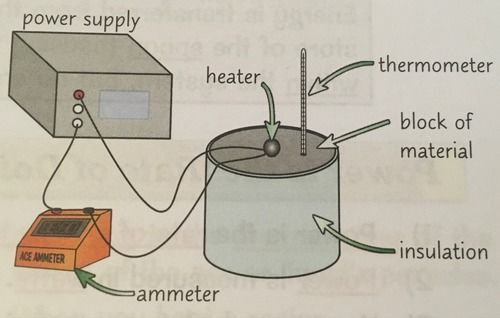
To determine the specific heat capacity of one or more materials.
The investigation will involve linking the decrease of one energy store (or work done) to the increase in temperature and subsequent increase in thermal energy stored.
Slide 3
Equipment
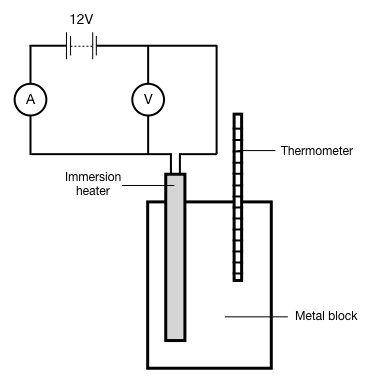
Metal block wrapped in insulation with two holes for thermometer and immersion heater
Thermometer
Pipette to put water in the thermometer hole
Immersion heater
Power supply
Insulation to wrap around block
Ammeter (and voltmeter if using one)
Leads
Stop watch or stop clock
Balance
1) Measure and record the mass of the metal block in kg using the balance
2) Wrap the block in insulation or place in an insulated container to minimise the amount of thermal energy transferred to the surroundings
3) Place the immersion heater in the larger hole in the block
4) Connect the ammeter, power pack and heater in a series circuit using the leads
5) Connect the voltmeter (if using one) across the power pack
6) Use the pipette to put a small amount of water in the other hole to prevent an air barrier and make sure you get an accurate temperature reading
7) Put the thermometer in this hole
Slide 5
Method
1) Measure the initial temperature of the block
2) Switch the potential difference, V, of power supply to 10V. Turn on the power supply and start the stop watch/clock
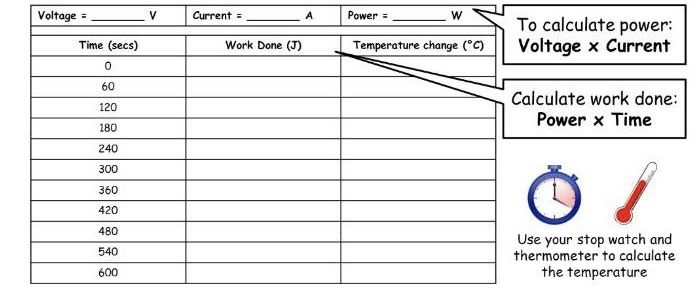
3) Record the ammeter (and voltmeter) readings. These shouldn’t change throughout the experiment.
4) Record the temperature every minute for 5 - 10 minutes
5) Turn off the power supply
6) Calculate the power of the heater in watts. To do this, use Power = Current x Potential Difference, multiply the ammeter reading by 10V (/the voltmeter reading)
7) Use this to calculate how much energy, E, has been transferred to the heater at the time of each temperature recording using Energy Transferred = Power x time
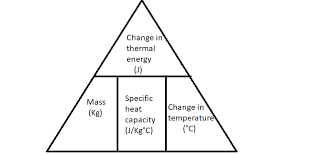
8) Calculate the specific heat capacity, c, using the formula Energy transferred = mass x specific heat capacity x temperature change
Caption: : Change in thermal energy = Mass x Specific heat capacity x Temperature change
Specific heat capacity formula
Slide 8
When you turn on the power supply, the current in the circuit (i.e the moving charges) does work on the heater, transferring energy electrically from the power supply to the heater’s thermal energy store. This energy is then transferred to the block’s thermal energy store by heating, causing the block’s temperature to increase.
Instead of using an ammeter (and a voltmeter), you may use a joulemeter which tells you directly how much energy is being transferred, meaning you can skip calculating the power of the heater and the energy transferred to the heater.
You can also investigate the specific heat capacity of liquids - place the immersion heater and thermometer in an insulated beaker filled with a known mass of the liquid.
This experiment can be repeated with different materials to see how their specific heat capacities compare.