
Quiz
Ch. 3 Review ~ Describing Sound Waves
Dieses Quiz enthält Fragetypen, die sich im gewohnten Player öffnen.
Fragen in diesem Quiz (32)
1What are the units of measure for:
1. Wavelength = [blank_start]millimeters[blank_end]
2. Frequency = [blank_start]Hertz[blank_end]
3. Intensity = [blank_start]Watts/cm(2)[blank_end]
4. Propagation speed = [blank_start]meters/second[blank_end]
5. Period = [blank_start]second[blank_end]
6. Power = [blank_start]Watts[blank_end]- Amillimeters
- BHertz
- CWatts/cm(2)
- Dmeters/second
- Esecond
- FWatts
2Does the medium or sound source determine these parameters?
1. wavelength [blank_start]Sound Source[blank_end]
2. frequency [blank_start]Sound Source[blank_end]
3. intensity (initial) [blank_start]Sound Source[blank_end]
4. propagation speed [blank_start]Sound Source[blank_end]
5. period [blank_start]Sound Source[blank_end]
6. power (initial) [blank_start]Sound Source[blank_end]
7. amplitude (initial) [blank_start]Sound Source[blank_end]- ASound Source
- BMedium
- CBoth
- DSound Source
- EMedium
- FBoth
- GSound Source
- HMedium
- IBoth
- JSound Source
- KMedium
- LBoth
- MSound Source
- NMedium
- OBoth
- PSound Source
- QMedium
- RBoth
- SSound Source
- TMedium
- UBoth
3Using a particular ultrasound system and transducer, which of the following cannot be changed by the operator?
1. wavelength [blank_start]Can[blank_end]
2. frequency [blank_start]Can[blank_end]
3. intensity [blank_start]Can[blank_end]
4. propagation speed [blank_start]Can[blank_end]
5. period [blank_start]Can[blank_end]
6. power [blank_start]Can[blank_end]
7. amplitude (initial) [blank_start]Can[blank_end]- ACan
- BCannot
- CCan
- DCannot
- ECan
- FCannot
- GCan
- HCannot
- ICan
- JCannot
- KCan
- LCannot
- MCan
- NCannot
4A wave with a frequency of 15,000 MHz is ultrasonic.
- ARichtig
- BFalsch
5If the amplitude of a wave is increased to 3 times its original value, the intensity is increased by 6 times.
- ARichtig
- BFalsch
6Which of the following best describes the line identified by the letter A?
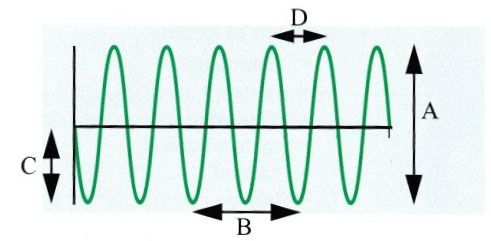
- Aamplitude
- Bperiod
- Cfrequency
- Dwavelength
- Epeak-to-peak amplitude
7Which of the following best describes the line identified by the letter B?
- Aamplitude
- Bpeak-to-peak amplitude
- Cfrequency
- Dwavelength
- Enone of the above
8Which of the following best describes the line identified by the letter C?
- Aamplitude
- Bpeak-to-peak amplitude
- Cfrequency
- Dwavelength
- Enone of the above
9Which of the lines is most likely to be the reciprocal of frequency?
- AA
- BB
- CC
- DD
10Which of the following best describes the line identified by the letter D?
- Aamplitude
- Bpeak-to-peak amplitude
- Cfrequency
- Dwavelength
- Enone of the above
11Which of the following best describes the line identified by the letter D?
- Aamplitude
- Bpeak-to-peak amplitude
- Cfrequency
- Dperiod
- Enone of the above
12Which of the lines is most likely to be determined by the source and the medium?
- AA
- BB
- CC
13If the power of a wave is halved, the intensity is reduced to one-fourth its original value.
- ARichtig
- BFalsch
14Medium 1 has a density of 9 and a stiffness of 6.
Medium 2 has a density of 8 and a stiffness of 6.
In which medium will sound travel slower?- AMedium 1
- BMedium 2
15Which of the following characteristics will create the fastest speed of sound?
- Ahigh density, high stiffness
- Blow density, high stiffness
- Chigh density, low stiffness
- Dlow density, low stiffness
16Propagation speed increases as frequency increases.
- ARichtig
- BFalsch
17Which of the following characteristics will create the fastest speed of sound?
- AHigh density, high stiffness
- BLow density, high stiffness
- CHigh density, low stiffness
- DLow density, low stiffness
18If the power in a beam is 1 watt and the area is 5 cm(2), what is the beam's intensity?
- A5 W/cm(2)
- B1 W/cm(2)
- C0.2 W/cm(2)
- D1 watt
19If the intensity remains the same while the power is doubled, what has happened to the beam area?
- Aquadrupled
- Bdoubled
- Chalved
- Dunchanged
20A sound beam travels a total of 10 cm in 2 seconds. What is the speed of the sound?
- A10 cm/sec
- B2 cm/sec
- C5 cm/sec
- D0.2 cm/sec
21Propagation speed increases as frequency increases.
- ARichtig
- BFalsch
22Propagation speed increases as frequency decreases.
- ARichtig
- BFalsch
23Propagation speed does not change as frequency increases.
- ARichtig
- BFalsch
24What is the wavelength of 3 MHz sound in soft tissue?
- A0.51 m
- B0.51 km
- C0.51 mm
- D0.51 nm
- E0.51 micrometers
25What is the wavelength of a wave with an unknown frequency traveling in soft tissue?
- A0.51 microseconds
- B0.51 m/s
- C0.51 pascals
- D0.51 watts
- E0.51 mm
26What is the wavelength of 2 MHz sound in soft tissue?
- A1.54 mm
- B0.77 mm
- C0.51 mm
- D1.54 km/s
- E3.08 mm
27The effects of sound waves on tissue in the body are called [blank_start]Bioeffects[blank_end].
- ABioeffects
28Which of the following are considered acoustic variables? (More than one answer could be correct)
- Afrequency
- Bdensity
- Cparticle motion
- Dtemperature
- Eperiod
- Fpressure
29Which of the following are considered acoustic parameters? (More than one answer could be correct)
- Afrequency
- Bdensity
- Cdistance
- Dpressure
- Eperiod
30The effects of tissue on sound waves are called [blank_start]Acoustic propagation properties[blank_end].
- AAcoustic propagation properties
31The effects of medium on an ultrasound wave are called [blank_start]Acoustic propagation properties[blank_end]
- AAcoustic propagation properties
32How are the following parameters related?
[blank_start]Directly Related[blank_end] - frequency and period
[blank_start]Directly Related[blank_end] - amplitude and power
[blank_start]Directly Related[blank_end] - amplitude and intensity
[blank_start]Directly Related[blank_end] - power and intensity
[blank_start]Directly Related[blank_end] - wavelength and intensity
[blank_start]Directly Related[blank_end] - wavelength and frequency
[blank_start]Directly Related[blank_end] - acoustic velocity and density
[blank_start]Directly Related[blank_end] - elasticity and speed of sound
[blank_start]Directly Related[blank_end] - acoustic velocity and compressibility
[blank_start]Directly Related[blank_end] - stiffness and sound speed
[blank_start]Directly Related[blank_end] - frequency and sound speed
[blank_start]Directly Related[blank_end] - frequency and intensity
[blank_start]Directly Related[blank_end] - power and frequency- Adirectly related
- Binversely related
- Cunrelated
- Ddirectly related
- Einversely related
- Funrelated
- Gdirectly related
- Hinversely related
- Iunrelated
- Jdirectly related
- Kinversely related
- Lunrelated
- Mdirectly related
- Ninversely related
- Ounrelated
- Pdirectly related
- Qinversely related
- Runrelated
- Sdirectly related
- Tinversely related
- Uunrelated
- Vdirectly related
- Winversely related
- Xunrelated
- Ydirectly related
- Zinversely related
- AAunrelated
- ABdirectly related
- ACinversely related
- ADunrelated
- AEdirectly related
- AFinversely related
- AGunrelated
- AHdirectly related
- AIinversely related
- AJunrelated
- AKdirectly related
- ALinversely related
- AMunrelated
Informationen
- Beschreibung
- Describing Sound Waves
- Autor
- Dawn Hubbard
- Sprache
- English
- Aufrufe
- 29
- Schlagwörter
- Bewertung
- Noch keine Bewertungen Bewerte dieses Quiz