
Karteikarten
Voice and focalization
Karten in diesem Stapel (25)
- 1With what was Gérard Genette unhappy?Stanzels concept of the narrative situation nor with the broad use of the term point of view because both combine the way a narrator tells a story and how its world is perceived.
Instead, he made a clear difference between the questions 'who speaks?'(voice) and 'who perceives'(focalization) - 2question of voicewho speaks to whom from which position in relation to the story?
- 3Focalizationfocalization has perceputal, psychological and ideological facets, which are sense impressions, emotionals and cognitive process and a system of norms.
- 4How do we find out who speaks?we first have to find who and where the narrator is in the first place
overt vs. covert narrator - 5covert narratoris merely a voice that reports information
The author passes on the task of evaluating the story to the reader. - 6overt narratorAn overt narrator, in constrast, appears as a mediator in the discourse. Overt narrators introduce themselves and the strories to the reader and give comments that guide the reader's understanding.
There are many variations in between a mere neutral voice and a narrator who seems to be a complex character. - 7What is the narrator's position?heterodiegetic author?
homodiegetic author? - 8heterodiegetic authorheterodiegetic author does not belong ti the world of characters
- 9homodiegetic authorhomodiegetic author belongs to the story world and is called an autodiegetic narrator if he/she tells the story of his/her own life.
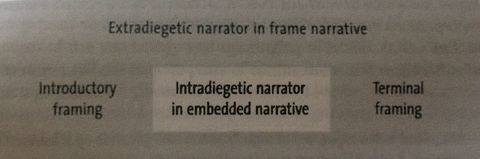
These technical terms roughly correspond to Stanzel's third-person and first-person narrative situation - 10story - within a story?In a story - within-a-story, an embedded narrative (Binnenerzählung) within a frame narrrative (Rahmenerzählung), the intradiegetic narrator tells his/her embedded story from within the primary or frame narrative, which is told by the extradiegetic narrator.
Embedded narratives mostly take an introductory but rarely a terminal framing, and often both. - 11What is the use of this distinction?Framing narratives direct the reader's attention to the ways and uses of storytelling itself in the specific transition zones between one story and another, and indirectly in the relationship between the embedded and the frame narrative.
- 12introductory/initial framing and terminal framing
- 13who for example would be a very reliable author?An omniscient and detached heterodiegetic narrator who inspires confidence.
- 14What do we have to be careful with?Homodiegetic narrators because of their limited perception and insight.
- 15checking reliablitychecking its 1.) consistency 2.) coherence and 3.) correspondence
- 16focalizationfocalization asks who perceives what in which way
- 17How can you spot the focalizer?by tracing the reference of the verbs of perception, feeling and thinking to the subject of the statement.
- 18What kind of focalizations are there?Internal focalization
fixed focalization
variable focalization
multiple focalization
external focalization
zero focalization - 19Internal focalizationInternal focalization locates the perspective within a character, limiting the information to hid/her perceptual and conceptual grasp of the world.
subcategories: fixed focalization, variable focalization, multiple focalization - 20fixed focalizationInternal focalization can vary between fixed focalization which is restricted to one and the same perspective throughout the narrative
- 21variable focalizationand variable focalization, which presents different scenes through different perspectives.
- 22multiple focalizationmultiple focalization which invites comparisons between several perspectives of the same event
- 23external focalizationexternal focalization presents information of characters' external behavior, such as speech and action, excluding feelings and thought.
- 24zero focalizationThe awkward term zero focalization does not mean that nor perspective is given but that the perspective cannot be atrributed to someone in particular or has no restrictions and thus can vary, such as that of Stanzel' omnicscient narraotr.
The question is whether the differnent points of view can be subsumed under one comprehensive or monological view of the world or fall apart into confliction or dialogic perspectives, multiplying options to make sense of the word. - 25how can a narrator represent a character's mental processes and utterances?a narrator has different options to represent a character's mental processes and utterance which can be ordered along a line that ranges from (diegetic) telling to (mimetic) showing.
Informationen
- Beschreibung
- Culture & Literature (Definition, etc.) Karteikarten am Voice and focalization, erstellt von Lisza Neumeier am 27/11/2016.
- Erstellt von
- Lisza Neumeier · Nov 2016
- Aktualisiert
- 17 Jan 2017
- Aufrufe
- 717
- Bewertung