
Mind map
Rules of Tajweed
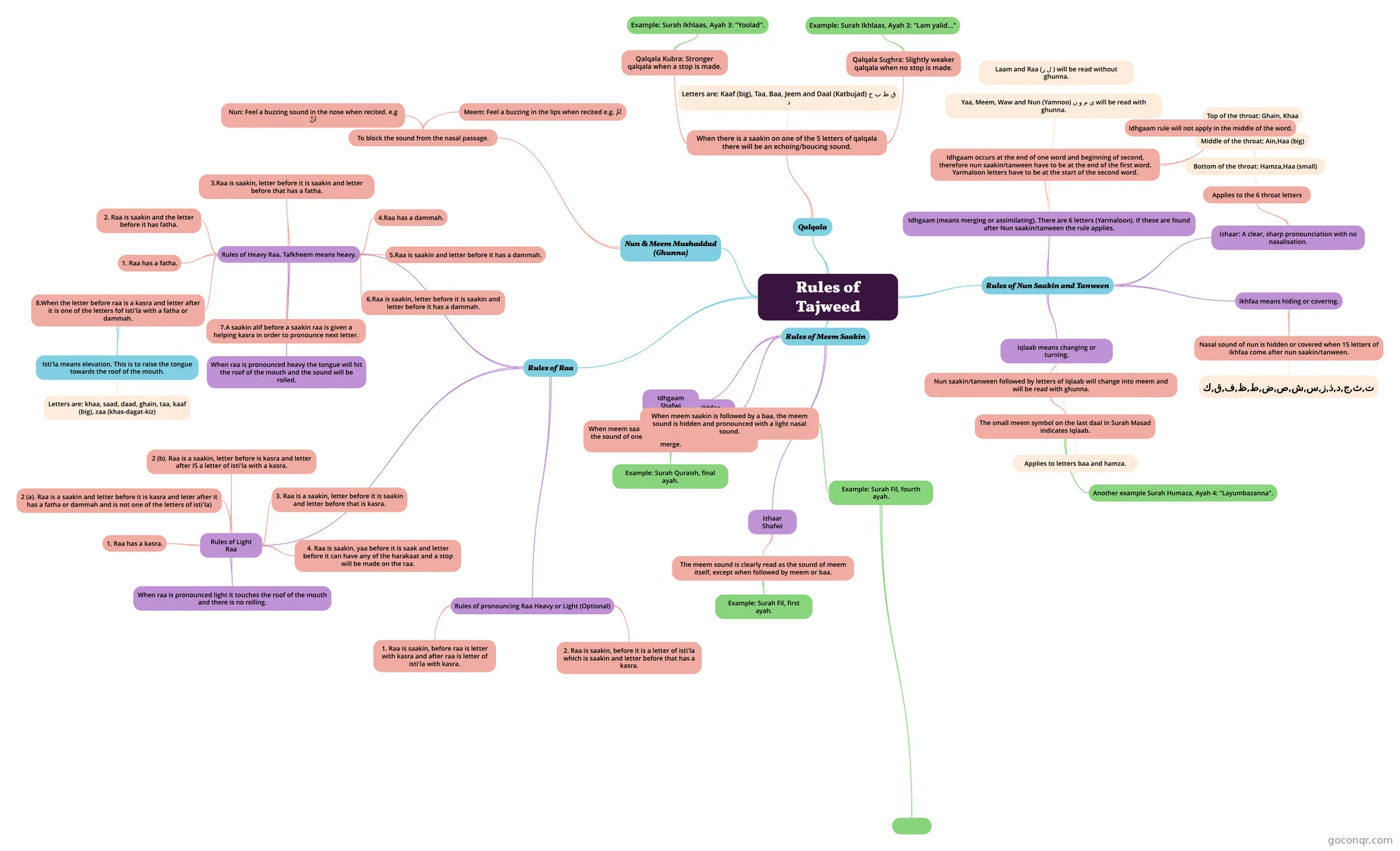
Mind map: Rules of Tajweed
Map content
Rules of Tajweed
Nun & Meem Mushaddad (Ghunna)
- To block the sound from the nasal passage.
- Nun: Feel a buzzing sound in the nose when recited. e.g اَنَّ
- Meem: Feel a buzzing in the lips when recited e.g. اَمَّ
- To block the sound from the nasal passage.
Qalqala
- When there is a saakin on one of the 5 letters of qalqala there will be an echoing/boucing sound.
- Qalqala Kubra: Stronger qalqala when a stop is made.
- Example: Surah Ikhlaas, Ayah 3: "Yoolad".
- Qalqala Sughra: Slightly weaker qalqala when no stop is made.
- Example: Surah Ikhlaas, Ayah 3: "Lam yalid..."
- Letters are: Kaaf (big), Taa, Baa, Jeem and Daal (Katbujad) ق ط ب ج د
- Qalqala Kubra: Stronger qalqala when a stop is made.
- When there is a saakin on one of the 5 letters of qalqala there will be an echoing/boucing sound.
Rules of Nun Saakin and Tanween
- Idhgaam (means merging or assimilating). There are 6 letters (Yarmaloon). If these are found after Nun saakin/tanween the rule applies.
- Laam and Raa (ل ر ) will be read without ghunna.
- Yaa, Meem, Waw and Nun (Yamnoo) ى م و ن will be read with ghunna.
- Idhgaam occurs at the end of one word and beginning of second, therefore nun saakin/tanween have to be at the end of the first word. Yarmaloon letters have to be at the start of the second word.
- Idhgaam rule will not apply in the middle of the word.
- Izhaar: A clear, sharp pronounciation with no nasalisation.
- Applies to the 6 throat letters
- Bottom of the throat: Hamza,Haa (small)
- Middle of the throat: Ain,Haa (big)
- Top of the throat: Ghain, Khaa
- Bottom of the throat: Hamza,Haa (small)
- Applies to the 6 throat letters
- Iqlaab means changing or turning.
- Applies to letters baa and hamza.
- Nun saakin/tanween followed by letters of Iqlaab will change into meem and will be read with ghunna.
- The small meem symbol on the last daal in Surah Masad indicates Iqlaab.
- Another example Surah Humaza, Ayah 4: "Layumbazanna".
- The small meem symbol on the last daal in Surah Masad indicates Iqlaab.
- Ikhfaa means hiding or covering.
- Nasal sound of nun is hidden or covered when 15 letters of ikhfaa come after nun saakin/tanween.
- ت,ث,ج,د,ذ,ز,س,ش,ص,ض,ط,ظ,ف,ق,ك
- Nasal sound of nun is hidden or covered when 15 letters of ikhfaa come after nun saakin/tanween.
- Idhgaam (means merging or assimilating). There are 6 letters (Yarmaloon). If these are found after Nun saakin/tanween the rule applies.
Rules of Meem Saakin
- Idhgaam Shafwi
- When meem saakin is followed by meem mushaddad, the sound of one meem will press into the other and merge.
- Example: Surah Quraish, final ayah.
- When meem saakin is followed by meem mushaddad, the sound of one meem will press into the other and merge.
- Ikhfaa Shafwi
- When meem saakin is followed by a baa, the meem sound is hidden and pronounced with a light nasal sound.
- Example: Surah Fil, fourth ayah.
- Example: Surah Fil, fourth ayah.
- When meem saakin is followed by a baa, the meem sound is hidden and pronounced with a light nasal sound.
- Izhaar Shafwi
- The meem sound is clearly read as the sound of meem itself, except when followed by meem or baa.
- Example: Surah Fil, first ayah.
- The meem sound is clearly read as the sound of meem itself, except when followed by meem or baa.
- Idhgaam Shafwi
Rules of Raa
- Rules of Heavy Raa. Tafkheem means heavy.
- When raa is pronounced heavy the tongue will hit the roof of the mouth and the sound will be rolled.
- 1. Raa has a fatha.
- 2. Raa is saakin and the letter before it has fatha.
- 3.Raa is saakin, letter before it is saakin and letter before that has a fatha.
- 4.Raa has a dammah.
- 5.Raa is saakin and letter before it has a dammah.
- 6.Raa is saakin, letter before it is saakin and letter before it has a dammah.
- 7.A saakin alif before a saakin raa is given a helping kasra in order to pronounce next letter.
- 8.When the letter before raa is a kasra and letter after it is one of the letters fof Isti'la with a fatha or dammah.
- Isti'la means elevation. This is to raise the tongue towards the roof of the mouth.
- Letters are: khaa, saad, daad, ghain, taa, kaaf (big), zaa (khas-dagat-kiz)
- Isti'la means elevation. This is to raise the tongue towards the roof of the mouth.
- Rules of Light Raa
- When raa is pronounced light it touches the roof of the mouth and there is no rolling.
- 1. Raa has a kasra.
- 2 (a). Raa is a saakin and letter before it is kasra and leter after it has a fatha or dammah and is not one of the letters of isti'la)
- 2 (b). Raa is a saakin, letter before is kasra and letter after IS a letter of isti'la with a kasra.
- 3. Raa is a saakin, letter before it is saakin and letter before that is kasra.
- 4. Raa is saakin, yaa before it is saak and letter before it can have any of the harakaat and a stop will be made on the raa.
- Rules of pronouncing Raa Heavy or Light (Optional)
- 1. Raa is saakin, before raa is letter with kasra and after raa is letter of isti'la with kasra.
- 2. Raa is saakin, before it is a letter of isti'la which is saakin and letter before that has a kasra.
- Rules of Heavy Raa. Tafkheem means heavy.
Information
- Description
- Revision tool for rules of Tajweed covered in lessons so far which will be tested in mid-year December exams 2014.
- Created by
- Naeema Abbas
- Views
- 880
- Tags
- Rating