
Mind map
Bullying: Theories
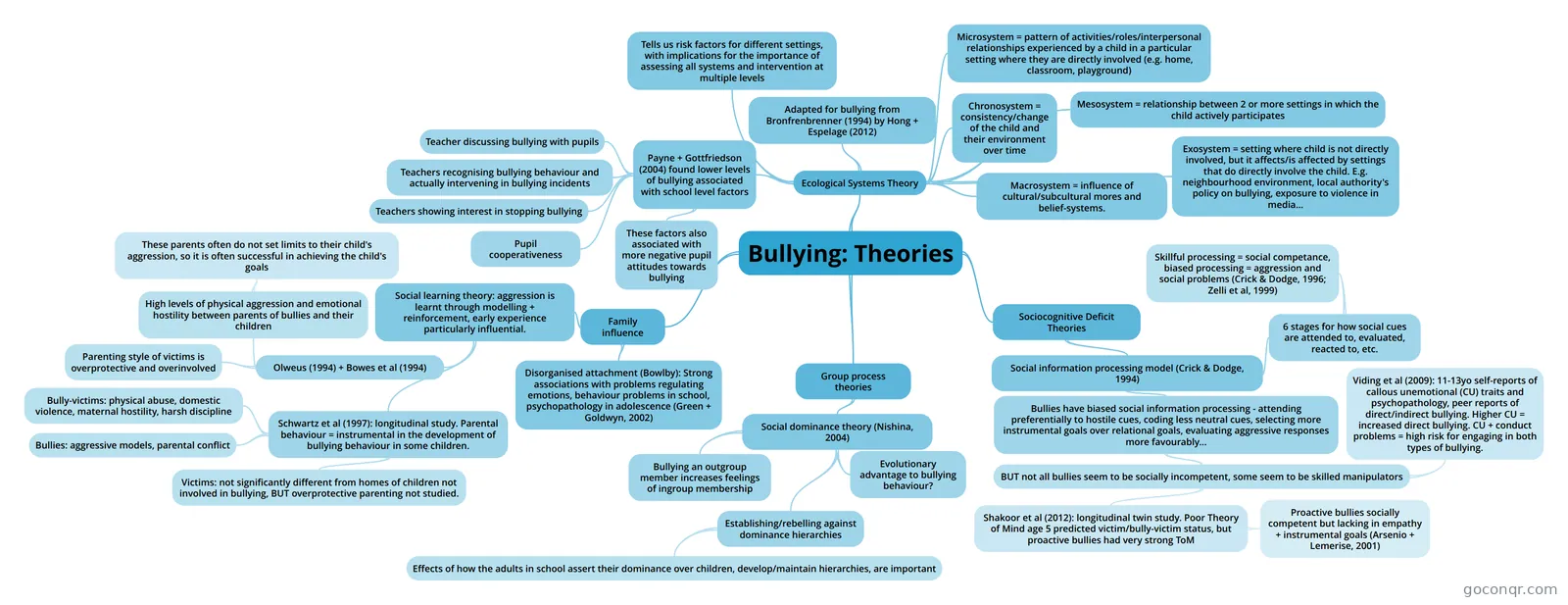
Mind map: bullying theories
Map content
Bullying: Theories
Ecological Systems Theory
- Adapted for bullying from Bronfrenbrenner (1994) by Hong + Espelage (2012)
- Microsystem = pattern of activities/roles/interpersonal relationships experienced by a child in a particular setting where they are directly involved (e.g. home, classroom, playground)
- Mesosystem = relationship between 2 or more settings in which the child actively participates
- Exosystem = setting where child is not directly involved, but it affects/is affected by settings that do directly involve the child. E.g. neighbourhood environment, local authority's policy on bullying, exposure to violence in media...
- Macrosystem = influence of cultural/subcultural mores and belief-systems.
- Chronosystem = consistency/change of the child and their environment over time
- Tells us risk factors for different settings, with implications for the importance of assessing all systems and intervention at multiple levels
- Payne + Gottfriedson (2004) found lower levels of bullying associated with school level factors
- Teacher discussing bullying with pupils
- Teachers recognising bullying behaviour and actually intervening in bullying incidents
- Teachers showing interest in stopping bullying
- Pupil cooperativeness
- These factors also associated with more negative pupil attitudes towards bullying
Sociocognitive Deficit Theories
- Social information processing model (Crick & Dodge, 1994)
- 6 stages for how social cues are attended to, evaluated, reacted to, etc.
- Skillful processing = social competance, biased processing = aggression and social problems (Crick & Dodge, 1996; Zelli et al, 1999)
- Bullies have biased social information processing - attending preferentially to hostile cues, coding less neutral cues, selecting more instrumental goals over relational goals, evaluating aggressive responses more favourably...
- BUT not all bullies seem to be socially incompetent, some seem to be skilled manipulators
- Shakoor et al (2012): longitudinal twin study. Poor Theory of Mind age 5 predicted victim/bully-victim status, but proactive bullies had very strong ToM
- Proactive bullies socially competent but lacking in empathy + instrumental goals (Arsenio + Lemerise, 2001)
- Viding et al (2009): 11-13yo self-reports of callous unemotional (CU) traits and psychopathology, peer reports of direct/indirect bullying. Higher CU = increased direct bullying. CU + conduct problems = high risk for engaging in both types of bullying.
- Shakoor et al (2012): longitudinal twin study. Poor Theory of Mind age 5 predicted victim/bully-victim status, but proactive bullies had very strong ToM
- BUT not all bullies seem to be socially incompetent, some seem to be skilled manipulators
- 6 stages for how social cues are attended to, evaluated, reacted to, etc.
- Social information processing model (Crick & Dodge, 1994)
Family influence
- Social learning theory: aggression is learnt through modelling + reinforcement, early experience particularly influential.
- Olweus (1994) + Bowes et al (1994)
- High levels of physical aggression and emotional hostility between parents of bullies and their children
- These parents often do not set limits to their child's aggression, so it is often successful in achieving the child's goals
- Parenting style of victims is overprotective and overinvolved
- High levels of physical aggression and emotional hostility between parents of bullies and their children
- Schwartz et al (1997): longitudinal study. Parental behaviour = instrumental in the development of bullying behaviour in some children.
- Bully-victims: physical abuse, domestic violence, maternal hostility, harsh discipline
- Bullies: aggressive models, parental conflict
- Victims: not significantly different from homes of children not involved in bullying, BUT overprotective parenting not studied.
- Olweus (1994) + Bowes et al (1994)
- Disorganised attachment (Bowlby): Strong associations with problems regulating emotions, behaviour problems in school, psychopathology in adolescence (Green + Goldwyn, 2002)
- Social learning theory: aggression is learnt through modelling + reinforcement, early experience particularly influential.
Group process theories
- Social dominance theory (Nishina, 2004)
- Evolutionary advantage to bullying behaviour?
- Establishing/rebelling against dominance hierarchies
- Effects of how the adults in school assert their dominance over children, develop/maintain hierarchies, are important
- Bullying an outgroup member increases feelings of ingroup membership
- Social dominance theory (Nishina, 2004)
Information
- Description
- University Educational Psychology Mind Map on Bullying: Theories, created by Maisie Rose Woodward on 11/01/2016.
- Created by
- Maisie Rose Woodward
- Views
- 499
- Tags
- Rating