
Quiz
Microbiology Lab Exam I
This quiz has question types that open in the usual player.
Questions in this quiz (48)
1The skin is generally a(n) [blank_start]inhospitable[blank_end] environment for most microorganisms.
- Ainhospitable
- Bhospitable
2Whare are some protential invasive avenues for pathogens through the skin?
- Ahair follicles
- Bopenings of secreting glands
- Cfingernails
- Dcuts
- Efreckles
3What are some traits of human skin that make it inhospitable to most microbes?
- Asalt from sweat
- Bslightly cooler temperature
- Cnormal inhabitants
- Dhair
4Human skin acts as an efficient protective barrier by making a hostile environment that no microbes can live on.
- ATrue
- BFalse
5More bacteria are found in moist areas, such as the [blank_start]armpit[blank_end], than on the dry surfaces of the [blank_start]arms/legs[blank_end].
- Aarmpit
- Barms/legs
- Carms/legs
- Darmpit
6Examples of normal flora include:
- AStreptococcus
- BStaphylococcus
- CMicrococcus
- Dyeast
- EE. coli
- FPseudomonas
7What are transient microorganisms?
- AMicroorganisms that may be found on skin temporarily, but are not permanent residents.
- BMicroorganisms that only live for a short time, reproduce, then die.
- CMicroorganisms that blink in and out of existence.
- DMicroorganisms that refuse to conform to society's expectations.
8What is an etiological agent?
- AA disease-causing agent
- BA beneficial agent
- CAn ethical problem-solver
9The significance of bacteria as etiological agents was documented by [blank_start]Robert Koch[blank_end] in [blank_start]1876[blank_end].
- ARobert Koch
- BLouis Pasteur
- CFrancis Crick
- D1876
- E1492
- F1926
- G1776
10Handwashing is generally considered the [blank_start]most[blank_end] important procedure for stopping infections and the spread of germs, but excessive handwashing can actually be [blank_start]detrimental[blank_end] effects.
- Amost
- Bleast
- Cdetrimental
- Dbeneficial
11The main goals of smearing are:
- Aadhere the cells to the slide
- Bnot to overheat the smear
- Cprepare a thin smear
- Dget as many microbes on the slide as possible
12[blank_start]Simple stain[blank_end]: uses a single stain or dye to color bacterium.
[blank_start]Gram stain[blank_end]: differentiates organisms according to cell wall structure.
[blank_start]Endospore stain[blank_end]: differentiates endospores and vegetative cells with differential staining.
[blank_start]Acid-fast[blank_end]: useful for waxy cells that may not be easily stained by other procedures.- ASimple stain
- BGram stain
- CEndospore stain
- DAcid-fast
13Basic dyes are [blank_start]positively[blank_end] charged, containing [blank_start]cationic[blank_end] chromophores. Because the bacterial cells are slightly [blank_start]negatively[blank_end] charged, there is an attraction between the [blank_start]positive[blank_end] dye and the [blank_start]negative[blank_end] cell.
Acidic dyes are [blank_start]negatively[blank_end] charged, containing [blank_start]anionic[blank_end] chromophores, and do not stain bacterial cells.- Apositively
- Bnegatively
- Ccationic
- Danionic
- Enegatively
- Fpositively
- Gpositive
- Hnegative
- Inegative
- Jpositive
- Knegatively
- Lpositively
- Manionic
- Ncationic
14Examples of basic dyes are:
- Amethylene blue
- Bcrystal violet
- Cbasic fuchsin
- Dnigrosin
- EIndia ink
- Feosin
15Examples of acidic dyes are:
- Anigrosin
- BIndia ink
- Ceosin
- Dmethylene blue
- Ecrystal violet
- Fbasic fuchsin
16Label the parts of the microscope.
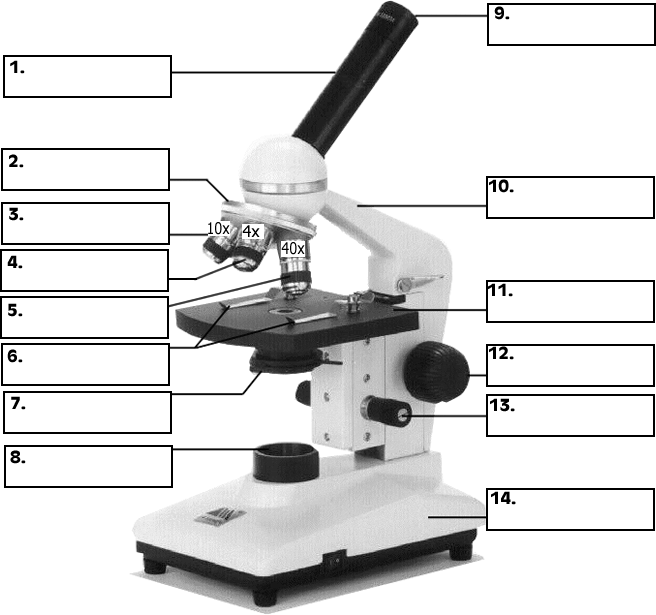
- Aeyetube
- Beyepiece
- Carm
- Dstage
- Eillumination system
- Fabbe condenser
- Gobjective
- Hrevolving nosepiece
- Ibase
- Jfine focus
- Kcourse focus
17Match the growth media with their physical forms:
[blank_start]Broths[blank_end]: liquid
[blank_start]Deeps[blank_end]: semi-solid
[blank_start]Petri Dishes and Slants[blank_end]: solid- ABroths
- BDeeps
- CPetri Dishes and Slants
18What is the most common solidifying agent used in growth media?
- Aagar
- Bglucose
- Cgelatin
- Dstarch
19What is agar?
- AA mix of complex sugars extracted from the cell walls of Gelidium.
- BA form of bacterium commonly used as nutrients for other microbes.
- CA fish common to the Gulf of Mexico
20Agar contains key nutrients for bacteria, which is why it is used in growth media so often.
- ATrue
- BFalse
21[blank_start]Aseptic[blank_end]: without contamination
[blank_start]Septic[blank_end]: without any microbe growth- AAseptic
- BSeptic
- CSeptic
- DAseptic
22Tools used for inoculation must be [blank_start]sterile[blank_end], but the inoculation itself must be carried out by [blank_start]aseptic[blank_end] technique.
- Asterile
- Baseptic
- Caseptic
- Dsterile
23A petri dish must be labeled with:
- Ainitials
- Bthe date
- Cabbreviation for medium type
- Dabbreviattion for bacterial culture
- Ethe lab
- Finstructor name
24Petri dishes should be labeled on the [blank_start]bottom[blank_end], and stored agar side [blank_start]up[blank_end].
- Abottom
- Btop
- Cup
- Ddown
25The best way to attain isolated colonies on a petri dish is by using the [blank_start]four[blank_end]-way streak technique.
- Afour
- Bthree
- Ctwo
- Done
26Gram staining causes gram-positive cells with a [blank_start]thick[blank_end] peptidoglycan layer to stain [blank_start]blue to purple[blank_end] and gram-negative cells with a [blank_start]thin[blank_end] peptidoglycan layer to stain [blank_start]red to pink[blank_end].
- Athick
- Bthin
- Cblue to purple
- Dred to pink
- Ethin
- Fthick
- Gred to pink
- Hblue to purple
27Label the morphology forms:
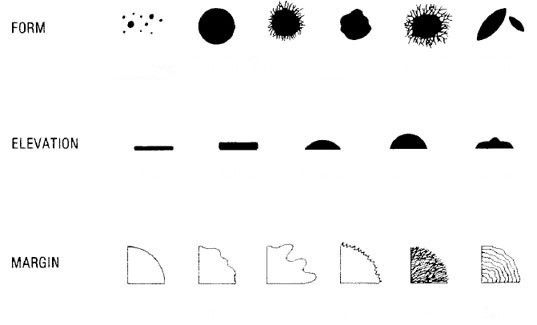
- Apunctiform
- Bcircular
- Cfilamentous
- Dirregular
- Erhizoid
- Fspindle
28Label the morphology elevation terms:
- Aflat
- Braised
- Cconvex
- Dpulvinate
- EUmbonate
29Label the margins:
- Aentire
- Bundulate
- Clobate
- Derose
- Efilamentous
- Fcurled
30What are endospores?
- Aa dormant form of bacteria
- Breproductive organelles holding copies of DNA
- Crefractile bodies
31Endospores serve as a protective structure for survival of the organisms.
- ATrue
- BFalse
32Endospores possess a permeability barrier that prevents dyes from entering unless the barrier is destroyed.
- ATrue
- BFalse
33An endospore is structurally and chemically [blank_start]more[blank_end] complex than the vegetative cell it comes from. Externally, there are [blank_start]more[blank_end] layers.
- Amore
- Bless
- Cmore
- Dfewer
34What makes the endospore chemically unique?
- Asynthesis of dipicolinic acid
- Bincrease in calcium ions
- Csilica particles
- Dcomplex proteins
35Endospores are often called metabolically active.
- ATrue
- BFalse
36Check traits of the cortex of the endospore:
- Alocated below spore coat
- Bcontains peptidoglycan
- Ccan protective layers have been penetrated, can interact with typical dyes
- Dacts as protective layer
- Etop layer of endospore
37A chemically-defined ([blank_start]synthetic[blank_end]) medium is one in which the exact chemical composition [blank_start]is[blank_end] known. A complex ([blank_start]undefined[blank_end]) medium is one in which the exact chemical constitution of the medium [blank_start]is not[blank_end] known.
- Asynthetic
- Bundefined
- Cis
- Dis not
- Eundefined
- Fsynthetic
- Gis not
- His
38When is a defined medium a minimal medium?
- AWhen it provides only the exact nutrients needed by the organism for growth.
- BWhen it uses the minimum depth of medium to promote the growth of the organism.
- CWhen it doesn't try very hard.
39What is a selective medium?
- AA medium which has components which will inhibit or prevent the growth of certain types of bacteria, while also promoting the growth of desired bacteria.
- BA medium which won't let certain bacteria sit with them.
- CA medium which has very specific conditions in which it must be stored and inoculated in order for it to be effective.
40[blank_start]Selective[blank_end] medium: has components to inhibit growth of some bacteria and promote growth of desired bacteria.
[blank_start]Differential[blank_end] medium: allows investigator to distinguish between different types of bacteria based on pattern of growth- ASelective
- BMinimal
- CDifferential
- DDefined
41What is an enrichment medium?
- AA get-rich-quick scheme
- BA medium which contains some component that permits the growth of specific types or species of bacteria
- CA medium that facilitates an environment of learning
- DA medium which contains many nutrients that can sustain many microbes
42When is an enrichment medium the best option?
- AWhen the desired microbe is able to utilize very extreme components, particularly if they are the only ones that can.
- BWhen the desired microbe got a liberal arts degree.
- CWhen the desired microbe went abroad for a few months.
- DAn enrichment medium is rich in nutrients, so it can support many microbes in many conditions.
43Which of these are chemically defined mediums?
- Aglucose
- BKH2PO4
- Cwater
- Dpeptone
- Eagar
- F(NH4)2HPO4
44Which of these are complex mediums?
- Aglucose
- Bpeptone
- Cagar
- Dyeast extract
- EK2HPO4
- FFeSO4 7H2O
45[blank_start]Psychrophiles[blank_end]: can grow at 0 degrees, but optimally near 37 degrees
[blank_start]Mesophiles[blank_end]: optimum temperature near 37 degrees
[blank_start]Thermophiles[blank_end]: optimum temperature about 45-70 degrees
[blank_start]Extreme Thermophiles[blank_end]: optimum temperature 80 degrees or higher- APsychrophiles
- BMesophiles
- CThermophiles
- DExtreme Thermophiles
- EHalophiles
46How are psycrophilic bacteria adapted to a cool environment?
- AHave largely unsaturated fatty acids in their plasma membrane
- BHave blubber underneath their cell wall
- CAdapted their metabolic processes to function in colder temperatures
- DNothing. The cold never bothered them, anyways
47How are thermophiles adapted to warmer environments?
- AHigher G+C content in their DNA
- BHighly saturated membrane fatty acids
- CThinner plasma membranes
- DHighly unsaturated membrane fatty acids
48[blank_start]Obligate aerobes[blank_end]: require O2 for growth
[blank_start]Obligate anaerobes[blank_end]: do not need O2, in fact, it is toxic to them
[blank_start]Facultative anaerobes[blank_end]: can switch between aerobic and anaerobic types of metabolism
[blank_start]Aerotolerant anaerobes[blank_end]: strictly anaerobic, but can tolerate presence of O2- AObligate aerobes
- BObligate anaerobes
- CFacultative anaerobes
- DAerotolerant anaerobes
Information
- Description
- Study Guide for Microbiology I Lab, including all of the content from labs 1-16.
- Author
- Jo O'Bar
- Language
- English
- Views
- 183
- Tags
- Rating
- No ratings yet Rate this quiz