
Quiz
Alcohols
This quiz has question types that open in the usual player.
Questions in this quiz (17)
1Is this alcohol a Primary, Secondary or Tertiary Alcohol?
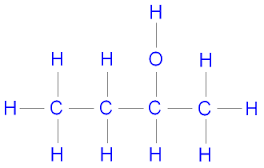
- APrimary
- BSecondary
- CTertiary
2Is this a Primary, Secondary or Tertiary Alcohol?
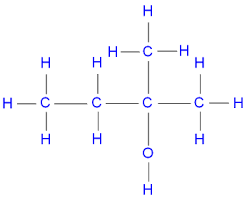
- APrimary
- BSecondary
- CTertiary
3Is this a Primary, Secondary or Tertiary Alcohol?
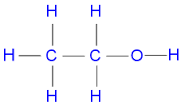
- APrimary
- BSecondary
- CTertiary
4Elimination of water from an Alcohol is also known as [blank_start]a Dehydration[blank_end] Reaction. It allows the creation of [blank_start]Alkenes[blank_end] from a renewable source. Water is the other product.
The industrial method heats [blank_start]Ethanol[blank_end] with concentrated [blank_start]Sulfuric[blank_end] Acid which acts as a catalyst. The resulting mixture contains the products, reactants and the acid. To separate the mixture, [blank_start]a Distillation[blank_end] Reaction is required which relies on the differences in boiling points. However, some impurities will still be present, so a separating funnel is required. Water is added to dissolve the water-soluble impurities and then the mixture is allowed to separate out into layers. The bottom layer is filtered out and purified using anhydrous [blank_start]Calcium Chloride[blank_end]. The resulting mixture is [blank_start]distilled[blank_end] again to get the required product.- Aa Dehydration
- Ban Evaporation
- Ca Hydrolysis
- Da Condensation
- EAlkenes
- FAlkanes
- GAcids
- HAlkalis
- IEthanol
- JMethanol
- KCyclohexanol
- LButanol
- MSulfuric
- NNitric
- OHydrochloric
- PEthanoic
- Qa Distillation
- Ran Evaporation
- Sa Substitution
- TCalcium Chloride
- UCopper Sulfate
- Vdistilled
- Wevaporated
- Xsubstituted
5Alcohols are produced by the [blank_start]Hydration[blank_end] of [blank_start]Alkenes[blank_end] using steam in the presence of an acid catalyst.
- AHydration
- BAddition
- CCondensation
- DSubstitution
- EAlkenes
- FAlkanes
- GAlkalis
6Select all the requirements for the production of Ethanol using Ethene and steam.
- A300C
- B10 atm pressure
- Csolid Phosphoric Acid catalyst
- Dliquid Sulfuric Acid catalyst
7Select all the conditions required for the fermentation of Glucose to produce Ethanol.
- AYeast
- Bwith Oxygen
- C30-40C
- DpH of 4.5
8Fermentation produces a mixture containing 15% Ethanol which needs to be distilled to concentrate it so that it can be of any use as a fuel. Water boils at 100C and Ethanol at 78.4C. So it all seems relatively easy. HOWEVER, Ethanol and Water form a mixture called an [blank_start]Azeotrope[blank_end] which boils at 78.1C and contains 95.6% Ethanol and 4.4% Water. Distillation alone can't make Ethanol any more concentrated. The [blank_start]Azeotrope[blank_end] must be [blank_start]dehydrated[blank_end] to remove the water content before it is mixed with petrol.
- AAzeotrope
- BAllotrope
- CAzeotrope
- DAllotrope
- Edehydrated
- Fevaporated
- Gcondensed
- Hhydrolysed
9What are the benefits of Fermentation as a method of producing Ethanol?
- AThe Atom Economy is high
- BIt does not use up Crude Oil but uses Renewable materials so it's Carbon Neutral
- CIt's a fast process
- DIt costs less than a continual process
- EIt's carried out at a lower temperature and pressure than Hydration of Steam
10What are the disadvantages of Fermentation as a method of producing Ethanol?
- AIt's a slow reaction
- BThe yield is low
- CIt has to be done in batches - not a continuous process
- DIt's highly exothermic
11What are the benefits of Hydration of Ethene as a method of producing Ethanol?
- AIt's fast
- BIt has a high yield
- CThe Atom Economy is 100% because it's an Addition Reaction
- DIt's a continuous process
12What are the disadvantages of Hydration of Ethene as a method of producing Ethanol?
- AIt uses up Crude Oil
- BIt's more expensive to carry out than Fermentation
- CThere are no disadvantages - it's all good, good and more good!
- DIt produces a lot of Greenhouse Gases
13Name this Alcohol.
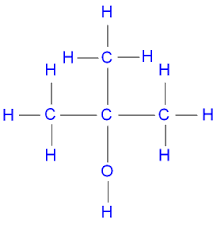
- A2-methyl-propan-2-ol
- B2,2-dimethyl-ethan-2-ol
- C1,1,1-trimethyl-methan-1-ol
- Dbutan-3-ol
14Aldehydes have [blank_start]one Hydrogen and one Alkyl group[blank_end] attached to the carbonyl carbon atom. The functional group is C=O and the suffix is [blank_start]-al[blank_end].
Ketones have [blank_start]two Alkyl groups[blank_end] attached to the carbonyl carbon atom. The functional group is C=O and the suffix is [blank_start]-one[blank_end].
Carboxylic Acids have [blank_start]a COOH group[blank_end] attached to the end of the carbon chain. The suffix is [blank_start]-oic[blank_end] acid.- Aone Hydrogen and one Alkyl group
- B-al
- Ctwo Alkyl groups
- D-one
- Ea COOH group
- F-oic
15[blank_start]Primary[blank_end] Alcohols are oxidised to [blank_start]Aldehydes[blank_end] and then to [blank_start]Carboxylic Acids[blank_end].
[blank_start]Secondary[blank_end] Alcohols are oxidised to [blank_start]Ketones[blank_end] only.
[blank_start]Tertiary[blank_end] Alcohols cannot be oxidised at all except by combustion.- APrimary
- BSecindary
- CTertiary
- DAldehydes
- ECarboxylic Acids
- FKetones
- GCarboxylic Acids
- HAldehydes
- IKetones
- JSecondary
- KPrimary
- LTertiary
- MKetones
- NCarboxylic Acids
- OAldehydes
- PTertiary
- QPrimary
- RSecondary
16Fehling's Solution and Benedict's Solution are reduced to brick-red Copper Oxide when warmed with an Aldehyde but stay blue with a Ketone.
- ATrue
- BFalse
17Tollens' Reagent is reduced to silver when warmed with a Ketone but not with an Aldehyde.
- ATrue
- BFalse
Information
- Description
- Test your knowledge of Alcohols for A-Level Chemistry
- Author
- Eleanor H
- Language
- English
- Views
- 646
- History
- Created on 6 Jun 2016 · updated on 6 Oct 2016
- Tags
- Rating
- No ratings yet Rate this quiz