
Flashcards
Paediatric Primary Survey
Cards in this deck (5)
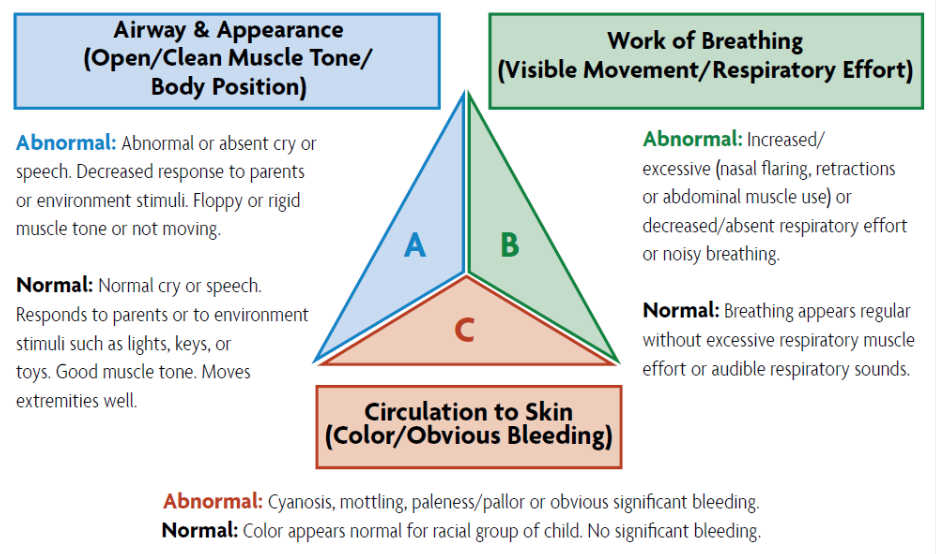
- 1The Paediatric Assessment Triangle
- 2Breathing Sounds• Grunting = respiratory failure
• Stridor = upper airway obstruction
• Crackles = Asthma, pneumonia, bronchiolitis
• Wheezes = Asthma, pneumonia, bronchiolitis
• Colour: Visible cyanosis means that oxygen saturation level has fallen by as much as 50%. Evident when deoxygenated haemoglobin reaches 5g/dL - 3Focused Abdo Exam• Cullens Sign: periumbilical bruising = pancreatitis
• Grey Turners Sign: flank bruising associated with acute pancreatitis and abdominal trauma/haemorrhage
• McBurneys Sign: Deep tenderness at McBurneys point = appendicitis
• Aarons Sign: refered pain to the epigastrium = appendicitis
• Rosenstein’s sign: Increased pain in the R
iliac region as patient lies of their left side = appendicitis
• Blumberg Sign: rebound tenderness = peritonitis - 4Bowel sounds• Normally vary in frequency, pitch, and intensity and occur
irregularly from 5 to 34 times per minute
• Borborygmi is the loud, gurgling, splashing bowel sounds heard
over the large intestine as gas passes through it
• Hyperactive bowel sounds-loud, high-pitched, tinkling sounds that
occur frequently-may be caused by diarrhoea, constipation, or early intestinal obstruction.
• Hypoactive bowel sounds are heard infrequently. They're associated with ileus, bowel obstruction, or peritonitis and indicate diminished peristalsis. - 5Kernig’s signThe leg is bent at the hip and knee at 90 degree angle, and subsequent extension in the knee is painful = may indicate subarachnoid hemorrhage or meningitis
Information
- Description
- VIVA (Paediatrics) Flashcards on Paediatric Primary Survey, created by Jonathan Cash on 10/10/2017.
- Created by
- Jonathan Cash · Oct 2017
- Updated
- Oct 11, 2017
- Views
- 8
- Rating