
3017458


| Question | Answer |
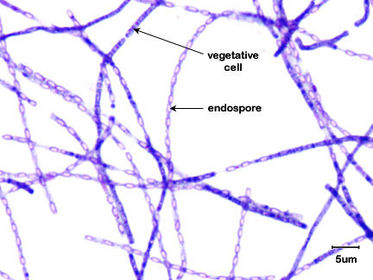
| Spore-forming aerobic gram positive bacilli | Bacillus spp. |
| Non-spore forming aerobic gram positive bacilli | Listeria Erysipelothrix Corynebacterium |
| Are all Bacillus species found in soil? | YES! |
| Is Bacillus catalase positive or negative? | POSITIVE! |
| Name the most common disease you can get from Bacillus cereus. | Food poisoning mediated by toxin (Pwede ding eye & wound infection kung opportunistic) |
| Enumerate the two forms of food poisoning | Diarrheal (24 hours) caused by eating meat & Emetic (10 hours) caused by fried rice Note: Both of them are self limiting |
| Type of hemolysis on agar plate produced by Bacillus cereus | Beta hemolysis |
| How can you acquire anthrax? | Through contact with anthrax infected animals or animal products. There is no human-to-human spread. |
| The causative agent of woolsorter's disease | Bacillus anthracis |
| Three forms of anthrax | Cutaneous Inhalation Gastrointestinal |
| Describe the disease progression of cutaneous anthrax | (PVU) Starts as a PAPULE VESICULAR Depressed black necrotic ULCER *eschar* |
| Describe the pathology of inhalation anthrax | Begins as "viral-like" Respiratory symptoms, fever, fatigue, myalgia leading to hypoxia Possibility of rhinorrhea/runny nose |
| This form of anthrax is sometimes seen as oropharyngeal ulcerations with cervical adenopathy and fever | GI anthrax |
| Give some complications of anthrax | Meningitis (5%) Coma, Death (1-6 days after exposure) |
| Does recovery from anthrax confer infection? | Fortunately, yes! |
| Give some antibiotics used after anthrax exposure | Ciprofloxacin Tetracycline |
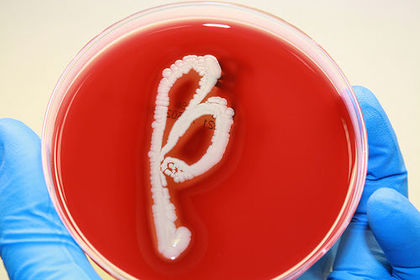
| Describe the characteristic appearance of Bacillus colonies | Medusa head appearance Non-hemolytic Catalase positive |
| Bacteria associated with meat processors and veterinarians | Listeria monocytogenes |
| Is congenital transmission possible for Listeriosis? | Sadly, yes. :( |
| Fill in the data for Listeria monocytogenes Appearance on Gram stain: Oxygen requirements: Spore formation: Acid-fast: Temperature requirements: Hemolytic pattern: Motility pattern: | GP short rods or coccobacilli Aerobic Non-spore-forming Not acid fast either Grows at 4 degrees Beta hemolysis Umbrella pattern |
| Listeriosis is predominantly food-borne. Yes or No? | Yes! |
| Agent of swine erysipelas and human erysipeloid | Erysipelothrix rhusiopathiae |
| Small GP bacilli Singly, short chains, filaments Aerobic or FA Nonmotile Catalase (-) | Erysipelothrix rhusiopathiae |
| Erysipelothrix is resistant to what kind of environment? | Cold and alkaline |
| Cutaneous human erysipelothrix infection consisting of localized cellulitis after acquisition through the skin | Erysipeloid (-pelas for animals) (-peloid for man) *sounds like keloid* |
| Specimen of choice for diagnosis of erysipelothrix infection | Skin biopsy |
| Medium for cultivation of Erysipelothrix | SBA with 5% to 10% CO2 |
| Triple Sugar Iron Agar Slant for Erysipelothrix: H2s Positive or Negative? | Positive! |
| Gram positive bacilli resembling "Chinese letters" and have a characteristic "dry colonial morphology" | Corynebacterium spp. |
| Hallmark of corynebacterium disease | Adherent membrane of the tonsils, pharynx, nose |
| 5 Complications of corynebacterium infection | (5 top organs) Heart: myocarditis Kidney and Liver: inflammation Brain: peripheral neuropathy Lungs: airway obstruction DEATH |
| How does corynebacterium invade the body? | Colonizing and proliferating in the throat, creating pseudomembrane and producing an EXOTOXIN leading to cell death |
| Culture medium selective for Corynebacteirum diphtheriae (black to gray) | Cystine-Tellurite Medium (CTBA) |
| Culture medium differential for Corynebacteirum diphtheriae (black with brown halos) | Tinsdale Agar |
| Biochemical characteristics of Corynebacteirum diphtheriae | CUN :: PNP Catalalse (+) Urease (-) Nitrate (+) |


Want to create your own Flashcards for free with GoConqr? Learn more.