
6454864
Description

Flashcards by Bianca Lemus, updated more than 1 year ago

|
Created by Bianca Lemus
over 9 years ago
|
|
| Question | Answer |
| What is a network? | A group of devices that are connected together to communicate and share network resources such as files and peripheral devices. |
| Network Components- Devices | Hardware such as computers, tablets, cell phones, servers, printers, switches and routers. |
| Network Components- Physical Media | Media that connects devices to a network and transmits data between the devices. |
| Network components- Network Adapters | Hardware that translates data between the network and a device. |
| Network Components- Operating Systems | Software that controls network traffic and access to a common network resources. |
| What is a node? | Any device or computer that can connect to a network and generate, process or transfer data. |
| What is an endpoint? | Nodes that function as a source or destination for data transfer. |
| What are redistribution points? | Nodes that transfer data, such as a network switch or a router. |
| What are protocols? | Establishes the rules and formats that must be followed for effective communication between networks, as well as from one network node to another. |
| Nodes can also be referred to as? | A workstation, client or host. |
| What is a network segment? | A subdivision of a network that links a number of devices or serves as connection between two nodes. |
| What is a network backbone? | A very high speed transmission path that connect networks, network segments and nodes. |
| LAN | Local Area Network |
| Typical network backbone for LAN | Is one or more core level switches or several switches connected together by trunk links. |
| WAN | Wide Area Network |
| Typical network backbone for WAN | Is an asynchronous transfer mode (ATM) or frame relay cloud. |
| ATM | Asynchronous Transfer Mode |
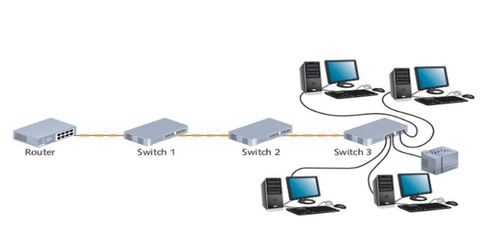
| Types of Network Backbones- Serial | The most simple. Referred to Daisy Chaining. Consists of multiple switches connected by one backbone cable. Typically not scaled for enterprise-wide use. |
| Serial Backbone Network | |
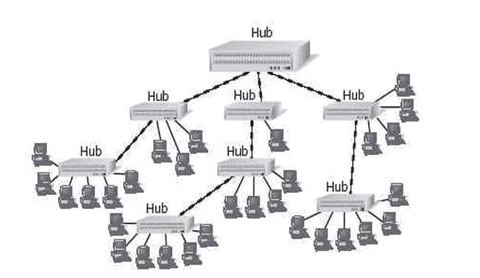
| Types of Network Backbones- Distributed/Hierarchical | The most common and the easiest to expand your network. It's "scalable". Disadvantage is that if the main hub goes down they all go down- If the top hub doesn't have the capacity it can overload. |
| Distributed Backbone Network | |
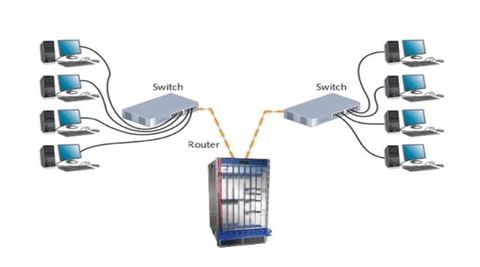
| Types of Network Backbones- Collapsed | The router or switch must have multiprocessors to bear the frequently high level of network traffic. Router or switch failures can bring down the entire network. |
| Collapsed Backbone Network | |
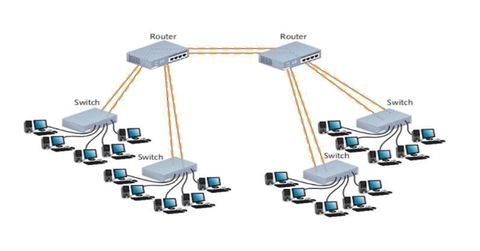
| Types of Network Backbones- Parallel | Uses a central router or switch but augments the dependant switches with multiple cable connections- ensures connectivity to entire enterprise. |
| Parallel Backbone Network | |
| Is a computer or process that shares resources with and responds to requests from computers or devices on the network. This is where you control file access. | A server |
| What is a client? | A computer process running on a device that initiates a connection to a server. Sometimes of end user device. |
| What is a thin client? | Typically an actual device with CPU and RAM but no hard drive. |
| What is a client operating system? | Windows, Apple OS X, Linux Operating Systems, Android or iOS |
| What is a host? | Any device that is connected to the network- other devices can access resources. |
| TCP/IP | Transmission control Protocol/ Internet Protocol |
| What is a TCP/IP host? | Any independent device or system on a TCP/IP network. |
| What is a peer device? | A self sufficient computer that acts as both a server and a client to other computers on a network. |
| What is a mainframe computer? | A powerful centralized computer system that performs data storage and processing tasks on behalf of clients and other network devices. |
| What is a terminal? | End user device on a mainframe- based network that transmits data to the mainframe for processing and displays the results. It has no memory or processor. |
| CPU | Central Processing Unit |
| Binary is also referred to as... | Base 2 numbering |
| Decimal numbering is also referred to as... | Base 10 numbering |
| Hexadecimal numbers are... | Base 16 numbering |
| What is a network device called that shares resources with and responds to requests from other devices called? | A server |
| What is a network device that transmits data a user enters to a mainframe for processing and display the results? | Terminal |
| What is a device that acts as both a server and a client? | Peer |
| True or False. A mainframe computer transmits data to another device for processing and displays the result to the user. | False |
| In which type of network are multiple switches connected by a single backbone cable? | Serial |
Want to create your own Flashcards for free with GoConqr? Learn more.