
Mind map
A2 Geography- Energy Security
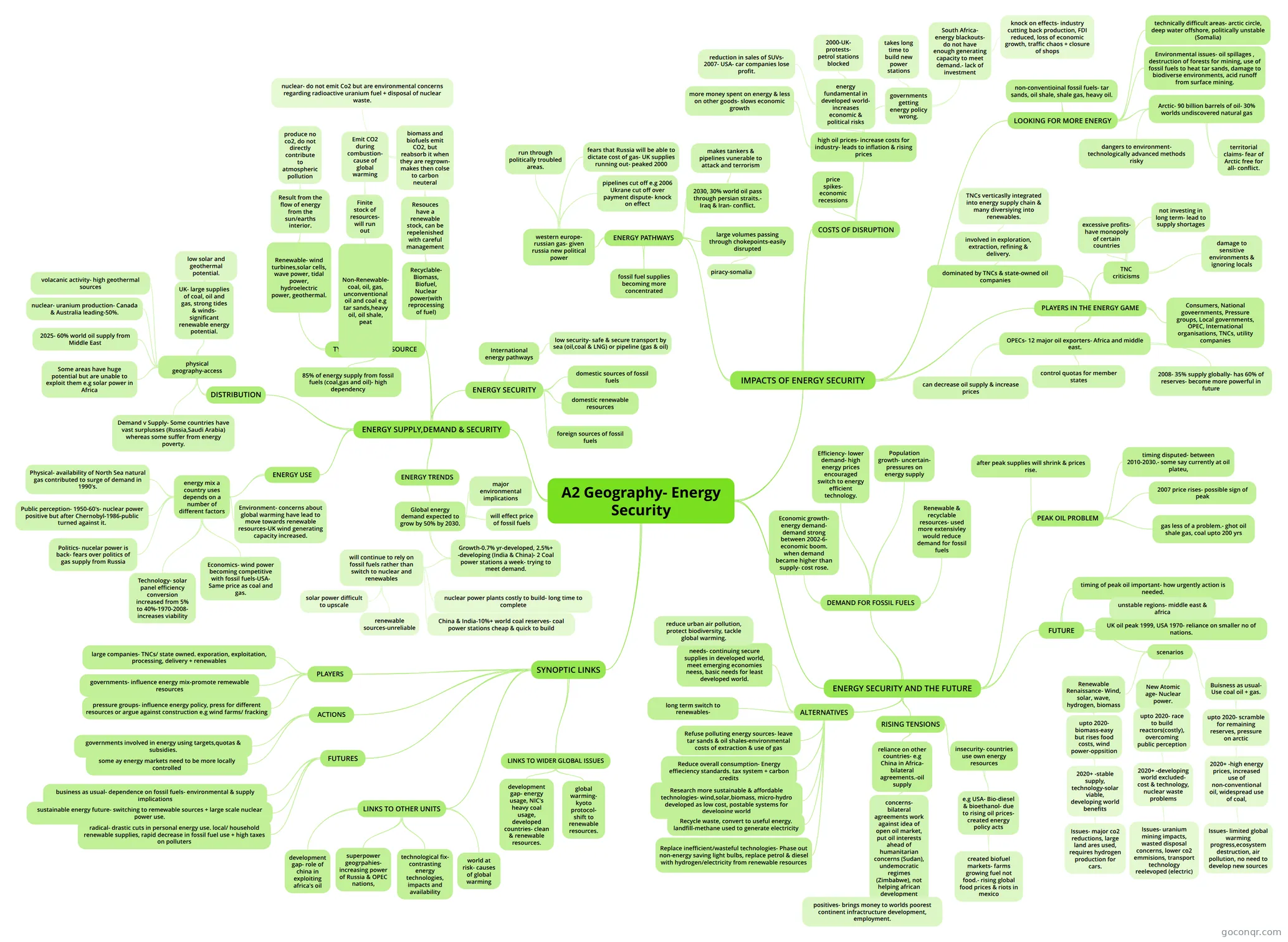
Mind map: A2 Geography energy security
Map content
A2 Geography- Energy Security
ENERGY SUPPLY,DEMAND & SECURITY
- TYPES OF ENERGY SOURCE
- 85% of energy supply from fossil fuels (coal,gas and oil)- high dependency
- Renewable- wind turbines,solar cells, wave power, tidal power, hydroelectric power, geothermal.
- Result from the flow of energy from the sun/earths interior.
- produce no co2, do not directly contribute to atmospheric pollution
- Result from the flow of energy from the sun/earths interior.
- Non-Renewable- coal, oil, gas, unconventional oil and coal e.g tar sands,heavy oil, oil shale, peat
- Finite stock of resources- will run out
- Emit CO2 during combustion- cause of global warming
- Finite stock of resources- will run out
- Recyclable- Biomass, Biofuel, Nuclear power(with reprocessing of fuel)
- Resouces have a renewable stock, can be repelenished with careful management
- biomass and biofuels emit CO2, but reabsorb it when they are regrown- makes then colse to carbon neuteral
- nuclear- do not emit Co2 but are environmental concerns regarding radioactive uranium fuel + disposal of nuclear waste.
- biomass and biofuels emit CO2, but reabsorb it when they are regrown- makes then colse to carbon neuteral
- Resouces have a renewable stock, can be repelenished with careful management
- DISTRIBUTION
- physical geography-access
- UK- large supplies of coal, oil and gas, strong tides & winds- significant renewable energy potential.
- low solar and geothermal potential.
- volacanic activity- high geothermal sources
- nuclear- uranium production- Canada & Australia leading-50%.
- 2025- 60% world oil supply from Middle East
- Demand v Supply- Some countries have vast surplusses (Russia,Saudi Arabia) whereas some suffer from energy poverty.
- Some areas have huge potential but are unable to exploit them e.g solar power in Africa
- UK- large supplies of coal, oil and gas, strong tides & winds- significant renewable energy potential.
- physical geography-access
- ENERGY USE
- energy mix a country uses depends on a number of different factors
- Physical- availability of North Sea natural gas contributed to surge of demand in 1990's.
- Public perception- 1950-60's- nuclear power positive but after Chernobyl-1986-public turned against it.
- Politics- nucelar power is back- fears over politics of gas supply from Russia
- Technology- solar panel efficiency conversion increased from 5% to 40%-1970-2008- increases viability
- Economics- wind power becoming competitive with fossil fuels-USA- Same price as coal and gas.
- Environment- concerns about global warming have lead to move towards renewable resources-UK wind generating capacity increased.
- energy mix a country uses depends on a number of different factors
- ENERGY TRENDS
- Global energy demand expected to grow by 50% by 2030.
- Growth-0.7% yr-developed, 2.5%+ -developing (India & China)- 2 Coal power stations a week- trying to meet demand.
- will continue to rely on fossil fuels rather than switch to nuclear and renewables
- nuclear power plants costly to build- long time to complete
- renewable sources-unreliable
- solar power difficult to upscale
- China & India-10%+ world coal reserves- coal power stations cheap & quick to build
- will continue to rely on fossil fuels rather than switch to nuclear and renewables
- will effect price of fossil fuels
- major environmental implications
- Growth-0.7% yr-developed, 2.5%+ -developing (India & China)- 2 Coal power stations a week- trying to meet demand.
- Global energy demand expected to grow by 50% by 2030.
- ENERGY SECURITY
- International energy pathways
- low security- safe & secure transport by sea (oil,coal & LNG) or pipeline (gas & oil)
- domestic renewable resources
- foreign sources of fossil fuels
- domestic sources of fossil fuels
- International energy pathways
- TYPES OF ENERGY SOURCE
IMPACTS OF ENERGY SECURITY
- ENERGY PATHWAYS
- fossil fuel supplies becoming more concentrated
- western europe- russian gas- given russia new political power
- run through politically troubled areas.
- pipelines cut off e.g 2006 Ukrane cut off over payment dispute- knock on effect
- fears that Russia will be able to dictate cost of gas- UK supplies running out- peaked 2000
- 2030, 30% world oil pass through persian straits.- Iraq & Iran- conflict.
- makes tankers & pipelines vunerable to attack and terrorism
- large volumes passing through chokepoints-easily disrupted
- piracy-somalia
- COSTS OF DISRUPTION
- price spikes- economic recessions
- high oil prices- increase costs for industry- leads to inflation & rising prices
- more money spent on energy & less on other goods- slows economic growth
- energy fundamental in developed world- increases economic & political risks
- reduction in sales of SUVs- 2007- USA- car companies lose profit.
- 2000-UK- protests- petrol stations blocked
- governments getting energy policy wrong.
- South Africa- energy blackouts- do not have enough generating capacity to meet demand.- lack of investment
- knock on effects- industry cutting back production, FDI reduced, loss of economic growth, traffic chaos + closure of shops
- takes long time to build new power stations
- South Africa- energy blackouts- do not have enough generating capacity to meet demand.- lack of investment
- LOOKING FOR MORE ENERGY
- technically difficult areas- arctic circle, deep water offshore, politically unstable (Somalia)
- non-conventioinal fossil fuels- tar sands, oil shale, shale gas, heavy oil.
- Environmental issues- oil spillages , destruction of forests for mining, use of fossil fuels to heat tar sands, damage to biodiverse environments, acid runoff from surface mining.
- Arctic- 90 billion barrels of oil- 30% worlds undiscovered natural gas
- territorial claims- fear of Arctic free for all- conflict.
- dangers to environment- technologically advanced methods risky
- PLAYERS IN THE ENERGY GAME
- dominated by TNCs & state-owned oil companies
- involved in exploration, extraction, refining & delivery.
- TNCs verticaslly integrated into energy supply chain & many diversiying into renewables.
- involved in exploration, extraction, refining & delivery.
- TNC criticisms
- excessive profits- have monopoly of certain countries
- not investing in long term- lead to supply shortages
- damage to sensitive environments & ignoring locals
- Consumers, National goveernments, Pressure groups, Local governments, OPEC, International organisations, TNCs, utility companies
- OPECs- 12 major oil exporters- Africa and middle east.
- can decrease oil supply & increase prices
- control quotas for member states
- 2008- 35% supply globally- has 60% of reserves- become more powerful in future
- dominated by TNCs & state-owned oil companies
- ENERGY PATHWAYS
ENERGY SECURITY AND THE FUTURE
- DEMAND FOR FOSSIL FUELS
- Economic growth- energy demand- demand strong between 2002-6- economic boom. when demand became higher than supply- cost rose.
- Efficiency- lower demand- high energy prices encouraged switch to energy efficient technology.
- Population growth- uncertain- pressures on energy supply
- Renewable & recyclable resources- used more extensivley would reduce demand for fossil fuels
- PEAK OIL PROBLEM
- after peak supplies will shrink & prices rise.
- timing disputed- between 2010-2030.- some say currently at oil plateu,
- 2007 price rises- possible sign of peak
- gas less of a problem.- ghot oil shale gas, coal upto 200 yrs
- FUTURE
- timing of peak oil important- how urgently action is needed.
- UK oil peak 1999, USA 1970- reliance on smaller no of nations.
- unstable regions- middle east & africa
- scenarios
- Buisness as usual- Use coal oil + gas.
- upto 2020- scramble for remaining reserves, pressure on arctic
- 2020+ -high energy prices, increased use of non-conventional oil, widespread use of coal,
- Issues- limited global warming progress,ecosystem destruction, air pollution, no need to develop new sources
- 2020+ -high energy prices, increased use of non-conventional oil, widespread use of coal,
- upto 2020- scramble for remaining reserves, pressure on arctic
- New Atomic age- Nuclear power.
- upto 2020- race to build reactors(costly), overcoming public perception
- 2020+ -developing world excluded- cost & technology, nuclear waste problems
- Issues- uranium mining impacts, wasted disposal concerns, lower co2 emmisions, transport technology reelevoped (electric)
- 2020+ -developing world excluded- cost & technology, nuclear waste problems
- upto 2020- race to build reactors(costly), overcoming public perception
- Renewable Renaissance- Wind, solar, wave, hydrogen, biomass
- upto 2020- biomass-easy but rises food costs, wind power-oppsition
- 2020+ -stable supply, technology-solar viable, developing world benefits
- Issues- major co2 reductions, large land ares used, requires hydrogen production for cars.
- 2020+ -stable supply, technology-solar viable, developing world benefits
- upto 2020- biomass-easy but rises food costs, wind power-oppsition
- Buisness as usual- Use coal oil + gas.
- RISING TENSIONS
- insecurity- countries use own energy resources
- e.g USA- Bio-diesel & bioethanol- due to rising oil prices- created energy policy acts
- created biofuel markets- farms growing fuel not food.- rising global food prices & riots in mexico
- e.g USA- Bio-diesel & bioethanol- due to rising oil prices- created energy policy acts
- reliance on other countries- e.g China in Africa- bilateral agreements.-oil supply
- concerns- bilateral agreements work against idea of open oil market, put oil interests ahead of humanitarian concerns (Sudan), undemocratic regimes (Zimbabwe), not helping african development
- positives- brings money to worlds poorest continent infractructure development, employment.
- concerns- bilateral agreements work against idea of open oil market, put oil interests ahead of humanitarian concerns (Sudan), undemocratic regimes (Zimbabwe), not helping african development
- insecurity- countries use own energy resources
- ALTERNATIVES
- needs- continuing secure supplies in developed world, meet emerging economies neess, basic needs for least developed world.
- reduce urban air pollution, protect biodiversity, tackle global warming.
- long term switch to renewables-
- Refuse polluting energy sources- leave tar sands & oil shales-environmental costs of extraction & use of gas
- Reduce overall consumption- Energy effieciency standards. tax system + carbon credits
- Research more sustainable & affordable technologies- wind,solar,biomass, micro-hydro developed as low cost, postable systems for developing world
- Recycle waste, convert to useful energy. landfill-methane used to generate electricity
- Replace inefficient/wasteful technologies- Phase out non-energy saving light bulbs, replace petrol & diesel with hydrogen/electricity from renewable resources
- needs- continuing secure supplies in developed world, meet emerging economies neess, basic needs for least developed world.
- DEMAND FOR FOSSIL FUELS
SYNOPTIC LINKS
- PLAYERS
- large companies- TNCs/ state owned. exporation, exploitation, processing, delivery + renewables
- governments- influence energy mix-promote remewable resources
- pressure groups- influence energy policy, press for different resources or argue against construction e.g wind farms/ fracking
- ACTIONS
- governments involved in energy using targets,quotas & subsidies.
- some ay energy markets need to be more locally controlled
- FUTURES
- business as usual- dependence on fossil fuels- environmental & supply implications
- sustainable energy future- switching to remewable sources + large scale nuclear power use.
- radical- drastic cuts in personal energy use. local/ household renewable supplies, rapid decrease in fossil fuel use + high taxes on polluters
- LINKS TO OTHER UNITS
- world at risk- causes of global warming
- technological fix- contrasting energy technologies, impacts and availability
- superpower geogrpahies- increasing power of Russia & OPEC nations,
- development gap- role of china in exploiting africa's oil
- LINKS TO WIDER GLOBAL ISSUES
- global warming- kyoto protocol- shift to renewable resources.
- development gap- energy usage, NIC's heavy coal usage, developed countries- clean & renewable resources.
- PLAYERS
Information
- Description
- (Geography) Mind Map on A2 Geography- Energy Security, created by sophielee0909 on 20/01/2014.
- Created by
- sophielee0909
- Views
- 2,450
- Tags
- Rating