
Mind map
Food Technology - Functions of ingredients
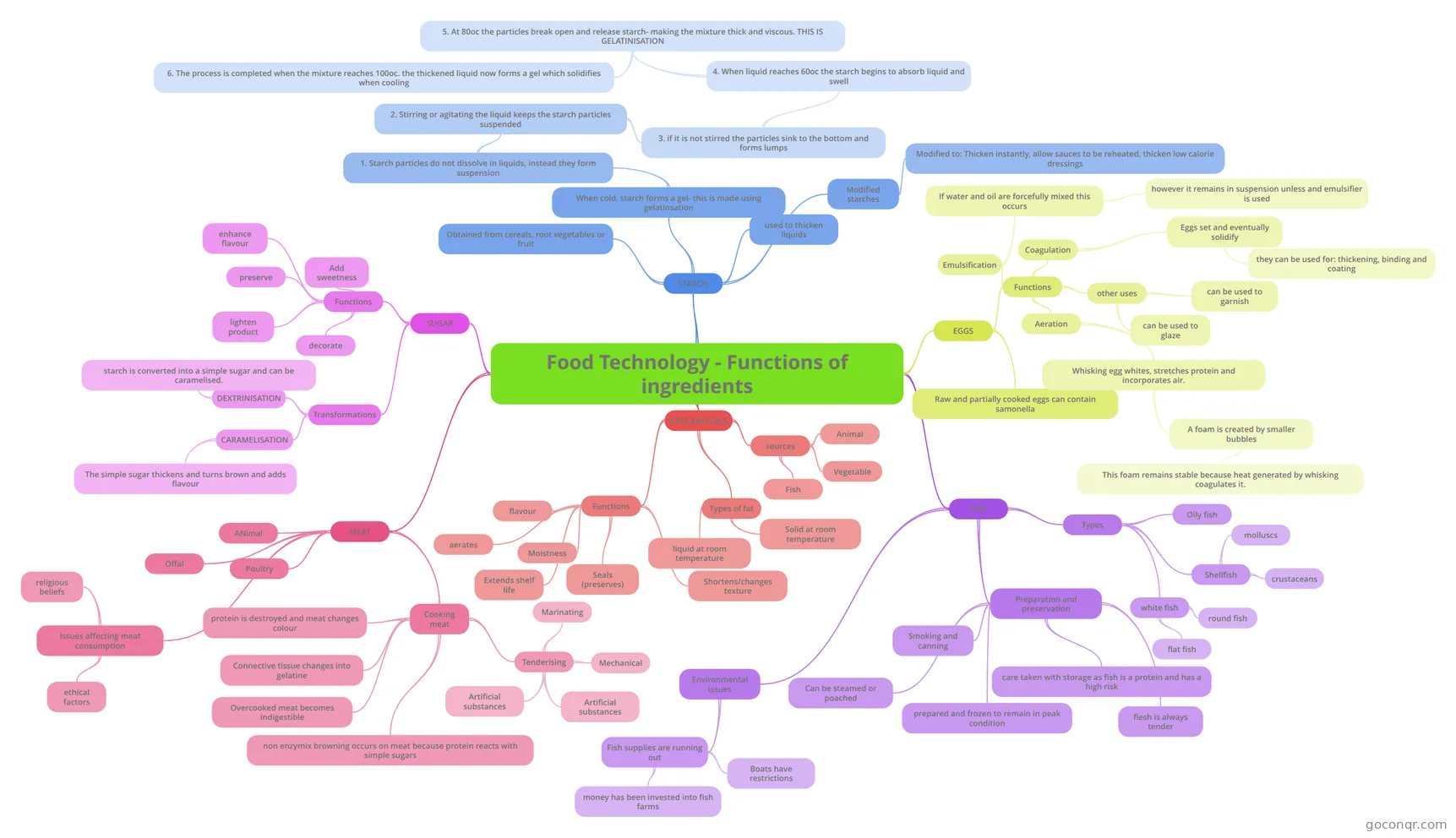
Mind map: Food technology functions of ingredients
Map content
Food Technology - Functions of ingredients
STARCH
- Obtained from cereals, root vegetables or fruit
- used to thicken liquids
- When cold, starch forms a gel- this is made using gelatinsation
- 1. Starch particles do not dissolve in liquids, instead they form suspension
- 2. Stirring or agitating the liquid keeps the starch particles suspended
- 3. if it is not stirred the particles sink to the bottom and forms lumps
- 4. When liquid reaches 60oc the starch begins to absorb liquid and swell
- 5. At 80oc the particles break open and release starch- making the mixture thick and viscous. THIS IS GELATINISATION
- 6. The process is completed when the mixture reaches 100oc. the thickened liquid now forms a gel which solidifies when cooling
- 5. At 80oc the particles break open and release starch- making the mixture thick and viscous. THIS IS GELATINISATION
- 4. When liquid reaches 60oc the starch begins to absorb liquid and swell
- 3. if it is not stirred the particles sink to the bottom and forms lumps
- 2. Stirring or agitating the liquid keeps the starch particles suspended
- 1. Starch particles do not dissolve in liquids, instead they form suspension
- Modified starches
- Modified to: Thicken instantly, allow sauces to be reheated, thicken low calorie dressings
FATS AND OILS
- sources
- Animal
- Vegetable
- Fish
- Types of fat
- Solid at room temperature
- liquid at room temperature
- Functions
- flavour
- Moistness
- Seals (preserves)
- Shortens/changes texture
- aerates
- Extends shelf life
- sources
SUGAR
- Functions
- Add sweetness
- preserve
- lighten product
- decorate
- enhance flavour
- Transformations
- DEXTRINISATION
- starch is converted into a simple sugar and can be caramelised.
- CARAMELISATION
- The simple sugar thickens and turns brown and adds flavour
- DEXTRINISATION
- Functions
EGGS
- Functions
- Aeration
- Whisking egg whites, stretches protein and incorporates air.
- A foam is created by smaller bubbles
- This foam remains stable because heat generated by whisking coagulates it.
- A foam is created by smaller bubbles
- Whisking egg whites, stretches protein and incorporates air.
- Emulsification
- If water and oil are forcefully mixed this occurs
- however it remains in suspension unless and emulsifier is used
- If water and oil are forcefully mixed this occurs
- Coagulation
- Eggs set and eventually solidify
- they can be used for: thickening, binding and coating
- Eggs set and eventually solidify
- other uses
- can be used to garnish
- can be used to glaze
- Aeration
- Raw and partially cooked eggs can contain samonella
- Functions
MEAT
- ANimal
- Poultry
- Offal
- Cooking meat
- Tenderising
- Marinating
- Mechanical
- Artificial substances
- Artificial substances
- protein is destroyed and meat changes colour
- Connective tissue changes into gelatine
- Overcooked meat becomes indigestible
- non enzymix browning occurs on meat because protein reacts with simple sugars
- Tenderising
- Issues affecting meat consumption
- religious beliefs
- ethical factors
FISH
- Types
- Oily fish
- Shellfish
- molluscs
- crustaceans
- white fish
- round fish
- flat fish
- Preparation and preservation
- care taken with storage as fish is a protein and has a high risk
- prepared and frozen to remain in peak condition
- Smoking and canning
- flesh is always tender
- Can be steamed or poached
- Environmental issues
- Fish supplies are running out
- Boats have restrictions
- money has been invested into fish farms
- Fish supplies are running out
- Types
Information
- Description
- AS and GCSE Food Tech revision on the functions of ingredients
- Created by
- evie.daines
- Views
- 936
- Tags
- Rating