
Flashcards
The Universe
Flashcards do conjunto (55)
- 1Absolute MagnitudeA measure of how bright a star would appear if it was 10 parsecs from Earth
- 2Apparent MagnitudeA measure of the brightness of a star as it appears to an observer on Earth
- 3Blue SupergiantsStars that are ten or more times more massive than the sun.
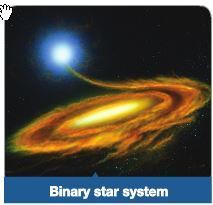
- 4Binary Star SystemWhen two stars orbit a common centre of mass
- 5Black DwarfCold dark remains of a white dwarf
- 6Black HoleAlso known as a singularity, a collapsed star so massive that not even light can escape from its gravitational field.
- 7DensityMass per unit volume of a material
- 8Electromagnetic spectrumDifferent types of electromagnetic radiation ranging from radio waves to gamma rays
- 9Gamma RaysVery high-energy electromagnetic ray
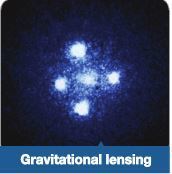
- 10Gravitational lensingThe bending of light rays due to the distortion of space caused by a massive object like a black hole.
- 11GravityThe force that causes all matter to collect together
- 12isotopeatoms with the same number of protons but different numbers of neutrons
- 13Light-year (l.y.)The distance light travels in a year, approximately 9 500 000 000 000 km
- 14MagnitudeA measure of the brightness of a star
- 15Main SequenceA groups of stars lying on a line running from the top left to the bottom right of the H-R diagram.
- 16NeutrinoAn almost mass-less, neutral particle released during some nuclear reactions
- 17Neutron StarRemnant of a supernova, consisting entirely of neutrons
- 18Nuclear fusionProcess in which hydrogen is converted into helium to produce light and heat
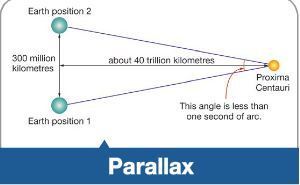
- 19ParallaxA technique used to measure the distance to other stars
- 20Parsecan astronomical unit of length equal to 3.26 light-years
- 21PlasmaState of matter consisting of positively charged ions and free electrons
- 22PositronPositively charged electron
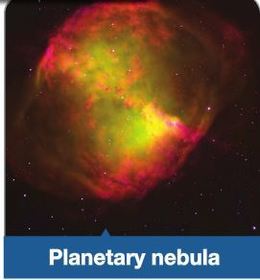
- 23Planetary NebulaA cloud of gas produced when a red giant runs out of fuel
- 24Radiation pressureThe force produced by radiation from a hot object
- 25Red Gianta star produced when the core of a Sun-sized star runs out of hydrogen
- 26Spectral classA classification system for stars based on their colour
- 27SpectrometerA device that splits light into a spectrum to show its component wavelengths
- 28Stellar parallaxThe apparent change in the position of a star throughout the year due to the Earth's motion around the Sun
- 29Supermassive black holeA black hole millions or billions of times the mass of our Sun found at the centre of a galaxy
- 30White Dwarfhot, dense star that is the remains of a red giant
- 31Big BangTheory that the universe began with an enormous explosion of energy
- 32Blue ShiftThe compression of light waves due to the motion of stars towards the Earth; blue-shift makes light appear bluer than it should.
- 33Cosmic microwave background radiationthe afterglow of the Big Bang; low energy radiation that fills the universe
- 34Cosmologythe study of the history and structure of the entire universe
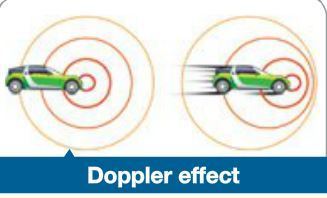
- 35Doppler effectthe expansion of waves due to the motion of the object making the waves
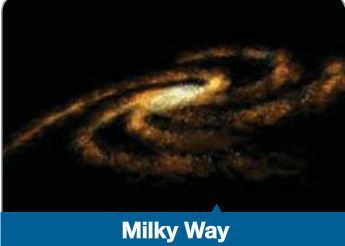
- 36Milky Waythe galaxy in which the solar system is located
- 37Red-shiftThe stretching of light waves due to the motion of stars away from the Earth; red-shift makes light appear more red than it should.
- 38Steady state theoryNow discounted theory that the universe has always existed in the form that it is today; also known as the 'infinite universe' theory.
- 39Abiogenesisthe formation of the living organisms from inanimate material
- 40Accretionprocess in which particles of dust and rock slowly come together due to gravity to form a larger object
- 41Amino acidsorganic compounds that can be combined to form proteins
- 42Astrobiologythe study of living organisms beyond the Earth's atmosphere
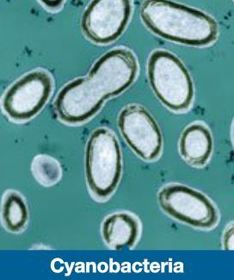
- 43Cyanobacteriaalso known as blue-green bacteria, microscopic organisms that can store energy from sunlight using the process of photosynthesis.
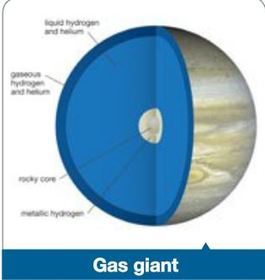
- 44Gas giantlarge planet consisting mainly of gases, e.g. Jupiter, Saturn, Uranus and Neptune
- 45Hydrocarbona compound consisting primarily of hydrogen and carbon
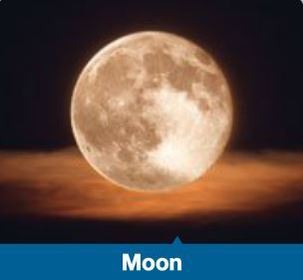
- 46Moonany naturally occurring satellite that orbits a planet
- 47Organic compoundschemical compounds consisting primarily of chains of carbon and hydrogen molecules found primarily in living organisms
- 48Panspermiatheory that life did not evolve on Earth but rather came to Earth on a comet or meteorite
- 49Proteinschemical compounds that all living organisms have
- 50Planeta celestial body that is in orbit around the Sun, has sufficient mass for its self-gravity to overcome rigid body forces so that is assumes a nearly round shape, and has cleared the neighbourhood around its orbit
- 51Protoplanetary diskdisk of gas surrounding a protostar that will form into planets
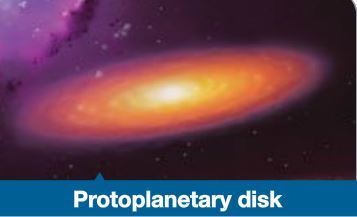
- 52Protostara collapsing cloud of gas that will eventually become a star
- 53Seismic waveswaves that carry the energy from an earthquake around the world
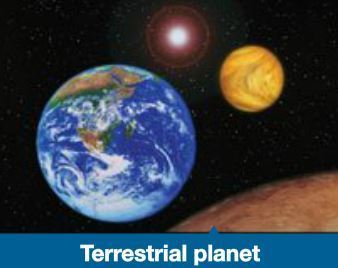
- 54Terrestrial planetliterally 'Earth-like' planet, planet made primarily of rock and solid material, e.g. Mercury, Venus, Earth and Mars
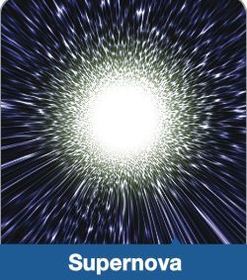
- 55Supernovaa giant explosion that occurs when a star many times larger than our Sun runs our of nuclear fuel
Informações
- Descrição
- FlashCards sobre The Universe, criado por Hannah Cox em 03-11-2014.
- Criado por
- Hannah Cox
- Visualizações
- 133
- Tags
- Avaliação