
Flashcards
AS Unit 1 Physics Flashcard Deck

Flashcards do conjunto (43)
- 1How to calculate specific charge?Charge / Mass
i.e. Charge-Mass ratio - 2What is an isotope?A variant of an atom that has an equal number of protons but a different number of neutrons to the original.
- 3What are the forces acting on the nucleons in a nucleus called?Electromagnetic - repel
Gravitational - attract
Strong Nuclear Force - attract - 4What is the general equation for alpha decay?
- 5What is the general equation for beta-minus decay?
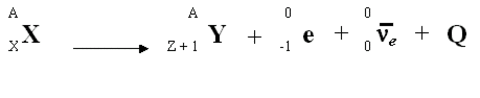
- 6What happens in pair production?A photon of sufficient energy splits into a particle-antiparticle pair.
- 7What happens in annihilation?A particle and antiparticle collide and annihilate each other. All the mass of the two particles are converted into energy in the form of two gamma photons.
- 8Name two baryonsProton
Neutron - 9Name two mesonsPion
Kaon - 10Name two leptonsElectron
Muon - 11What is the quark composition of a baryon?Three quarks
- 12What is the quark composition of a meson?Quark-antiquark pair
- 13Why do leptons not have any quarks?Because leptons are fundamental particles - just like quarks.
- 14What is the photoelectric effect?In the photoelectric effect, electrons are emitted from solids, liquids or gases when they absorb energy from light of high enough frequency. Electrons emitted in this manner may be called photoelectrons.
- 15Diagram of the photoelectric effect?
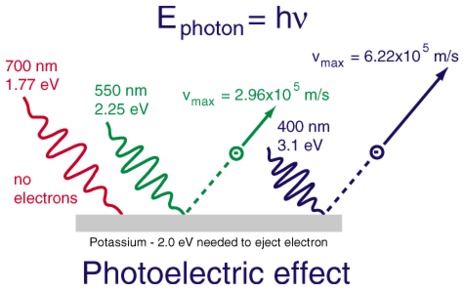
- 16How do you calculate threshold frequency?f = Φ / h
- 17How do you calculate photon energy?Φ = hf - EKmax
- 18How do you convert electron volts (eV) to joules (J)?1 eV = 1.6 x 10^-19
So multiply by 1.6 x 10^-19 - 19What makes an atom excited?When one or more of its electrons is in an energy level higher than the ground state. Electrons can move down an energy level by emitting a photon of equal change in energy.
- 20What makes an atom ionised?When an electron has been removed entirely from the atom. The ionisation energy is the energy needed to remove an electron from the ground state atom.
- 21What do line spectra provide evidence for?That electrons can only exist in discrete energy levels. Atoms can only emit photons with energies equal to the difference between the two energy levels. Since only certain energy levels are allowed, the corresponding wavelengths can be seen in the line spectrum.
- 22What are line absorption spectra?You get line absorption spectrum when light with a continuous spectrum of energy (white light) passes through a cool gas. Photons of the correct wavelength are absorbed by the electrons to excite them to higher energy levels. These wavelengths are then missing from the continuous spectrum when it comes out of the other side of the gas.
- 23Is light a wave or a particle?Neither - light exhibits wave-particle duality.
- 24Where does light exhibit wave and particle properties?Diffraction of light as they pass through a narrow slit shows light as a wave. Particles would either not go through the gap due to being too large or just pass straight through, leaving the beam unchanged.
The photoelectric effect shows light as particle-like photons. If a photon of light is a discrete bundle of energy, then it can interact with an electron in a one-to-one way. All the energy in the photon is given to one electron. - 25Do electrons have wave-particle duality?Yes - electron diffraction can prove this. Diffraction patterns are observed when accelerated electrons in a vacuum tube interact with the spaces in a graphite crystal sheet. As they pass through the spaces, they diffract just like waves passing through a narrow slit and produce a pattern of rings.
- 26What is current?Current is the rate of flow of charge, measured in amperes (A).
- 27What is potential difference?The work done in moving a unit charge between two points, measured in volts (V).
- 28What is resistance?A measure of how difficult it is to get a current to flow through a component, measured in ohms (Ω).
- 29What makes a conductor an ohmic conductor?When current is directly proportional to potential difference (Ohm's law). This forms a straight line of a constant gradient on an I-V graph.
- 30Are metallic conductors ohmic?Yes - provided they are kept at a constant temperature. Their characteristic I-V graph is a straight line as their resistance doesn't change.
- 31Are filament lamps ohmic?No - their characteristic I-V graph is a curve that starts steep but gets shallower as the voltage rises. This is due to an increase in temperature as a result of an increase in current. This rise in temperature causes a higher resistance due to more 'vibrations' in the electrons, making it harder for charge to flow. Eventually, the current and temperature cancel each other out, meaning current levels off at high values.
- 32Give examples of semiconductors.Thermistors
Diodes
Light Dependant Resistors - 33What is resistivity?A measure of how much a particular material resists current flow,measured in ohm metres (Ωm). It depends on the structure of the material as well as environmental factors such a temperature and light intensity.
- 34What are superconductors?You can lower the resistance of many materials by cooling them down. If you cool some materials below a transition temperature, they become superconducting - zero resistance. This is usually around 10 kelvin (-263 degrees Celsius), thus it is very difficult and expensive to achieve.
Superconductors have uses as long range power cables that do not lose power, really strong electromagnets in maglev trains, or in PCBs that work really fast. - 35What is power?The rate of transfer of energy, measured in watts (W).
- 36How do you calculate the total energy transferred in a given time?E = VIt
E = (V^2 / R)t
E = I^2Rt - 37What is internal resistance?The resistance due to the power source itself, measured in ohms (Ω).
- 38What is e.m.f.?The amount of electrical energy the battery produces and transfers to each coulomb of charge, measured in volts (V).
- 39How do you calculate electromotive force?ℰ = I(R + r)
- 40How can you use a V-I graph to find values for internal resistance and e.m.f.?Y-intercept c = ℰ
Gradient m = -r - 41Summarise Kirchhoff's laws.I(in) = I(out)
ℰ = ΣIR
R(total) = R1 + R2 + R3
1 / R(total) = 1 / R1 + 1 / R2 + 1 / R3 - 42What is a potential divider?Potential dividers divide up the voltage within a circuit, so that parts of a circuit only receive the voltage they require. Potential dividers usually consist of two or more resistors arranged in series across a power supply.
- 43What is an alternating current?A current that changes with time i.e. a sin wave.
Informações
- Descrição
- A flashcard deck for the AS Unit 1 Physics course from AQA, featuring Sections 1, 2 and 3 - Particles and Radiation, Electromagnetic Radiation and Quantum Phenomena, and Current Electricity respectively. If you need any help or have any suggestions, contact me directly on ExamTime or email me on: cmcclintock977@gmail.com
- Criado por
- Callum McClintock
- Visualizações
- 1.019
- Tags
- Avaliação