
4183737
Description

Quiz by katherineratclif, updated more than 1 year ago

|
Created by katherineratclif
about 10 years ago
|
|
Question 1
Question
The heart lies within the [blank_start]pericardial[blank_end] sac, surrounded by [blank_start]pericardial[blank_end] fluid.
Answer
-
pericardial
-
pericardial
Question 2
Question
The [blank_start]mitral[blank_end] valve is found between the left atrium and the left ventricle. The [blank_start]aortic[blank_end] valve is found between the left ventricle and the aorta. The [blank_start]pulmonary[blank_end] valve is found between the right ventricle and the pulmonary trunk. The [blank_start]tricuspid[blank_end] valve is found between the vena cava and the right ventricle.
Answer
-
mitral
-
tricuspid
-
aortic
-
pulmonary
-
aortic
-
mitral
-
pulmonary
-
tricuspid
-
pulmonary
-
aortic
-
mitral
-
tricuspid
-
tricuspid
-
mitral
-
aortic
-
pulmonary
Question 3
Question
Atrioventricular valves differ from semilunar valves by the presence of what? (may choose more than one)
Answer
-
pulmonary surfactant
-
papillary muscles
-
myocardium
-
cordae tendenae
Question 4
Question
Label the major structures through which you (a RBC) would pass until entering the aorta
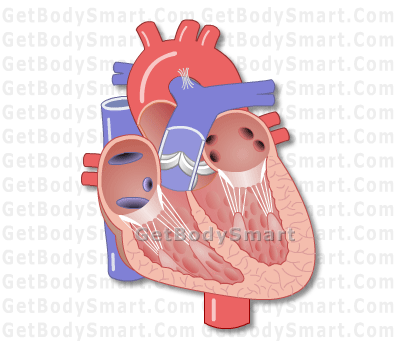
Answer
-
superior vena cava
-
tricuspid valve
-
right ventricle
-
right atrium
-
pulmonary semilunar valve
-
pulmonary trunk
-
out to lungs
-
pulmonary veins
-
left atrium
-
mitral valve
-
left ventricle
-
aortic semilunar valve
-
aorta
Question 5
Question
Choose five characteristics of cardiac muscle cells
Answer
-
lightly striated
-
large in size
-
auto-rhymthic
-
mono-nucleated
-
controlled by the nervous system
-
branched (functional syncytium)
-
long refractory period (all or none)
Question 6
Question
The [blank_start]right[blank_end] heart receives blood from the [blank_start]systemic[blank_end] circuit and pumps it to the pulmonary circuit. The [blank_start]left[blank_end] heart receives blood from the [blank_start]pulmonary[blank_end] circuit and pups it to the systemic circuit.
Answer
-
right
-
left
-
systemic
-
pulmonary
-
systemic
-
right
-
left
-
pulmonary
-
left
-
right
-
systemic
-
pulmonary
-
pulmonary
-
systemic
-
right
-
left
Question 7
Question
Fill of the ventricles of the heart occurs during [blank_start]diastole[blank_end], or the relaxed phase.
Answer
-
diastole
Question 8
Question
Contraction of the ventricular muscle and the ejection of blood from the ventricles is referred to as [blank_start]systole[blank_end].
Answer
-
systole
Question 9
Question
The volume of blood pumped by the left heart is greater than the volume of blood pumped by the right heart.
Answer
- True
- False
Question 10
Question
Insufficient cardiac valves cause murmurs which occur when the valve is normally...
Answer
-
open
-
closed
Question 11
Question
The area of the heart with the fastest auto-rhythmic rate is called the [blank_start]sinoatrial[blank_end] node (aka pacemaker).
Answer
-
sinoatrial
Question 12
Question
label the sequence of excitation of the heart
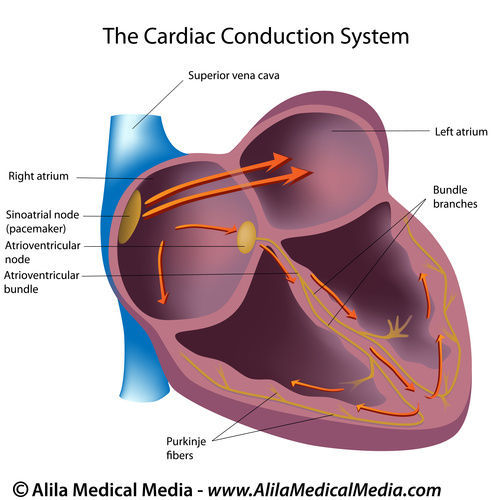
Answer
-
SA node
-
atrial muscle
-
AV node
-
Bundle of His
-
Purkingie fibers
-
ventricular muscle
Question 13
Question
The condition of the AV valves during diastole is closed.
Answer
- True
- False
Question 14
Question
The condition of the SL valves during diastole is [blank_start]closed[blank_end].
Answer
-
closed
Question 15
Question
What occurs in the atria during ventricular systole?
Answer
-
filling
-
expanding
-
ejection
-
shrinking
Question 16
Question
Cardiac Output (CO) is defined as:
CO = HR x SV
Answer
- True
- False
Question 17
Question
In what two ways can cardiac output can be increased?
Answer
-
increase heart rate
-
increase stroke volume
-
increase exercise
-
increase pH
Question 18
Question
In a patient with significant mitral insufficiency, cardiac output would go [blank_start]down[blank_end].
Answer
-
down
-
up
Question 19
Question
Starling's Law of the Heart can be defined as, "the more blood that is in the heart before a beat, the harder it beats."
Answer
- True
- False
Question 20
Question
Choose two effects that parasympathetic stimulation has on the heart.
Answer
-
slow down heart rate
-
speed up heart rate
-
ACH does not go to ventricles
-
ACH does go to ventricles
Question 21
Question
In [blank_start]sympathetic[blank_end] stimulation of the heart, heart rate [blank_start]increases[blank_end] and norepinephrine and epinephrine make the heart beat [blank_start]faster[blank_end] and [blank_start]harder[blank_end].
Answer
-
sympathetic
-
parasympathetic
-
increases
-
decreases
-
faster
-
slower
-
harder
-
softer
Question 22
Question
Indicate whether the relationship between these variables is "direct" or "inverse."
A. pressure & flow rate___ [blank_start]direct[blank_end]
B. vessel length & resistance___ [blank_start]direct[blank_end]
C. vessel diameter & resistance___ [blank_start]inverse[blank_end]
D. vessel length & flow rate___ [blank_start]inverse[blank_end]
E. vessel diameter & flow rate___ [blank_start]direct[blank_end]
F. resistance & flow rate___inverse
Answer
-
direct
-
direct
-
inverse
-
inverse
-
direct
Question 23
Question
Indicate the direction of change in each of these variables in order to correct of compensate for the condition listed on the left.
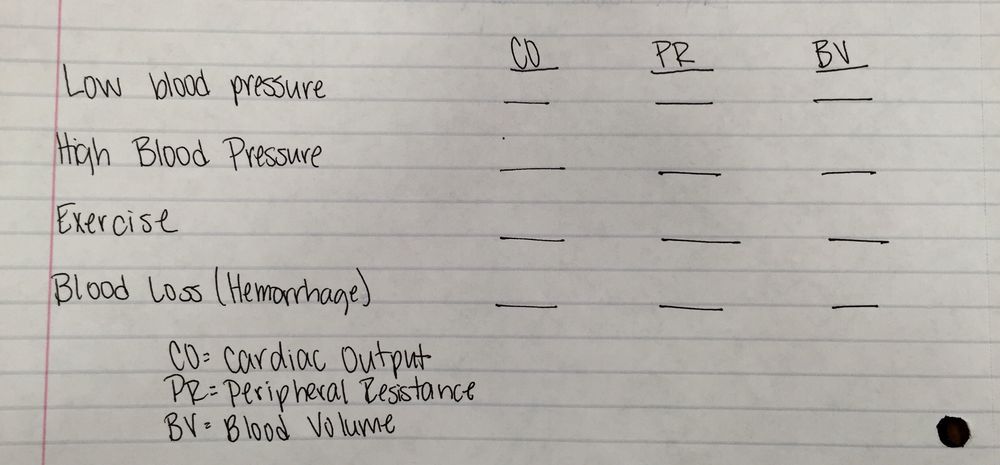
Answer
-
increase
-
decrease
-
increase
-
decrease
-
increase
-
decrease
-
increase
-
decrease
-
increase
-
decrease
-
increase
-
decrease
-
increase
-
decrease
-
increase
-
decrease
-
increase
-
decrease
-
neither
-
increase
-
decrease
-
increase
-
decrease
-
increase
-
decrease
Question 24
Question
[blank_start]Hypertension[blank_end] is a persistent elevation of systemic arterial pressure.
Answer
-
Hypertension
Question 25
Question
Hypotension is generally considered a [blank_start]systolic[blank_end] pressure of less than 100mmHg.
Answer
-
systolic
-
diastolic
Question 26
Question
"Essential (primary)" hypertension is hypertension of an unknown cause where "Secondary" hypertension is hypertension of a known cause (the result of another disease.
Answer
- True
- False
Question 27
Question
"Body position hypertension" is sometimes also known as [blank_start]orthostatic[blank_end] hypertension.
Answer
-
orthostatic
Question 28
Question
The [blank_start]sympathetics[blank_end] is the division of the autonomics that mobilizes energy.
Answer
-
sympathetics
-
parasympathetics
-
autonomics
Question 29
Question
The parasympathetics is the division of the autonomics that [blank_start]conserves and restores energy.[blank_end]
Answer
-
conserves and restores energy.
-
mobilizes energy
Question 30
Question
Receptors stimulated by acetylcholine are collectively referred to as [blank_start]cholinergic[blank_end] receptors.
Answer
-
cholinergic
Question 31
Question
Receptors stimulated by epinephrine and norepinephrine are collectively referred to as what kind of receptors?
Answer
-
adrenergic
-
cholinergic
-
ADH
-
beta
-
acetylcholine
Question 32
Question
Acetylcholine receptors found on target cells stimulated by the autonomics are pharmacologically referred to as muscarininc receptors.
Answer
- True
- False
Question 33
Question
The muscarinic receptors may be blocked by [blank_start]atropin[blank_end].
Answer
-
atropin
Question 34
Question
The myocardium of the heart only has [blank_start]beta[blank_end] adrenergic receptors.
Answer
-
beta
Question 35
Question
Excitation of alpha adrenergic receptors may cause
Answer
-
vasoconstriction
-
vasodilation
Question 36
Question
Excitation of beta adrenergic receptors may cause what three effects...
Answer
-
increased heart rate
-
increase force of contraction
-
vasodilation
-
bronchodilation
Question 37
Question
A beta blocker would have what effect on heart rate? [blank_start]Lowers hr[blank_end]
While an alpha exciter would [blank_start]increase hr and bp[blank_end] because it causes vasoconstriction.
Answer
-
Lowers hr
-
raises hr
-
increase hr and bp
-
decrease hr and bp
Question 38
Question
Label the waves. Describe the changes in ventricular pressure associated with each wave.
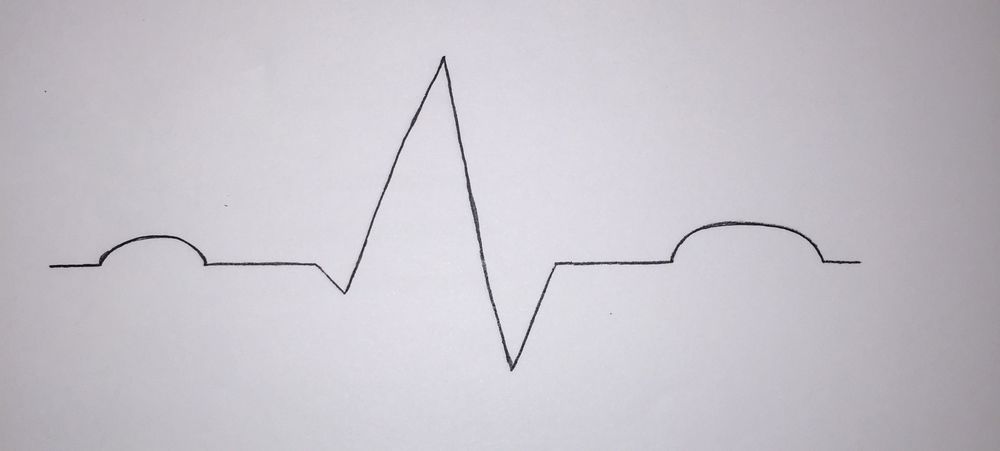
Answer
-
P wave
-
Q wave
-
R wave
-
S wave
-
T wave
-
Atrial Depolarization
-
Ventricular Depolarization
-
"LUB"
-
Complete Ventricular Depolarization
-
Ventricular Repolarization
-
"DUP"
Question 39
Question
All the following take place in the P wave of an EKG:
The heart is in diastole
Atrial Depolarization
Atria contract, pushing blood into ventricles
Answer
- True
- False
Question 40
Question
Check all that occur during a QRS complex on an EKG
Answer
-
Ventricular Septum Depolarization
-
LUB
-
AV valves close
-
from diastole to systole
-
Ventricular Pressure increases enough to open SL valves
-
Complete Ventricular Depolarization
-
DUP
-
AV valves open
-
Atrial pressure > Ventricular pressure
Question 41
Question
The T wave of an EKG symbolizes ventricular repolarization and the DUP noise occurs.
Answer
- True
- False
Question 42
Question
Outline the feedback loop in neural regulation of systemic arterial pressure
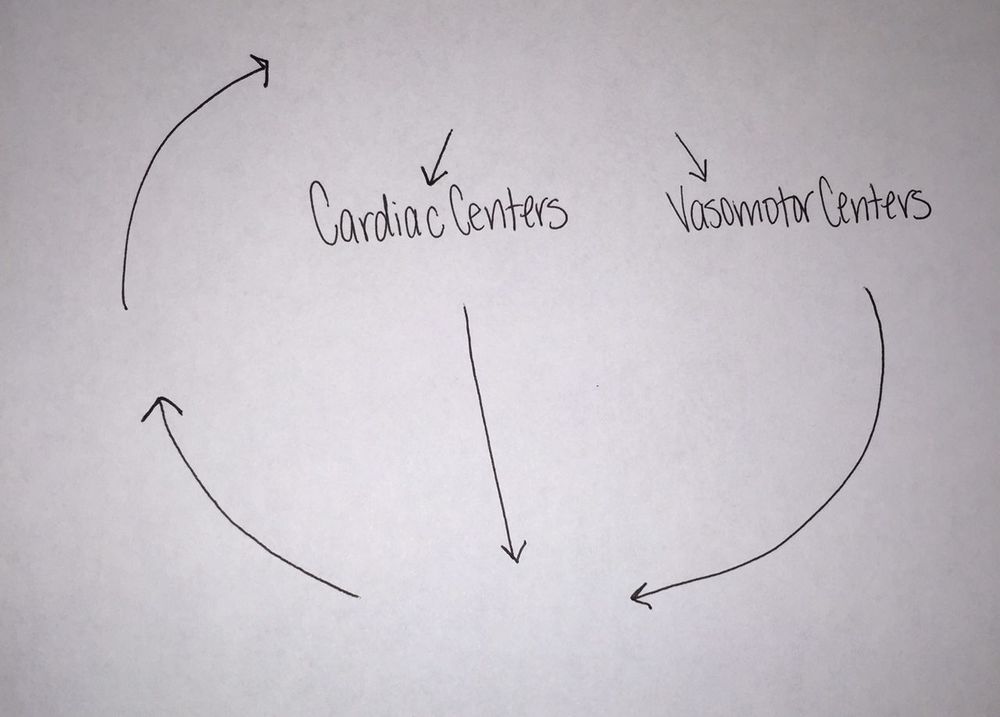
Answer
-
Blood Pressure
-
Baro Receptors
-
Integration Center (Medulla Oblongata)
-
HR & Force = CO
-
Vasoconstriction and Vasodilation = PR
Question 43
Question
Indicate if an excess in the hormone would be associated with hypertension or hypotension.
epinephrine [blank_start]hypertension[blank_end]
aldosterone [blank_start]hypertension[blank_end]
ADH [blank_start]hypertension[blank_end]
Answer
-
hypertension
-
hypotension
-
hypertension
-
hypotension
-
hypertension
-
hypotension
Question 44
Question
[blank_start]circulatory shock[blank_end] - low blood perfusion to tissues resulting in cellular injury and inadequate tissue function
[blank_start]ischemia[blank_end] - inadequate blood supply to a localized area, especially in heart muscles
[blank_start]infarction[blank_end] - obstruction of blood supply causing local death of tissue
[blank_start]angiotensinogen[blank_end] - blood protein produced by the liver that is converted to angiotensin I by the enzyme, renin
[blank_start]cardiac reserve[blank_end] - difference between resting and maximum CO
[blank_start]heart failure[blank_end] - failure to maintain adequate CO due to cardiovascular problems or myocardial damage
Answer
-
circulatory shock
-
ischemia
-
infarction
-
angiotensinogen
-
cardiac reserve
-
heart failure
-
ischemia
-
circulatory shock
-
infarction
-
angiotensinogen
-
cardiac reserve
-
heart failure
-
infarction
-
circulatory shock
-
ischemia
-
angiotensinogen
-
cardiac reserve
-
heart failure
-
angiotensinogen
-
circulatory shock
-
ischemia
-
infarction
-
cardiac reserve
-
heart failure
-
cardiac reserve
-
circulatory shock
-
ischemia
-
infarction
-
angiotensinogen
-
heart failure
-
heart failure
-
circulatory shock
-
ischemia
-
infarction
-
angiotensinogen
-
cardiac reserve
Question 45
Question
Failure of the heart to pump adequately is [blank_start]heart failure[blank_end].
Answer
-
heart failure
Question 46
Question
[blank_start]Left[blank_end] heart failure is more frequent.
Answer
-
Left
-
Right
Question 47
Question
The difference between ventricular end-diastolic volume and ventricular end-systolic volume is called [blank_start]stroke volume[blank_end].
Answer
-
stroke volume
Question 48
Question
[blank_start]Preload[blank_end] is synonymous with ventricular end-diastolic volume.
Answer
-
Preload
Question 49
Question
After load is a function of what?
Answer
-
aortic pressure
-
pre load
-
stroke volume
-
ventricles
Question 50
Question
Patients with coronary artery disease generally benefit from therapies which [blank_start]decrease[blank_end] preload and [blank_start]decrease[blank_end] after load.
Answer
-
decrease
-
increase
-
decrease
-
increase
Question 51
Question
[blank_start]Left[blank_end] heart failure is generally associated with pulmonary congestion, while right heart failure is generally associated with systemic congestion.
Answer
-
Left
Question 52
Question
ACH receptors are also known as [blank_start]muscarininc[blank_end] receptors and are blocked by [blank_start]atropine[blank_end].
Answer
-
muscarininc
-
atropine
Want to create your own Quizzes for free with GoConqr? Learn more.