RED MODEL IN CRITICAL THINKING

Description

How we use RED Model in critical thinking
Bushra Abid
Slide Set by Bushra Abid, updated more than 1 year ago
Bushra Abid
Created by Bushra Abid almost 2 years ago
94
0

Resource summary

Slide 2

    Group Members:
    Zoha Farooq (3932-FLL/BSENG/F-23) (Introduction) Unood Iqbal (3834-FLL/BSPSY/F-23) (Recognize Assumption) Zonab  Ali Khan (3884-FLL/BSPSY/F-23) ( Evaluate Information) Zaib-un-Nisa (3787-FLL/BSPSY/F-23) (Draw Conclusion) Sidra Khan (3994-FLL/BSPSY/F-23) ( Elaborate with example) Zohra Bibi (3806-FLL/BSPSY/F-23) (Conclusion)

Slide 3

Slide 4

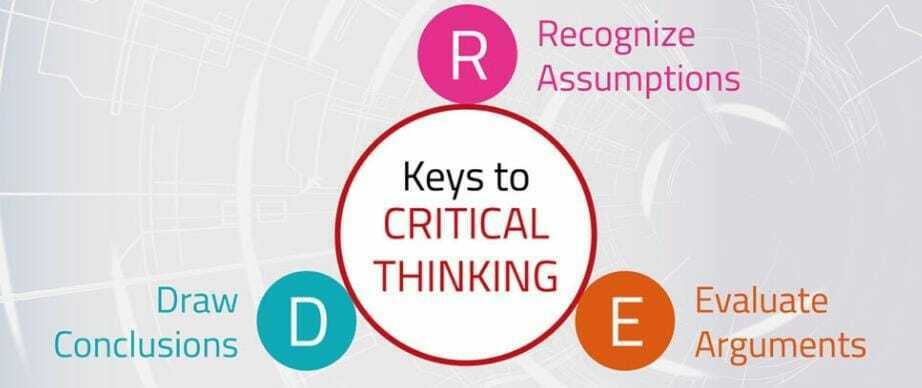
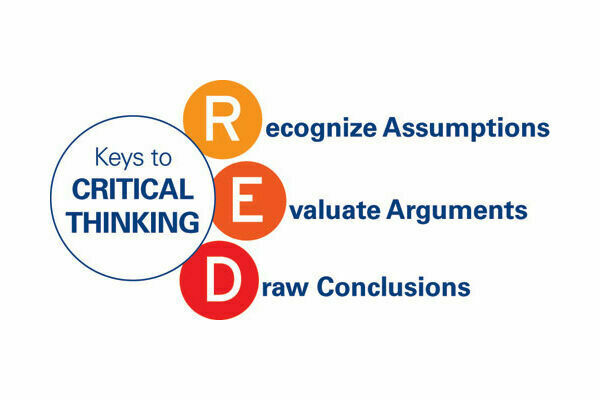
    Red model was developed in 1925 called the Watson Glacer critical thinking model, which helps in organizing and identifying factors in people that are important for critical thinking and judgment making.   What is RED MODEL ? Critical thinking can be organized into a "RED MODEL" an organising framework to facilitate learning.
    RED MODEL

Slide 5

Slide 6

    Separate Facts from Fiction An assumption is an inference, an opinion, or belief about a person, place, or philosophical position When we assume we make a decision based on many things but not necessarily facts. When we assume we accept something to be correct we may or may not have actual proof but we believe the the opinion or position to be accurate
    Recognizing Assumptions:

Slide 7

    It is deceptively easy to listen to a comment or presentation and assume the information presented is true even though no evidence was given to back it up Noticing and questioning assumptions helps to reveal information gaps or unfounded logic We also need to examine assumptions from different veiwpoints  It is important because it helps us to become aware of any biases or preconceived notion that may affect your analysis and decision-making process
    Con...

Slide 8

    Example questions to ask:  What is the key problem we’re trying to solve? What information and facts do we have? Are we making any underlying assumptions? What if we’re the problem? What else do we need to know? Examples: Political candidate is telling the truth because he belongs to the political party we belongs to.
    Examples:

Slide 9

    Con...
    Assumption: Patients follow medical advice accurately.        Example: A healthcare provider assumes that a patient will take prescribed medications as directed without missing doses. Assumption: Student assume she cannot be an engineer because females just cannot do math.  Assumption: Students have access to necessary resources for learning.        Example: A teacher assumes that students have access to textbooks, internet, and other materials required for completing assignments.  

Slide 10

    Evaluate Information
    not aasigned

Slide 11

    Draw Conclusion:
    The next step of our critical-thinking model logically follows the preceding two Once you have separated fact from fiction and have objectively analyzed and evaluated the information presented, you are in a good position to make a decision about what you have before you. Based on the information presented, you are now in a position to arrive at a conclusion. If you think about it, this is what learning is all about (or, at least, it should be). We have an experience or gain some knowledge and draw a conclusion based on the experience or knowledge. Perhaps what we have learned reinforces our behavior, or maybe we change how we act. In either case, we have made an evaluation that to act or not act a certain way works or does not work for us.

Slide 12

    Example:
    Let's say you're considering whether to invest in a particular company's stock. You start by gathering information about the company's financial performance, market trends, and industry analysis. After objectively analyzing and evaluating this information, you conclude that the company has strong financials, a solid market position, and positive growth prospects. As a result, you decide to invest in the company's stock. In this example, drawing the conclusion to invest in the company's stock is based on the critical examination of relevant information and logical reasoning, leading to a well-informed decision.

Slide 13

    The RED model provides a structured approach to critical thinking by emphasizing the recognition of assumptions, evaluation of arguments, and drawing of informed conclusions.  It's a framework to guide effective critical thinking and decision-making processes involves synthesizing the information gathered, weighing the strengths and weaknesses of the arguments, and reaching a reasoned judgment or decision. By following the RED model, individuals can systematically analyze and evaluate reasoning and arguments, leading to more effective problem-solving and decision-making.
    Conclusion:
Show full summary Hide full summary

Similar

English Language Techniques
lewis001
Using GoConqr to teach English literature
Sarah Egan
Using GoConqr to study English literature
Sarah Egan
New English Literature GCSE
Sarah Egan
A Level: English language and literature techniques = Structure
Jessica 'JessieB
A Level: English language and literature technique = Dramatic terms
Jessica 'JessieB
The Strange Case of Dr. Jekyll and Mr. Hyde
K d
English Literary Terminology
Fionnghuala Malone
English Speech Analysis Terminology
Fionnghuala Malone
To Kill A Mockingbird GCSE English
naomisargent
Bayonet Charge flashcards
katiehumphrey