
Karteikarten
Tectonics- EQ2, Key idea 1, 2, 3
Karten in diesem Stapel (18)
- 1What is a disaster?UN defines disaster as:
'a serious disruption of the functioning of a community/society involving widespread human/material/ eco/env losses & impacts, which exceeds ability of affected community/society to cope using its own resources. - 2What is a natural hazard?A natural hazard is a natural events that has the potential to harm people and their property.
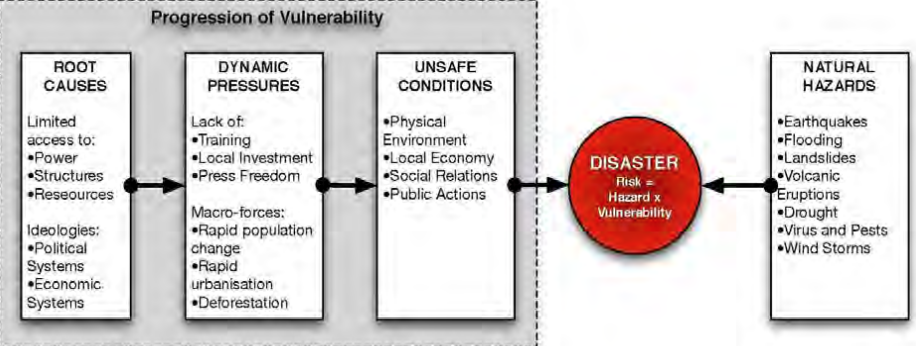
- 3The Pressure and Release ModelAnalyses factors that cause pop to be
vulnerable to hazard. Hazards on one side.
Dif factor on other, dynamic & often not related to hazard e.g. poverty - 4CASE STUDY: Japan 2011 Tohoku earthquake (Developed) IMPACTS-Magnitude 9 & caused tsunami.
-16,000 deaths (60% old ppl), 6000 injuries.
-$300 billion in eco loss, 46,000 buildings destroyed &145,000 damaged.
-Destroyed Fukushima nuclear power plant
-Global effects: manufacturing disrupted + exports. Caused closing of nuclear factories due to possible impacts like Japan. - 5CASE STUDY: Japan 2011 Tohoku earthquake (Developed) PREPARATION & RESPONSE-Hazard training at work/schools, sent phone warning , earthquake resistant buildings, earthquake survival kits, predicted tsunami but wrong height so ppl thought safe behind sea wall,10m sea wall.
-Relief efforts from other countries, temp shelter, emergency centres. - 6CASE STUDY: Nepal 2015 earthquake (Developing)Magnitude 7.9
Landslides, avalanches
9000 deaths, 22,000 injured
$5 billion in losses
50% pop live below poverty line ($1.25 a day) - 7CASE STUDY: Nepal 2015 earthquake (Developing)-Earthquake Risk Management Project as preparedness initiative. Instituted an earthquake scenario program that simulated an emergency situation.
- 8CASE STUDY: Haiti 2010 earthquake (Developing)-mg 7, 52 aftershocks
-killed 200,000 ppl
-1.5 million homeless
-$8 bn in costs
-70% buildings collapsed
-Caused cholera epidemic: killed 10,000, infected 800,000. - 9CASE STUDY: Haiti 2010 earthquake (Developing)-corrupt governance: left ppl vulnerable as slum housing, ineffectual water supply and endemic poverty.
-Relief team struggled as many health workers killed
-Dominican republic send supplies, Iceland gave emergency response team. - 10CASE STUDY: Iceland 2010 Eyjafjallajokull volcano (Developed) IMPACTS-Exploded under ice sheet so melting ice caused ash cloud.
-100,000 cancelled flights cost over £1 billion. trade affected, manufacturing, foods from farm, couldn't get to work. - 11CASE STUDY: Iceland 2010 Eyjafjallajokull volcano (Developed) PREPARATION AND RESPONSE-20 European country affected by closure of airspace. Ash from ash cloud could be ingested by jets.
-Emergency beds set up for passengers.
-Aid for red cross.
-predicted using seismic monitoring - 12CASE STUDY: Phillipines 1991 Mt Pinatubo eruption (Developing) IMPACTS-Exploded as result of highly gas charged magma.
-850 deaths
-$700 million in eco damage
1.2 million lost their homes
-Typhoon at same time caused lahars of ash. - 13CASE STUDY: Phillipines 1991 Mt Pinatubo eruption (Developing) PREPARATION AND RESPONSE-Eruption predicted by seismometers
-75,000 ppl evacuated.
-Evacuation camps
-Alert systems - 14What is the Moment Magnitude Scale (MMS)?Measures earthquake magnitudes by measuring energy released.
Logarithmic scale e.g. 6 mg 10x more ground shaking than 5 mg. - 15What is the Mercalli scale?measures earthquake intensity on a scale of I-XII. Measures what ppl feel during earthquake. Cannot easily compare as shaking experienced depends on building type/quality, ground conditions etc.
- 16What is the Volcanic Explosivity Index (VEI)?mg of volcanic eruption. Ranges from 0-8 & combines eruption height/volume of material (ash, gas, tephra) erupted & duration.
- 17What is a hazard profile?Used to compare tectonic events, allow better understanding & risks.
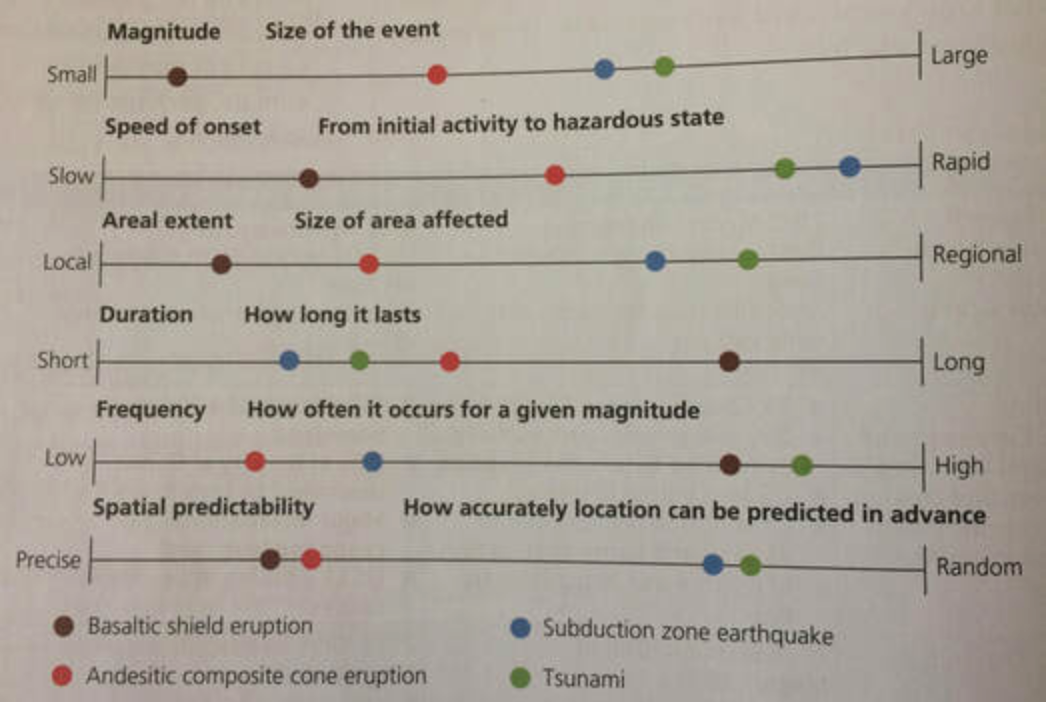
- 18What characteristics of hazards present the highest risk?High mg, low freq- not 'expected' as unlikely to occur.
Rapid onset events w/ low predictability- occur in many places, w/o warning.
regional areal extent- affect large no of ppl in wide range of locations.
Informationen
- Beschreibung
- EQ2: Why do some tectonic hazards develop into disasters? Key idea 1: Disaster occurrence can be explained by the relationship between hazards, vulnerability, resilience and disaster. Key idea 2: Tectonic hazard profiles are important to an understanding of contrasting hazard impacts, vulnerability and resilience. Key idea 3: Development and governance are important in understanding disaster impact and vulnerability and resilience.
- Erstellt von
- Qashrina Collier
- Aufrufe
- 8
- Bewertung