
Flashcards
Xylem and Phloem
Cards in this deck (28)
- 1What kind of organism are plants?Multicellular organisms
- 2What substances do plants need to live?Water, sugars, carbon dioxide and minerals (DO NOT SAY nutrients)
- 3What effect does being a multicellular organism have on plants?It means that they have a small surface area : volume ratio and are also relatively big with a fairly high metabolic rate
- 4Why do plants need a transport system?To move substances to and from individual cells quickly as they can't rely on diffusion alone (as they're too big)
- 5What are the two types of tissue involved in plant transport?Xylem and Phloem
- 6What does xylem tissue do?It transports water and mineral ions in solution up the plant from the roots to the leaves.
They also provide support. - 7What does phloem tissue do?Transports sugars in solution, both up and down the plant
- 8What is the vascular system made up of?Xylem and phloem tissue
- 9Where are vascular tissue found?They are found throughout a plant. Where they're found in each part is connected to xylem (for support)
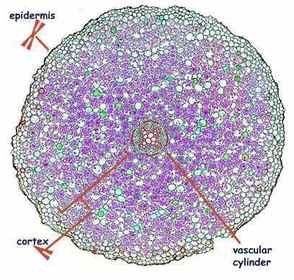
- 10Explain how the position of vascular tissue in a root relates to its functionHere, the xylem is in the centre surrounded by phloem to provide support for the root as it pushes through the soil
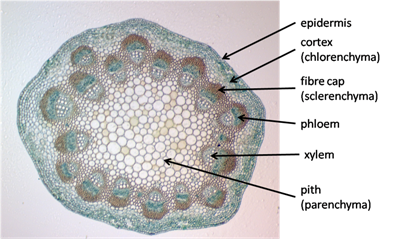
- 11Explain how the position of vascular tissue in a stem relates to its functionIn the stems, the xylem and phloem are near the outside to provide a sort of 'scaffolding' that reduces bending
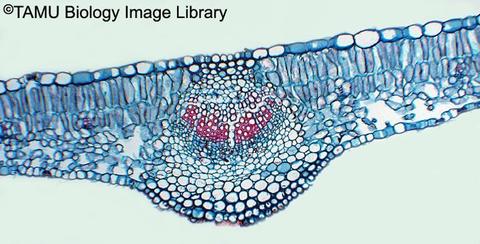
- 12Explain how the position of vascular tissue in a leaf relates to its functionThe xylem and phloem make up a network of veins which support the thin leaves
- 13What type of cross sections can a plant be shown in?Either a transverse cross section or a longitudinal cross section
- 14What is a transverse cross section?This is a cross section where the sections are cut through each structure at a right angle to its length
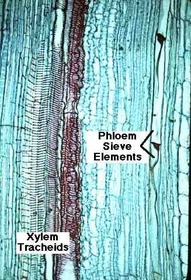
(the pictures on the previous cards are taken in a transverse cross section) - 15What is a longitudinal cross section?This is a cross section which are taken along the length of a structure. E.g. this picture:
- 16What are 'herbaceous dicotyledonous'?These are basically flowering plants without a woody stem
- 17Explain how xylem vessel's structure is adapted for it's function (I)They are very long, tube-like structures formed from cells (vessel elements) joined end to end
There are no end walls on these cells, making an uninterrupted tube that allows water to pass up through the middle easily
The cells are dead, so they contain no cytoplasm
Their walls are thickened with a woody substance called lignin, which helps to support the xylem vessels and stops them collapsing inwards. Lignin can be deposited in xylem walls in different ways e.g. in a spiral or as the cells gets older. - 18Explain how xylem vessel's structure is adapted for it's function (II)Their walls are thickened with a woody substance called lignin, which helps to support the xylem vessels and stops them collapsing inwards. Lignin can be deposited in xylem walls in different ways e.g. in a spiral or as the cells gets older.
The amount of lignin increases a the cell gets older
Water and ions move into and out of the vessels through small pits in the walls where there's no lignin - 19What is phloem tissue adapted for?transporting solutes (dissolved substances), mainly sugars like sucrose around plants
- 20What do phloem tissues contain?Phloem fibres, phloem parenchyma, sieve tube elements and companion cells
- 21Explain why phloem is different to xylemPhloem tissue is purely a transport tissue (it isn't used for support as well)
- 22What are the most important cell types in phloem for plant transport?Sieve tube elements and companion cells
- 23What are sieve tube elements?These are living cells that form the tube for transporting solutes through the plant
- 24Describe the structure of sieve tube elementsThey are joined end to end to form sieve tubes.
The 'sieve' parts are the end walls, which have lots of holes in them to allow solutes to pass through.
Usually for living cells, sieve tube elements have no nucleus, a very thin layer of cytoplasm and a few organelles.
The cytoplasm of adjacent cells is connected through the holes in the sieve plates - 25Why can't companion cells survive on their own?As of the lack of a nucleus and other organelles in sieve tube elements
- 26What sort of functions do companion cells carry out?They carry out the living functions for both themselves and their sieve cells. For example, they provide the energy for the active transport of solutes
- 27Explain how to dissect a plant stem (I)Use a scalpel (or razor blade) to cut a cross section of the stem (transverse or longitudinal)
Use tweezers to gently place the cut sections in water until you come to use them. This stops them from drying out. - 28Explain how to dissect a plant stem (II)Transfer each section to a dish containing a stain, e.g. toluidine blue O (TBO), and leave for one minute. TBO stains the lignin in the walls of the xylem vessels blue-green. This will let you see the position of the xylem vessels and examine their structure.
Rinse off the sections in water and mount each one onto a slide (for observation under a light microscope)
Information
- Description
- AS - Level Biology (Transport in Plants) Flashcards on Xylem and Phloem , created by Tom Baker on 16/04/2016.
- Created by
- Tom Baker
- Views
- 192
- Rating