
Quiz
Exam 2 Linguistics
This quiz has question types that open in the usual player.
Questions in this quiz (20)
1What is the difference between phonetics and phonology ?
[blank_start]Phonetics[blank_end]: the study of sounds, how they are produced
[blank_start]Phonology[blank_end]: the sound system of a language. Inventory of sound and rules for their combination.- APhonetics
- BPhonology
2What is this?
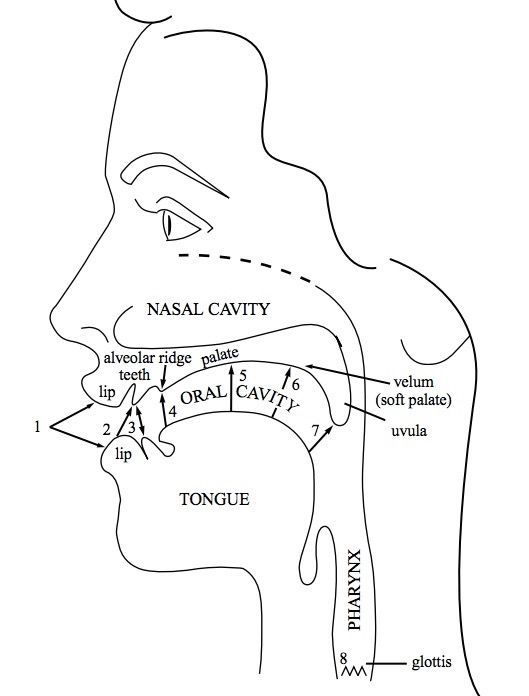
- AMid-sagittal section!
- BMid-sagittal section
3What chart is this ?
Memorize the sounds to each symbol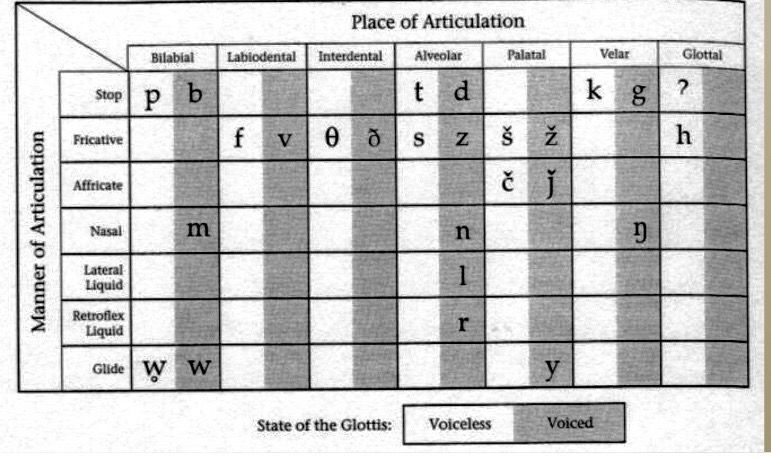
- Aenglish consonant IPA chart
4What is this?
Memorize the sounds to each symbol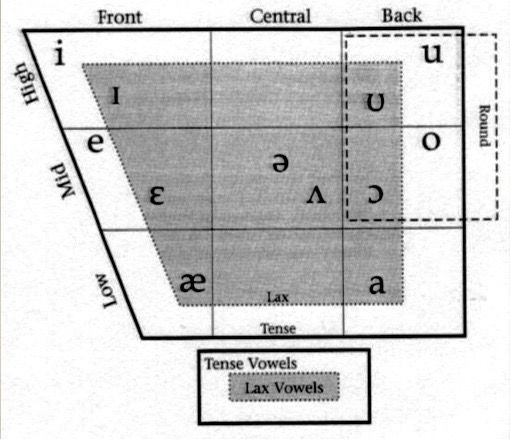
- Aenglish vowels IPA chart
5List all the bilabials. Bilabials are articulated by bringing both lips together.
[[blank_start]p[blank_end]]
[[blank_start]b[blank_end]]
[[blank_start]m[blank_end]]- Ap
- Bb
- Cm
6Lis all labiodentals. We articulate these sounds by touching the bottom lip to the upper teeth.
[[blank_start]f[blank_end]]
[[blank_start]v[blank_end]]- Af
- Bv
7List all interdentals. We articulate these by inserting the tip of the tongue between the teeth.
[[blank_start]θ[blank_end]] both, think
[[blank_start]ð[blank_end]] this, mother- Aθ
- Bð
8List all alveolars. These sounds are articulated with the tongue raised un various ways to the alveolar ridge.
[[blank_start]t[blank_end]]
[[blank_start]d[blank_end]]
[[blank_start]s[blank_end]]
[[blank_start]z[blank_end]]
[[blank_start]n[blank_end]]
[[blank_start]l[blank_end]]
[[blank_start]ɹ[blank_end]] remember to use the upside down ɹ instead of the regular r- At
- Bd
- Cs
- Dz
- En
- Fl
- Gɹ
9List all palatals. These are produced by raising the front part of the tongue to the palate.
[[blank_start]ʃ[blank_end]]
[[blank_start]ʒ[blank_end]]
[[blank_start]t͡ʃ[blank_end]]
[[blank_start]d͡ʒ[blank_end]]
[[blank_start]j[blank_end]]
[ʃ]
[ʒ]
[t͡ʃ]
[d͡ʒ]
[j] use j instead of y- Aʃ
- Bʒ
- Ct͡ʃ
- Dd͡ʒ
- Ej
10List all velars. These are produced by raising the back of the tongue to the soft palate.
[[blank_start]k[blank_end]]
[[blank_start]g[blank_end]]
[[blank_start]ŋ[blank_end]]- Ak
- Bg
- Cŋ
11List all glottals. These are articulated by stopping completely the air flow at the glottis and upon release is the glottal sound.
[[blank_start]h[blank_end]]
[[blank_start]ʔ[blank_end]]- Ah
- Bʔ
12List all english rounded vowels. These vowels are produced with pursed or rounded lips.
[[blank_start]u[blank_end]]
[[blank_start]ʊ[blank_end]]
[[blank_start]o[blank_end]]
[[blank_start]ɔ[blank_end]]
[u]
[ʊ]
[o]
[ɔ]- Au
- Bʊ
- Co
- Dɔ
13What is a diphthongs?
It is a sequence of two [blank_start]vowel[blank_end] sounds.- Avowel
14Nasalization of vowels. Are vowels that are produced with a raised [blank_start]velum[blank_end] that prevents the air from escaping through the nose.
- Avelum
15Tense and lax vowels. Tense vowels are [blank_start]longer[blank_end] in duration, generally than lax vowels.
"We may view Ma Shaw's fur coat." (All tense vowels)
"Big Ben had cooked the butter." (all lax vowels)- Alonger
16Tone in languages. Tone languages such as Chinese use tone to intonate a different word. Intonation is used to give sense of a [blank_start]question[blank_end] for example.
- Aquestion
17Phonetics of signed languages
Parameters in signed language
- p[blank_start]alm orientation[blank_end]
- h[blank_start]and shape[blank_end]
- m[blank_start]ovement[blank_end]
- l[blank_start]ocation[blank_end]- Aalm orientation
- Band shape
- Covement
- Docation
182/4 Phonology
Remember the difference between phonetics and phonology.
Phonetic deals with the production of sounds and phonology deals with how language organizes sounds and their rules to such organization.
Complementary distribution vs Contrastive distribution
Complementary distribution occurs when two sounds occur in two [blank_start]different[blank_end] environments and are not present in each others environment. Also, they will not be [blank_start]NO[blank_end] minimal pairs if the sounds are complementary. If this is the case, then you have two [blank_start]allophones[blank_end] of the same phoneme. One being the underlying phoneme, which for the most part is the allophone which is less restrictive.
Contrastive distribution is when two sounds can occur in the [blank_start]same[blank_end] environment thus having minimal pairs. If this is the case, then you have two complete different [blank_start]phonemes[blank_end].- Adifferent
- BNO
- Callophones
- Dsame
- Ephonemes
19Phonetic analysis problems. For practice, look at the homework "Phonology: phonological rules" from our assignments. You are given a data set that includes transcribed words from a specific language. Your task for example may be to decide whether such allophones [x] and [x] are of the same phoneme or if each allophone are of a separate phonemes. Follow the steps
Step 1: look for minimal pairs
Step 2: if minimal pairs are found, then you conclude that the sounds are of contrastive distribution and that you have two separate [blank_start]phonemes[blank_end]
or
Step 1: look for minimal pairs
Step 2: if you do NOT have minimal pairs, then you conclude that you have sounds of complementary distributions and they are [blank_start]allophones[blank_end] of the same phoneme.- Aphonemes
- Ballophones
20Minimal pairs are two swords (or more) that have identical IPA transcriptions except for [blank_start]one[blank_end] phoneme that occurs in the same position in each word.
- Aone
Information
- Description
- Exam 2
- Author
- Bianca Tonche
- Language
- English
- Views
- 254
- Tags
- Rating
- No ratings yet Rate this quiz