
5934012
Description

Flashcards by Abigail Cullis, updated more than 1 year ago

|
Created by Abigail Cullis
over 9 years ago
|
|
| Question | Answer |
| What influences consumer motivation? | |
| Give an example of each | |
| What is consumer motivation? | Understanding motivation is crucial to marketing. Motivation is a psychological force (aka an inner drive that impels individuals to take action). |
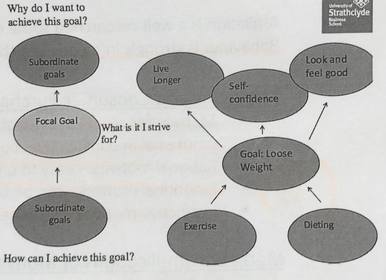
| Aspects of motivation | - DRIVE (or Need) is an internal stimulus (physical - hunger or pain; emotional - desire for affiliation, self-esteem) - Goals are ends/aspirations that direct action |
| Example | |
| Positive and negative motivation | Positive: People look for positive situations, positive mood, pleasure, sensory gratification, intellectual stimulation, social approval i.e. things that will enrich their lives Negative: People are motivated to escape from negative situations, negative mood, pain, illness and discomfort i.e. they want to avoid and remove problems e.g. sun-cream |
| Motivational conflict | Approach-approach conflict: both outcomes are good (Christmas break travelling or going home) Approach-avoidance conflict: Things in my choice I like and dislike (e.g. diet ready meals) Avoidance-avoidance: Catch-22. Two undesirable options. |
| The dynamics of motivation | - Needs are never fully satisfied - New needs emerge as old needs are satisfied - People who achieve their goals set new and higher goals for themselves - Success and failure influence goals (aspirations, substitute goals, frustration) |
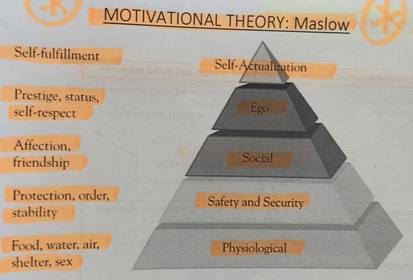
| Motivational Theory | |
| Motives for consumer purchase | These motives are not mutually exclusive and tend to comprise a combination of rational, emotional and instinctive motives - RATIONAL motives: easy to understand - EMOTIONAL motives: can be both positive and negative - INSTINCTIVE motives: impulse purchasing |
| The power of desire | (Belk, Ger and Askegaard, 2003) Consumer desire is a powerful emotion that overshadows other motivational constructs such as wants. The satisfaction of desire is not guaranteed; the journey is often better than the arrival i.e. the desire to desire. Desires are nurtured by fantasies of a different self and they may be stimulated by external sources including advertising. |
| Summary of MOTIVATION | Motivation is an inner drive that impels action in individuals. All individuals have needs, wants and desires. All behaviour is goal oriented. Needs and goals change depending on the individual's environment. As needs become satisfied, higher order needs emerge that must be fulfilled. Failure to achieve a goal results in feelings of frustration. Maslow's hierarchy of needs proposes 5 levels of human needs. Other needs often integrated into consumer advertising include the need for power, affiliation and achievement. |
| Consumer INVOLVEK | Involvement is an outcome of motivation, and involvement can be viewed as the motivation to process information. Perceived linkage between consumer's needs, wants, goals and product knowledge. Consumer motivated to pay attention to product information |
| Types of consumer involvement... | COGNITIVE INVOLVEMENT: Heightened thinking and processing information about a goal object AFFECTIVE INVOLVEMENT: Heightened feelings and emotional energy ENDURING INVOLVEMENT: Interest in an offering or an activity over a long period of time SITUATIONAL INVOLVEMENT: A temporary interest in the goal object The more important the reason for purchase, the higher the involvement; increases when social and financial risks are high. |
| 'The Flow State' | When involvement peaks, it is referred to as the FLOW STATE. A flow experience is when a person's attention is completely absorbed by the activity or the goal object. |
| HIGH INVOLVEMENT v. LOW INVOLVEMENT | HIGH: - Expand greater levels of shopping effort - Attention is increased and memory enhanced - Extensive search for relevant information - Consciously evaluate alternatives and make detailed comparisons - Shopping is more enjoyable and interesting - Often show more satisfied with products - Satisfaction levels may ebb and flow over time LOW: - Many purchase decisions are not important at all - Consumers do not actively seek out information - Low involvement consumers display indifference towards brands and products - Marketers of products that evoke low involvement must consider strategies that will increase consumer involvement with the brand over a short period or over longer periods e.g. link low involvement food products with high involvement issues |
| Involvement as a segmentation variable | Brand Loyalists: Involved with product category and a particular brand Information Seekers: Highly involved with a product category, but no brand preferences Routine Brand Buyers: Not involved with the category but are involved with a particular brand Brand Switchers: Not involved with either category nor brand |
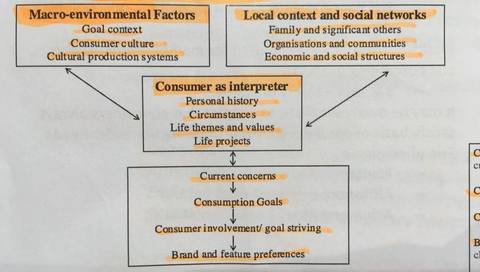
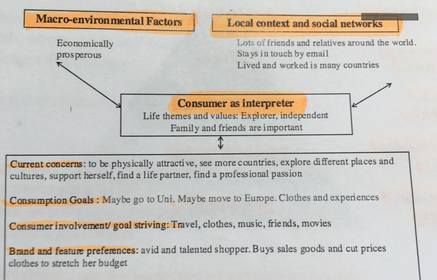
| Summary of INVOLVEMENT | Consumers re uniquely shaped by cultural and social settings Consumer motivations and goals depend on how they interpret macro-environmental factors, local contexts and social networks Understanding motivational theories are an important background for discussion. However, theories fail to incorporate cultural perspectives on motivation... Involvement is the psychological outcome of motivation It is important for marketers to understand the object(s) of consumer involvement High involvement consumers differ from low involvement consumers |
Want to create your own Flashcards for free with GoConqr? Learn more.