
1825787


Taxonomy and Classification
- Aristotle was the first to classify
animal and plants into groups
- Further classified animals based on their
means of transportation (air, land, or water)
- Further classified animals based on their
means of transportation (air, land, or water)
- John Ray (1627–1705) - English naturalist
- Published important works
on plants, animals, and
natural theology
- Classified plants according to similarities and differences that emerged from
observation – monocots and dicots.
- Published important works
on plants, animals, and
natural theology
- Carolus Linnaeus (1707–1778) - Swedish Botanist
- Grouped species according to shared physical
characteristics (what you can see).
- Method revised to improve
consistency with the
Darwinian principle of
common descent.
- Systema Naturae, ran through twelve
editions during his lifetime (1st ed.
1735).
- Nature was divided into three kingdoms: mineral (Mineralia),
vegetable (Vegetabilia) and animal (Animalia).
- Linnaeus used five ranks: class, order,
genus, species, and variety.
- Method still used to
formulate the
scientific name of
every species.
- Previously - long multi-worded names
which gave a description of the species -
were not fixed.
- Philosophia Botanica (1751)
Introduced new descriptive terms and
defined their meaning with precision.
- Late 1740s began to use a
parallel system of naming
species.
- Nomen triviale (trivial
name) was placed on
the margin of the page
next to the
many-worded
"scientific" name.
- Had to be short, unique within a given genus,
and that they should not be changed.
- Grouped species according to shared physical
characteristics (what you can see).
- Kingdoms
- Five-kingdom system -
proposed in 1969, still
used in many works, or
forms the basis for
newer multi-kingdom
systems.
- 1980s - emphasis on phylogeny and
redefining the kingdoms to be
monophyletic groups (groups made
up of relatively closely related
organisms).
- The kingdom-level
classification widely used for
grouping organisms, although
not perfect
- Some problems – linking phylogeny of
eukaryotic and kingdoms
- Animalia Multicellular Obtain energy from
ingesting food (Heterotrophic) Movement
- Plantae Multicellular Autotrophic –
obtain energy through photsynthesis
- Fungi Multicellular Collect energy from organic matter
Bodies consist of branching multinucleate filaments
- Protista Unicellular Live in water or in permanent moist
habitats eg. algae Cells are larger and more complex than most
bacteria Some obtain energy via photosynthesis ‘Algae’ Others
acquire energy by ingesting food ‘Protozoa’
- Monera Unicellular
Bacteria and Blue-green
algae Prokaryotic cells
- Monera Unicellular
Bacteria and Blue-green
algae Prokaryotic cells
- Protista Unicellular Live in water or in permanent moist
habitats eg. algae Cells are larger and more complex than most
bacteria Some obtain energy via photosynthesis ‘Algae’ Others
acquire energy by ingesting food ‘Protozoa’
- Fungi Multicellular Collect energy from organic matter
Bodies consist of branching multinucleate filaments
- Plantae Multicellular Autotrophic –
obtain energy through photsynthesis
- Five-kingdom system -
proposed in 1969, still
used in many works, or
forms the basis for
newer multi-kingdom
systems.
- Linnaean Classification
- Linnaean classification groups living organisms into a
hierarchy, including the following basic ranks:
- Kingdom
Phylum (plural -
phyla) Class
Order Family
Genus Species
- May be over 40 various other
ranks used for different species.
- For example, subphylum, superorder, subfamily, subtribe, or
subspecies to handle complex groups such as insects. (Sub - below,
super - above).
- For example, subphylum, superorder, subfamily, subtribe, or
subspecies to handle complex groups such as insects. (Sub - below,
super - above).
- Kingdom
Phylum (plural -
phyla) Class
Order Family
Genus Species
- Genus and Species names make up the scientific
name of a species. No species is ever listed
without its genus. E.g. Homo sapiens – Man.
- Mandatory suffixes for some of the ranks, for example:
Superfamily – oidea Family – idae Subfamily – inae Tribe – ini
- Binomial nomenclature - combination of a genus
name and a single specific epithet (e.g. sapiens) to
uniquely identify each species of organism.
- Every species is given a unique and fixed
name (compared with common names that
may not be unique or consistent globally).
- The names of the genera and species are always shown in italics or underlined if
hand written. The genus begins with a capital letter, and the species without.
- Example – Siberian Tiger Kingdom: Animalia Phylum: Chordata Class: Mammalia Order:
Carnivora – Animals capable of consuming flesh. Family: Felidae – Carnivores with short skulls
and well developed (normally retractible) claws. Genus: Panthera – Large cats with a specialised
larynx with elastic ligaments, unlike other cats they can roar and purr. Species: tigris altaica–
Striped coat in adults.
- Linnaean classification groups living organisms into a
hierarchy, including the following basic ranks:
- Phylogenetics
- Treats a species as a group of
lineage-connected individuals over
time. A means of classifying groups of
organisms according to degree of
evolutionary relatedness.
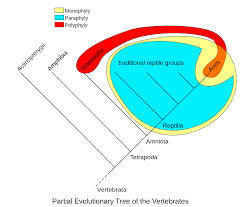
- Picture is of a
cladogram a form of classification
- Monophyly- all have common ancestor no matter where they
branched off. Paraphyly- evolving at the same time, parallel evolution
Polyphyly- link together, but not evolving at the same time, similar
connection between groups Only mammals and birds are
endothermic that is why they are linked Mammals and birds are
convergent
- Birds and reptiles - believed to be
descended from a single common ancestor,
so this taxonomic grouping is called
monophyletic.
- "Modern reptile" is a grouping that shares a common
ancestor, but as birds are excluded it is paraphyletic.
- A grouping such as ‘endothermic animals’ would include only mammals and birds – this
is polyphyletic because the members of this grouping do not share the most recent
common ancestor.
- "Modern reptile" is a grouping that shares a common
ancestor, but as birds are excluded it is paraphyletic.
- Treats a species as a group of
lineage-connected individuals over
time. A means of classifying groups of
organisms according to degree of
evolutionary relatedness.
- Cladistics
- Derived
from the
ancient
Greek
‘klados’
meaning
"branch.“
- German entomologist Will Hennig,
who referred to it as phylogenetic
systematics.
- Organisms that share common ancestors
(and therefore have similar features) are
grouped into taxonomic groups called
clades.
- Clades can be represented in terms of a cladogram -
branching diagram that depicts species divergence from
common ancestors. They show the distribution and
origins of hypothesized shared characteristics.
- Cladistics is based on three principles: Groups of organisms are descended from a common
ancestor. At each node (divergence of a population), there are two branching lines of descendants.
Evolution results in modifications of characteristics over time.
- Derived
from the
ancient
Greek
‘klados’
meaning
"branch.“
Media attachments
Want to create your own Mind Maps for free with GoConqr? Learn more.