
Flashcards
F211 Cells Keywords and Info
Flashcards do conjunto (16)
- 1Cytoskeleton - properties and functionsconsists of microtubules (hollow protein tubes) and microfilaments (protein strands)
1. transport vesicles & organelles within the cytoplasm around the cell
2. help maintain the cell shape, strengthen
3. can help to move the flagella / undulipodium
4. hold the organelles in position - 2Prokaryotic organisms/cellssingle celled organisms made up of prokaryotic cells
Naked DNA no nuclear envelope, Circular DNA
may have flagellum
extremely small
have a cell wall- polysaccharide - peptidoglycan
small ribosomes - 3eukaryotic organisms/cellsmulticellular organisms
eukaryotic cells
nuclear envelope around DNA
no cell wall
larger cells
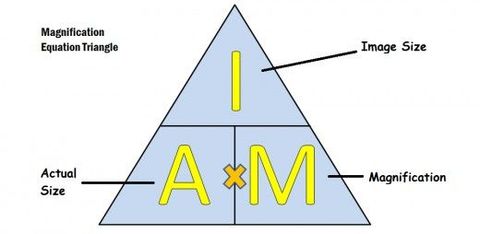
larger ribosomes - 4Microscope equation magnification =
- 5Light MicroscopeShines light through specimen
low resolution = 0.2 microm
low magnification = x1500
object can be stained so you can see better, not white - 6Transmission Electron Microscopeuses electro magnets to focus beam of electrons thru specimen, elctrons are absorbed by specimen, dense areas= absorb more electrons = darker on image
highest resolution = 0.0001 microm - look at small organelles
highest magnification = x 1000 000
staining may be necessary
have to cut very thin slices of specimen
have to be skilled - 7Scanning Electron MicroscopeFocus a beam of electrons at an angle onto specimen, record bounces of electrons using cathode ray tube
- 8explanation of the bohr effectcarbon dioxide diffuses into erythrocytes
carbonic anhydrase converts carbon dioxide and water into carbonic acid
carbonic acid splits into hydrogencarbonate ions and hydrogen ions - 9Mass Flow Hypothesis : At the sourceAT THE SOURCE:
1. active transport move H+ ion from sieve tube element into companion cell
2. facilitated diffusion using carrier protein, moves ion + assimilate (sucrose) back into sieve tubes of the phloem at the source
3. this lowers the water potential in the sieve tubes so water enters the tubes by osmosis - 10Mass flow hypothesis: At the SinkAT THE SINK:
1. assimilates are removed from phloem to be used up
2. increased water potential in sieve tubes at source
3. water leaves tubes by osmosis, lowering pressure inside sieve tubes at sink. - 11Osmosisnet movement of water from an area of high WATER POTENTIAL to are of low WATER POTENTIAL, via a PARTIALLY PERMEABLE MEMBRANE
water potential = tendency for water molecules to diffuse into another area
low water potential (-ve no.s kPa) = less 'free' water molecules = solutes present
high water potential (0 kPa) = more 'free water molecules = no/fewer solutes present - 12Mitosis: cell cycle - InterphaseINTERPHASE: Gap phase 1 - cell growth and new organelles are made
Synthesis - cell replicates DNA
Gap phase 2 - cell keeps growing, proteins for cell division are made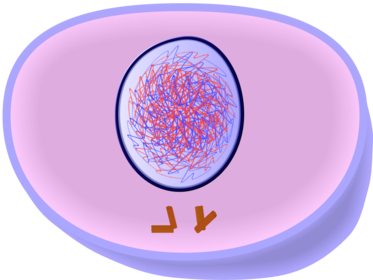
- 13Mitosis: cell cycle - ProphasePROPHASE: chromosomes condense
nuclear envelope breaks down
centrioles move to opposite ends and form spindles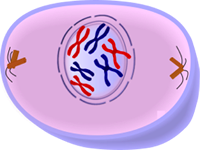
- 14Mitosis: cell cycle - MetaphaseMETAPHASE: chromosomes line up on spindle equator
become attached to spindles by centromere
- 15Mitosis: cell cycle - AnaphaseANAPHASE: centromeres divide, separates each pair of sister chromatids
spindles contract pulling chromatids to opposite ends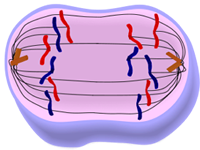
- 16Mitosis: cell cycle - TelophaseTELOPHASE: chromatids uncoil = called chromosomes
nuclear envelope forms around DNA
CYTOKINESIS: cytoplasm divides, cell surface membrane constrics into two daughter cells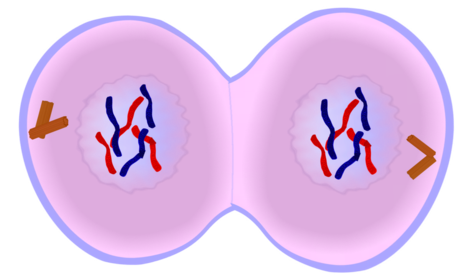
Informações
- Descrição
- A Levels Biology (F211 - Cells, Exchange and Transport) FlashCards sobre F211 Cells Keywords and Info, criado por Gurdev Manchanda em 05-05-2015.
- Criado por
- Gurdev Manchanda
- Visualizações
- 518
- Tags
- Avaliação